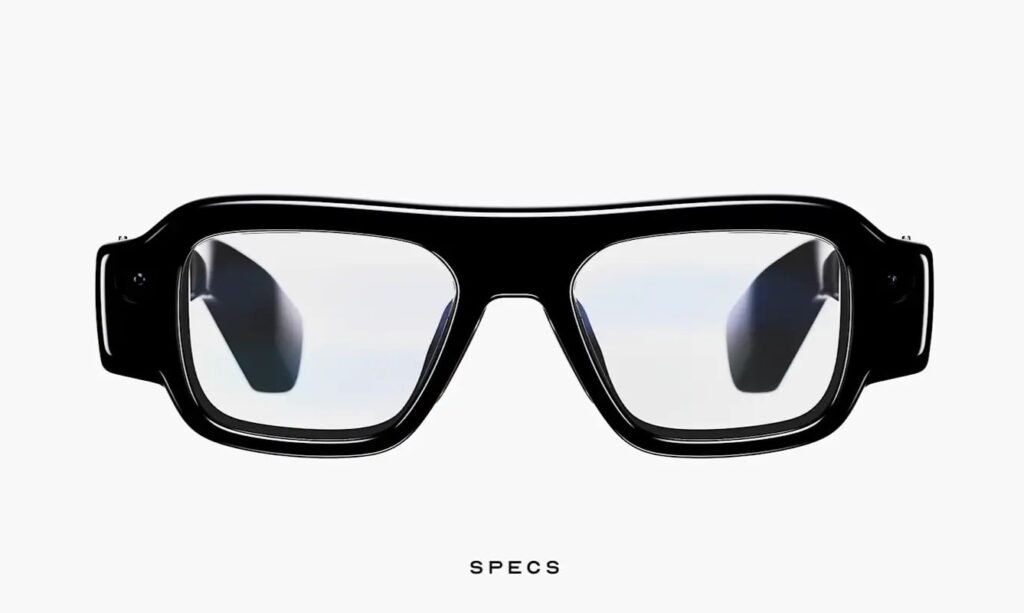

At the Augmented World Expo 2026, Snap (FKA Snapchat) CEO Evan Spiegel officially pulled back the curtain on Specs, the company’s first augmented reality glasses designed for the broader public. This lightweight wearable is not meant to just pipe audio or snap quick videos. Instead, it represents a fully standalone “face computer.”
Spiegel is betting heavily on a post-smartphone future. In an interview with CNBC, he highlighted how tired people are of staring down at tiny, opaque phone screens, suffering through neck pain, and missing out on real-world moments. Specs aim to solve that by projecting digital visuals directly into your field of vision through see-through lenses, encouraging users to look up and share experiences together.
The heavy tech hidden inside the frames
The Specs deliver a true untethered experience without pesky cables running down your neck. To achieve this, Snap packed an impressive amount of proprietary tech into the chunky frames. The display system utilizes custom liquid crystal on silicon technology, offering a 51-degree field of view capable of pushing 16 million colors. The lenses themselves are electrochromic, meaning they can automatically transition from crystal clear to a dark sunglass tint in just 10 seconds.
Under the hood, dual Snapdragon processors divide the heavy lifting. One chip is responsible for computer vision and high-speed hand tracking, and the other for rendering the interactive AR Lenses. Together, they bring motion-to-photon latency down to a responsive seven milliseconds, keeping digital objects anchored perfectly to your real-world environment.
You can expect around four hours of runtime on a single charge, juggling notifications, video playback and AI responses. Fortunately, the included charging case holds an extra four full charges to bump total battery life up to 20 hours.
A steep price for a niche market
While the tech sounds futuristic, the barrier to entry is undeniably high. Specs carry a jaw-dropping price tag of $2,195. It is a stark contrast to the original $130 camera glasses the company debuted a decade ago. It seems like a tough sell during a period where inflation is stretching consumer tech budgets thin. Market research experts from IDC noted that this premium pricing strategy might clash with Snap’s historically younger user base.
However, Snap isn’t backing down from the challenge, even with well-funded rivals like Meta and Google actively working on their own eyewear ecosystems. Alongside the hardware, Snap introduced updated developer tools that integrate with AI systems like Anthropic’s Claude Code and OpenAI’s Codex. These tools allow creators to build smart, agent-like experiences specifically for the platform.
If you want a pair, pre-orders are officially open at Snap’s website with a $200 refundable deposit. Shipments are expected to kick off this fall across the US, UK, and France.
The post Snap Unveils Specs: Its First Standalone AR Glasses With AI Power appeared first on Android Headlines.

