

The OPPO Find N6 went official last month, and a lot has been said about its nearly crease-less display, which has been a pain point on foldables. With the Find N6, OPPO has promised zero-feel crease. Though the crease is still there, you won’t feel it as much while swiping across the screen. Besides this, the phone also achieved TUV Rheinland certification for up to one million fold cycles. Claims from the brand aside, a new durability video of the OPPO Find N6 shows how much of it translates in reality.
OPPO Find N6 survives the extreme durability test
Popular YouTube channel JerryRigEverything has posted a video testing the durability of the OPPO Find N6 (review) in their usual style. The first evident thing is how thin the foldable is. For those with numbers, it measures 4.21 mm thin when open and 8.93 mm thin when folded. The video starts with a scratch test, which shows that the inner display scratches at level 2 on mohs scale, with deeper grooves at level 3. This is the same kind of soft-surface behavior on other foldables despite OPPO’s “Flex Glass” marketing.
However, things are different when it comes to the 6.62-inch nano crystal glass cover screen. It behaves more like a standard phone screen. It scratches at level 6 with deeper grooves at level 7. This should make it more resistant to daily wear and tear than the inner panel.
Titanium hinge and plastic backplate
The video highlights that the sides of the OPPO Find N6 are aluminum, along with the power button, volume rocker, and the special AI button. Meanwhile, the spine of the foldable is made from grade 5 titanium, which makes it twice as strong as aluminum. Popping out the SIM card tray shows a red rubber gasket for its IP56/IP58/IP59 water and dust resistance ratings.
The company is using a plastic backplate, compared to glass designs on other foldables, like the Samsung Galaxy Z Fold/Flip. The video then proceeds to a dust test to show what happens when sand or small particles get into the hinge mechanism. It shows that while there is some crunching sound going on, nothing is permanently jammed. The YouTuber notes that all gears of the internal hinge still have a full range of motion.
Though there’s flex, the Find N6 doesn’t snap
The video then proceeds to the burn test, which shows that the inner display is vulnerable to heat damage in a similar fashion to other foldables. The screen lasts for about 12 seconds before turning black. It doesn’t recover again after the heat source is removed.
Now for the moment of truth, the durability video shows how resistant the Find N6 can be against forced bending. Bending the Find N6 from the folded position shows a lot of flex. Even without opening the phone, there’s enough flex in the back plastic panel that it lifts off. That said, the foldable doesn’t catastrophically snap when bent in either direction during the manual stress test.
However, upon unfolding and bending it backwards, the video shows that the soft inner screen starts to wrinkle from the excess pressure. Even then, the foldable doesn’t take any damage, and everything seems intact. The YouTuber attributes this to the titanium spine and notes that the Find N6 is extremely durable to bends. For context, the foldable uses a 2nd generation Titanium Flexion Hinge, manufactured using 3D Liquid Printing.
Teardown reveals flexible display is quite fragile
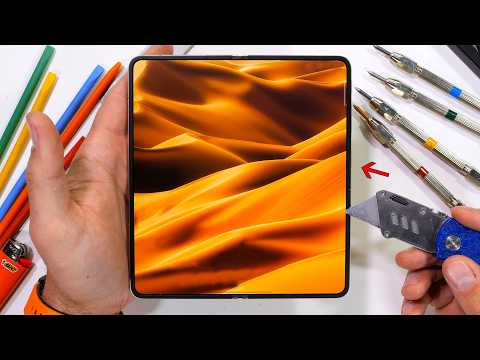
The video then proceeds to tear down the phone by removing the black borders on the display. However, this is where things go wrong, as the tip of the knife touches the edges of the flexible display, which immediately flickers. This reinforces how fragile inner displays on the foldables remain regardless of the exterior durability. The screen remains functional, though.
Moving on, the ribbon-cable connector for the inner screen sits near the top-left side of the chassis, and once disconnected, the inner display assembly lifts out cleanly. Beneath the outer plastic touch layer is OPPO’s “Auto-Smoothing Flex Glass.” The teardown shows that this is a real glass layer, and not just plastic. Scraping between the top plastic and the glass with a knife kills the pixels in that area.
The OPPO’s new “Auto-Smoothing Flex Glass” layer is apparently one of the main reasons for the crease to look much less pronounced. Replacing the center display would apparently require opening the back panel as well. Lastly, the video proceeds to open the plastic back panel and the cover screen by applying heat to loosen the adhesive. This reveals the entire internal structure of the phone, including the wireless charging coils, dual battery cells, speakers, cameras, and the motherboard.

The post OPPO Find N6 Durability Tested: Flexes Under Pressure But Never Snaps appeared first on Android Headlines.

