
For the past couple of years, artificial intelligence agents have mostly been cooperating up inside our web browsers, writing software code, summarizing long PDF files, and answering customer queries. Now, NVIDIA wants to give those digital brains a set of real-world hands. During a major product rollout, NVIDIA released a sweeping collection of open-source physical AI agent tools and skills. All are specifically designed to break down highly complex corporate workflows into autonomous, repeatable tasks.
Bridges between software and hardware
The core concept here is to eliminate the tedious manual engineering that usually slows down advanced development. According to NVIDIA, this release repositions the company’s massive existing portfolio of simulation and hardware frameworks—including Omniverse, Isaac, Cosmos, and Jetson—as tools that software coding agents can call on directly. Instead of hand-configuring every phase of a pipeline, engineering teams can simply give high-level directions.
“AI agents are revolutionizing software development, and that shift is now coming to physical AI,” noted Jensen Huang, founder and CEO of NVIDIA. He explained that letting agents directly leverage these pre-existing models and libraries will allow developers to build transportation, manufacturing, and robotic systems at an incredible pace. To keep these operations from going rogue, NVIDIA bundled the NemoClaw security blueprint and the OpenShell runtime into the toolkit. This provides policy-based privacy guardrails whether the code runs locally or on the cloud.
From factory floors to hospital wards
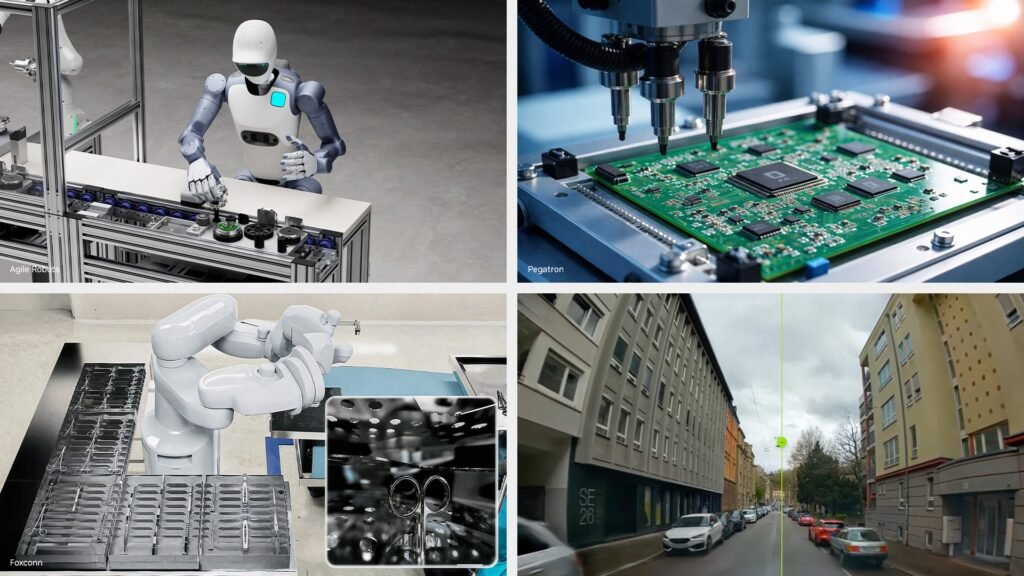
The practical applications of these new agent skills cover an immense footprint. In the autonomous vehicle sector, developers are using the tools to instruct agents to reconstruct real fleet data into simulated driving environments. Meanwhile, industrial simulation is taking a massive leap forward. Tech leaders like Siemens and Cadence are integrating these tools with Omniverse to build interactive digital twins. Physical spaces like semiconductor fabs are being completely modeled and optimized by agents before a single brick is laid in the real world.
The early production numbers look highly promising. According to NVIDIA, electronics manufacturer Pegatron managed a staggering 67% reduction in model training and deployment times by using a specialized Defect Image Generation skill to create synthetic visual data. Delta Electronics used the exact same method to increase its defect detection rates by 17% on manufacturing lines. On the other hand, Foxconn recorded a 3% boost in its overall manufacturing yield.
Even healthcare is getting an automated upgrade. Teams are using the toolkit to test clinical robots in simulated environments before deploying them into active hospital spaces. The entire toolkit is now available on GitHub and skills.sh.
The post NVIDIA Drops a Massive Wave of Open-Source Tools to Put AI Agents to Work appeared first on Android Headlines.