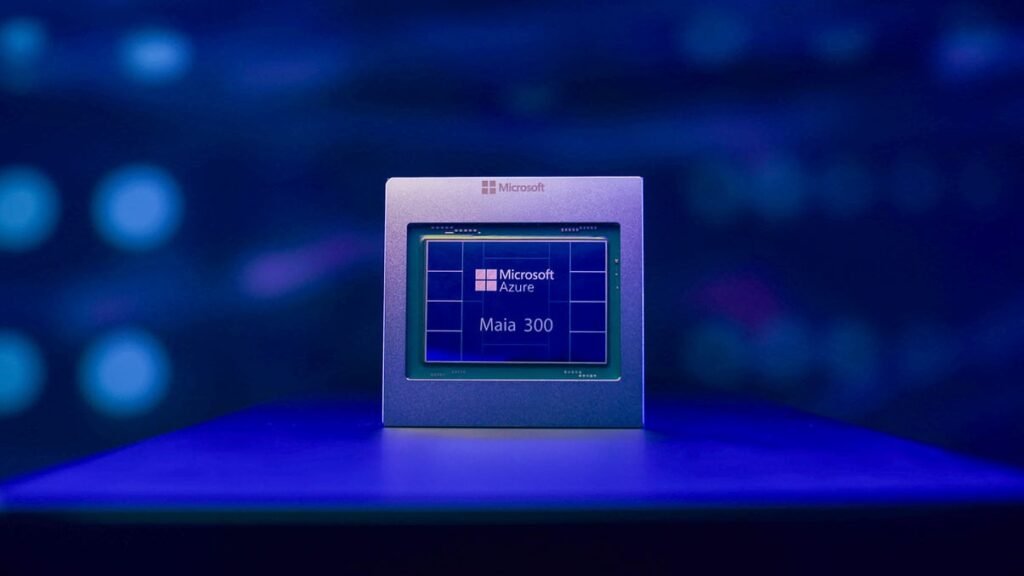

Microsoft is rolling out its next-generation Maia 300 AI chip to take direct control of the hardware running its massive cloud infrastructure. Reaching data centers in 2027, the custom accelerator aims to handle daily AI requests far more efficiently while cutting down reliance on expensive third-party GPUs.
Built for real-world tasks and massive power savings
Digital assistants evolved from basic chatbots into complex agents that run multi-step workflows. So, data centers are facing unprecedented energy demands. Microsoft engineered the Maia 300 around an “inference-first” architecture to tackle these heavy workloads directly. Instead of focusing on raw model training, the chip optimizes real-time conversational tasks and long-context reasoning across everyday tools like Microsoft 365 Copilot, Teams, Cowork, and GitHub.
According to Microsoft, each server rack will hold 96 Maia 300 accelerators operating within a 167-kilowatt power envelope. The company claims this setup generates 40% more tokens per megawatt than leading GPU systems while delivering seven times the token output of its previous Maia 200 generation. Built on TSMC’s 2-nanometer process with eight stacks of high-bandwidth memory, the hardware keeps data moving efficiently to prevent energy waste.
Shifting away from Nvidia while scaling Azure
Nvidia processors still dominate data centers across the tech industry. However, Microsoft is aggressively building out its own silicon stack. The company plans to scale the Azure Maia family into multi-gigawatt deployments, making homegrown hardware the main engine behind its AI ecosystem. Financial analysts at Evercore ISI estimate that custom Maia chips will represent roughly 10% of Microsoft’s AI hardware budget by early 2027.
Still, Microsoft is not abandoning traditional hardware suppliers anytime soon. The company continues working alongside Nvidia and AMD for heavy model training and general cloud infrastructure. Unlike cloud rivals Google and Amazon, which rent their custom processors to external clients, Microsoft keeps Maia chips strictly reserved for internal Azure services and proprietary software.
The post Microsoft Unveils Maia 300 AI Chip to Challenge Nvidia’s Dominance appeared first on Android Headlines.