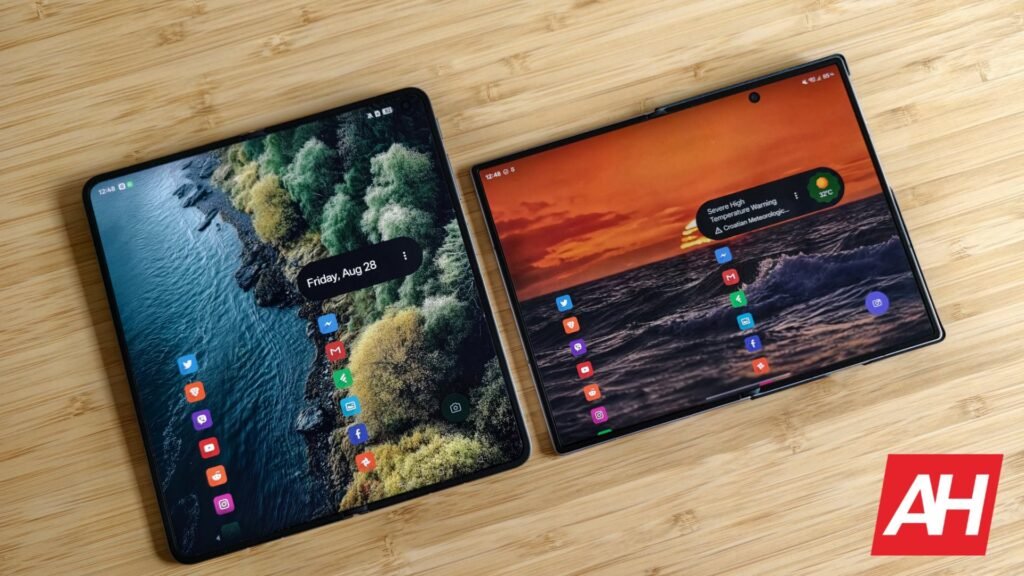

The arrival of wide foldable smartphones managed not only to bring freshness to the foldable form factor, but also to bring a form factor that many think is ideal for foldables. I’m one of those people, without a doubt, as I’ve been waiting for this form factor to arrive for years. It is hard to deny the benefits that wide foldables bring to the table. They’re not only better for both horizontal and vertical video content consumption (when unfolded), but you’re also getting a very compact device when the phone is folded. So it’s great for both one-handed use and two-handed use.
I wrote extensively about my experience with the Galaxy Z Fold 8, its pros and cons, and so on. That’s the only wide foldable that I managed to get my hands on, as I still haven’t experienced the Huawei Pura X or Huawei Pura X Max. I did use the OPPO Find N and Find N2 back in the day, but those were not exactly wide foldables, even though they were very compact when folded. In any case, a lot more wide foldable smartphones are expected to arrive in the coming months.
While the benefits of wide foldables are obvious, especially for those of you who have tried out such a device, does that mean that there’s no room left for regular book-style foldables? Well, I don’t think that’s the case. I do believe there’s room in the market for both of those form factors to exist. Regular book-style foldables, or square foldables, as I like to call them, still serve a purpose. In fact, some people may prefer them over the wide foldable form factor for a number of reasons.
Cover display
Let’s start with the cover display, actually. While the cover display on regular book-style foldables is tall and narrow, some people will definitely prefer that. Why? Well, the first thing that comes to mind is one-handed typing. It’s easier to reach to the opposite side of the keyboard with one hand, and thus glide typing is a breeze. It’s a bit more difficult to do on a cover display of a wide foldable. Let me take the Galaxy Z Fold 8 as an example. At first, I was pressing random things on the display with my palm. Once I got used to it, that stopped. However, I do have above-average hand size, so if you’re below average in that regard, reaching across may be more difficult.

Reaching the top portions of the display is much easier on the cover display of wide foldables, though. That’s not an easy feat on tall and narrow displays. However, such displays have another benefit… content consumption. If you like using Instagram and TikTok on the cover display, tall and narrow displays are the way to do it. The experience is not that good on the Galaxy Z Fold 8’s cover display, due to more black bars. The experience is entirely different on the main display, though.
What about two-hand typing on a cover display? Well, that’s where cover displays of wide foldables will have an edge. Why? Well, because you do get more space when it comes to width, and many people will lack that on tall and narrow cover panels. I’ve noticed I make more mistakes on tall and narrow displays than I do on this one, and that’s perfectly logical when you think about it. You simply have more space for the keyboard. Those are just some examples of how the cover displays differ from one another. Tall and narrow definitely has its place in the market.
Main display
I’ve been using book-style foldables with square main displays for a long time. I never liked content consumption on those panels, though. I never used it for watching vertical videos, only for horizontal videos, and those included considerable black bars. What I did like was the space. On square displays, you don’t feel obstructed in height or width, which is great for specific types of content.

Those displays are great for browsing in general, as they are for reading and handling spreadsheets, for example. I also loved doing image editing on that large display, amongst other things. There are a lot of reasons why square main displays make sense. I also talked to a friend of mine recently, and it turns out he’s interested in the Huawei Pura X View. That is Huawei’s new wide smartphone, a non-foldable. I don’t see much utility in it, but he surely does.
He said he prefers shorter and wider displays in general, though not necessarily as wide as on wide foldables. In fact, he flat out said that he’d love to use the Huawei Pura X View, and that he prefers foldables with square displays. When I asked him why? While adding the benefits of wide foldables. He basically said he doesn’t consume much video content on a phone, in general, and sees more benefits from a more squarish display, which is fair. We’re all different.
Pocketability
Now, when it comes to pocketability, it all depends. For some pockets, wide foldables are the better option. For others, tall and narrow is the way to go. In all honesty, I either wear jeans or shorts, both of which have ample pocket space, so I never had issues pocketing either one. I did feel more secure while pocketing the Galaxy Z Fold 8, though. Why? Well, because it’s shorter, and when I sit down, it did not have a tendency to slip out, which is what happened a ton of times with wide foldables.
That’s not as much of a problem if you’re using a grippy case, or something like that. However, these phones are made out of glass and metal. So if you don’t use a case, they’re very slippery, and staying in a pocket if you’re sitting down and your pocket ends up facing down at any point is not guaranteed. Overall, I’d say that smaller and wider phones (when folded) are safer to pocket. It all depends, though. If you have smaller pockets, their shape will determine which suits you better, if either one.
MagSafe compatibility
This is another one of those things that came to me while I was using the devices. While very few foldable phones have magnets built in, there are a ton of cases that can bring magnets to your phone. If you’re used to using MagSafe accessories on your devices, you’re probably aware that their compatibility is not always guaranteed. Some accessories are too tall for some phones, as their cameras can get in the way. It all depends on the height and width of an accessory, the position of the magnet inside it, and the position of the magnet inside a phone or its case… plus the camera location, of course.
For that reason, I’d say that regular book-style foldables are the way to go. Why? Well, just take a look at the image below. Look at how much space there is below the camera island on the OPPO Find N6. There’s a lot less space on the Galaxy Z Fold 8, not only because it’s a lot shorter, but because of its camera placement. Generally, tall and wide will likely be the better call. Sure, it would help if Samsung went with a horizontal camera setup up top, but the Find N6 would still be the better choice due to its sheer height.
The point is, we’re all different and prefer different things. Those of you who like regular book-style foldables probably like them for reasons you don’t like wide foldables, and vice versa. Both form factors have space to thrive in the market; I truly believe that. Flip foldables, well, that’s another thing entirely, and a story for another time.
The post Wide Foldables Are Great — but Here’s Why Regular Book-Style Foldables Still Have a Place appeared first on Android Headlines.