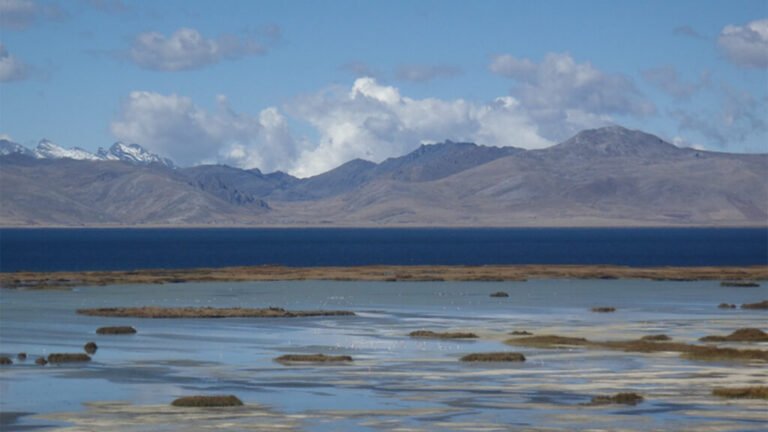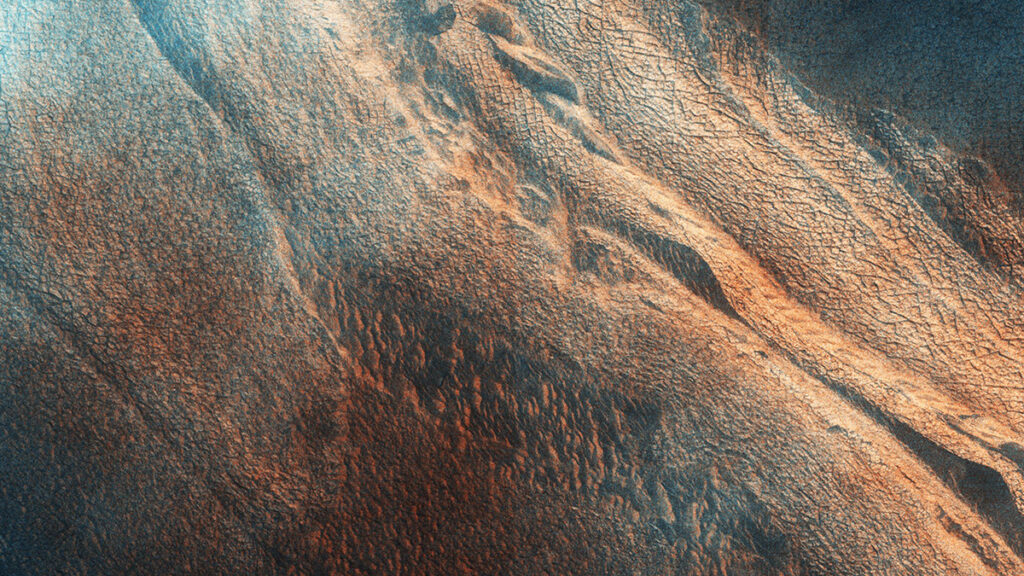

In its distant past, Mars was a warm, wet world much more like Earth than it is now, complete with a hydrologic cycle with liquid water rain. Mars’s watery past has made it a leading contender in the search for life beyond Earth, as has its intriguing non-Earthen chemistry.
Planetary scientists know that about 3.8–3.6 billion years ago, conditions were right for formaldehyde (H2CO) to form in Mars’s atmosphere and rain down onto its surface.
“Formaldehyde is a simple molecule that can contribute to prebiotic chemistry,” said Shungo Koyama, a planetary scientist and astrobiologist at the Institute of Science Tokyo. “Once delivered to water, it could help form sugars, amino acids, and more complex organic matter.”
A team of researchers, led by Koyama, wanted to know whether those chemical reactions, which create the building blocks of life, could have taken place on early Mars. Mars certainly had liquid surface water and formaldehyde, but were those two liquids in the same place at the same time?
“Knowing how much formaldehyde reached the surface, and where, helps us identify places where these ingredients [for life] could have been available,” Koyama said.
Cloudy with a Chance of Formaldehyde Rain
Koyama’s team modeled Mars’s atmosphere as it would have been 3.8–3.6 billion years ago, during the late Noachian and early Hesperian periods. At that time, Mars’s atmosphere was more substantial than it is today, still mostly filled with carbon dioxide with small quantities of molecular hydrogen and carbon monoxide. The researchers coupled that atmospheric model with a global climate model of Mars, factoring in changes in surface temperature and surface pressure across the planet, as well as the fact that wetter places would have had higher concentrations of atmospheric water vapor.
“Water vapor promoted formaldehyde production, so atmospheric concentrations were high over modeled water bodies.”
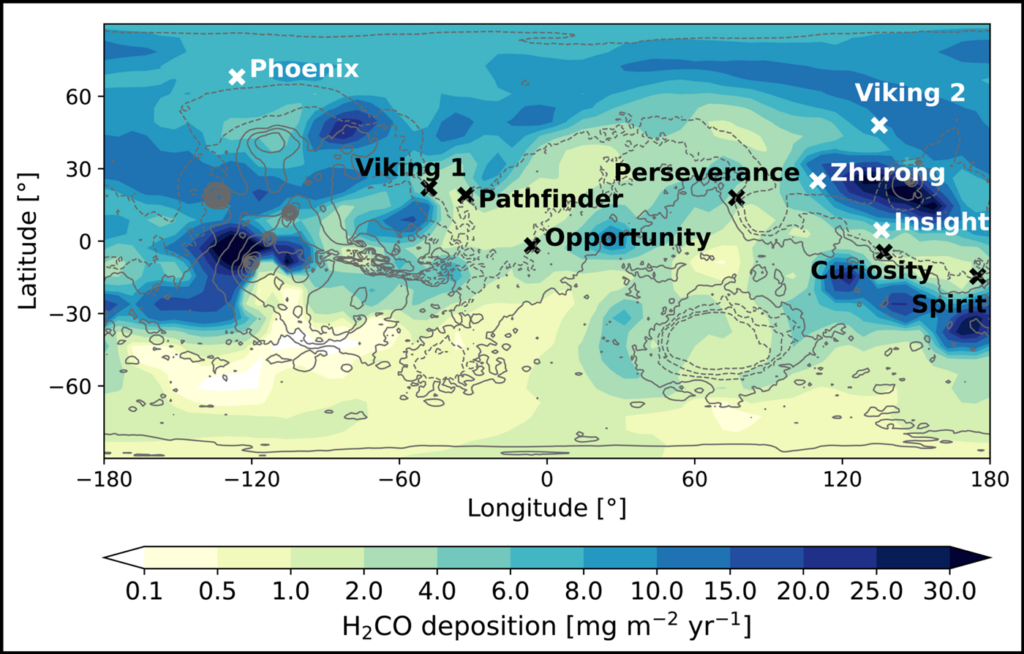
Their model also considered that extreme ultraviolet radiation from the Sun was about 10 times stronger back then. That radiation broke apart molecular hydrogen and stimulated the creation of formaldehyde from free hydrogen and water vapor. With these models, Koyama and his team created a global map of where formaldehyde could have rained down onto Mars’s surface.
“Under the warm early Mars conditions we modeled, formaldehyde delivery to the surface varied by roughly a factor of 100 across the planet and was several times greater in the northern hemisphere than in the southern hemisphere,” Koyama said. “Water vapor promoted formaldehyde production, so atmospheric concentrations were high over modeled water bodies, including the northern ocean and Lake Hellas.”
Their map showed that Tharsis and Elysium highlands received the highest concentrations of formaldehyde, about 10 times the global average. Just like how rising air currents around Earth’s mountain ranges generate strong rains, the elevations and slopes of Tharsis and Elysium led to stronger rains that brought more formaldehyde to the surface.
The researchers published these results in The Planetary Science Journal in September.
Maps for Future Missions
“This paper demonstrated that organic-bearing sediments were [more] widely distributed than previously thought,” said Yuichiro Ueno, a biogeochemist at Tokyo Institute of Technology who studies the early evolution of life. Ueno was not involved with this study.
“If so,” Ueno added, “the discovery of sedimentary organic matter by Curiosity and Perseverance rovers [was] not simply the result of a lucky landing in a particularly favorable location. Their study provides the map to test the scenario.”
While this map shows where formaldehyde would have rained down onto Mars’s surface, it doesn’t track what happened to that formaldehyde afterward, or the degree to which formaldehyde contributed to organic material on early Mars.
“The hot spots are useful targets for future investigation.”
“We want to trace what happened after formaldehyde reached the surface: where rivers and groundwater carried it, whether it accumulated in lakes or ponds that experienced wet-dry cycles, and what concentrations it might have reached there,” Koyama said. “We also need to understand how much of the resulting organic matter could have survived. Those steps would connect the atmospheric supply calculated in this study to the local conditions needed for prebiotic chemistry.”
Koyama added that tracing where formaldehyde and water could have mixed and created organic material could inform future Mars exploration efforts or help select locations from which to collect samples.
“The results point to ancient basins near persistently wet, high-delivery regions as promising places to investigate prebiotic chemistry,” Koyama said. “The hot spots are useful targets for future investigation.”
—Kimberly M. S. Cartier (@astrokimcartier.bsky.social), Staff Writer
This news article is included in our ENGAGE resource for educators seeking science news for their classroom lessons. Browse all ENGAGE articles, and share with your fellow educators how you integrated the article into an activity in the comments section below.
Citation: Cartier, K. M. S. (2026), Where did formaldehyde rain down on Mars? Almost everywhere., Eos, 107, https://doi.org/10.1029/2026EO260336. Published on 22 October 2026.
Text © 2026. AGU. CC BY-NC-ND 3.0
Except where otherwise noted, images are subject to copyright. Any reuse without express permission from the copyright owner is prohibited.