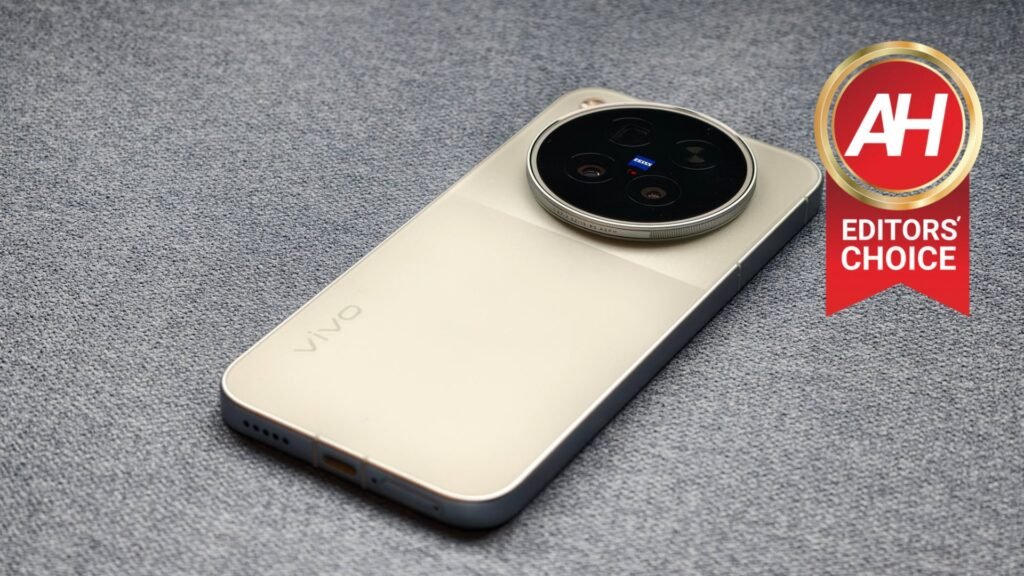

The Vivo X500 Pro is one of two high-end phones that Vivo announced. You can already read the Vivo X500 Pro Max review that is on the site. The Vivo X500 Pro is powered by the same chip as the Vivo X500 Pro Max, but it’s technically an inferior phone. Still, it’s only slightly behind the Pro Max, and mainly because of the cameras… which are still very, very good, as you’ll be able to find out in this review.
The Vivo X500 Pro is catered to people who don’t like huge smartphones. For better or worse, the Vivo X500 Pro Max is… well, large. The Vivo X500 Pro is the complete opposite, with its 6.36-inch display combined with very thin, uniform bezels. These two phones have a lot in common, as they are technically siblings. With that being said, let’s get down to it, shall we?
Vivo X500 Pro

For anyone tired of huge phones, this might be the one to get.
Pros
- Great design and build quality
- Excellent display all around
- Flagship performance
- Outstanding battery life
- OriginOS 7 is a major improvement
- Long software support
- Possibly the best camera performance when it comes to compact phones
- Charging is plenty fast
Cons
- Pricey
- Speakers are just fine
- Lower battery capacity than in Chinese model
Vivo supplied us with a review unit of the Vivo X500 Pro, but didn’t have a say in our opinion, nor did they see this review before you. We’ve been using the device for about two weeks before forming an opinion.
Specs
Vivo X500 Pro Specs
| Display Size | 6.36 inches |
| Display Resolution | 2660 x 1216 |
| Refresh Rate | Up to 144Hz |
| Dimensions | 151.78 x 71.92 x 8.12 mm |
| Weight | 197 grams |
| Chipset | MediaTek Dimensity 9600 Pro |
| RAM | 12GB |
| Storage | 256GB/512GB |
| Battery | 6,510mAh |
| Charging | 90W wired, 40W wireless (charger included) |
| OS | Android 17 with OriginOS 7 |
| Main Camera | 50MP (Sony LYTIA L910 1/1.28-inch sensor, f/1.57 aperture, gimbal-grade OIS) |
| Ultrawide Camera | 50MP (Samsung ISOCELL JN5 1/2.75-inch sensor, f/2.0 aperture) |
| Periscope Telephoto Camera | 64MP (Sony LYTIA 610 1/2.0-inch sensor, f/2.52-inch snesor size, OIS, CIPA 7.0 stabilization) |
| Front-Facing Camera | 50MP (Samsung ISOCELL JN1 sensor, 1/2.76-inch sensor size, f/2.0 aperture) |
| Network and Connectivity | Wi-Fi 7, GPS, Bluetooth 6.0, NFC |
| Water Resistance | IP68/IP69 |
| Colors | Black, Gray, Orange, White |
Vivo X500 Pro Review: Design
Design-wise, the Vivo X500 Pro is basically the same as the Vivo X500 Pro Max… but smaller. It’s made out of metal, glass, and glass-fiber-reinforced plastic. The phone is quite slippery in the hand, but that’s basically the only drawback of this design. The display is flat, as is the frame. That frame, which is made out of aluminum, does round up towards the edges, which makes the phone very comfortable to hold and use.
It has thin bezels and a modern design
There is also a camera hole centered at the top of the display. The bezels around the panel are thin and uniform. When it comes to buttons, you do get a standard set of them. The power/lock button sits on the right-hand side, with the volume up and down buttons sitting above it. The phone has stereo speakers. The main speaker sits at the bottom, while the second one is placed under the speaker grille.

The back of the phone is mostly flat. It does rise slightly in the section where the camera bump is located. You wouldn’t even notice if you didn’t feel it with your finger, in all honesty. It rises gradually, and it’s very subtle. Vivo does use a two-tone design on all models, though, so exactly where a different tone starts is where the back side starts to rise a bit. The camera oreo does protrude a bit on the back, and it’s actually a solid point to anchor your finger while holding the phone.
The Vivo X500 Pro does not wobble
I actually liked this design a lot. It does not cut into your hand one bit, and the size is perfect. I think this is an ideal size for a phone, in all honesty. Those thin bezels help a lot. The phone does not wobble on a table, and you can thank the placement of the camera module on the back for that. Some companies should really learn from this. It’s also quite thin and light. As I said at the beginning, the only negative I can say is that the phone is a bit too slippery. I always want to see more grippy materials used on backplates, but that’s something only very few companies do. Vivo used to be one of them. Now you do get a nice two-tone design on the back, though. The phone feels well-made as well. It is IP68 and IP69 certified, so it has excellent ingress protection.


Vivo X500 Pro Review: Accessories
When it comes to accessories, you do get everything you need in the Vivo X500 Pro retail box. In addition to the phone itself, Vivo also included a 90W charger, a charging cable, and a SIM card ejector tool. On top of that, some paperwork is included, and a case. Yes, a case sits in the box, and it’s your standard soft-touch silicone case, which is a good thing. Most people seem to prefer cases like this, and it’s far better than a hard plastic case that some OEMs include with their phones. Kudos to Vivo.
Vivo X500 Pro Review: Display
The Vivo X500 Pro features a 6.36-inch ZEISS Master Color Display. This display offers a 1.5+ resolution (2660 x 1216), and it’s a high refresh rate display. Its refresh rate goes from 1 to 144Hz as needed. The peak brightness this panel can offer is 4,500 nits. Having its size and resolution in mind, you do get 459 PPI here, in case you’re keeping track. This is also a Dolby Vision, Ultra HDR display. We’ve said it earlier, but it’s a flat panel with a centered display camera hole and thin, uniform bezels around it.
It has an outstanding display
This display is… great. You’re not really losing anything compared to the Vivo X500 Pro Max, not at all. The other one does offer 2K resolution, but it’s also notably larger, so it balances itself out. I could never tell one is sharper than the other; both are very, very sharp. The PPI on the Pro Max is only slightly higher, not something you’ll notice. Everything else is basically the same. I’m just not sure about the display protection. It says ‘Armor Glass’ for the Pro Max, but nothing is mentioned for the Vivo X500 Pro in official specs. Either way, the phone does come with a plastic screen protector pre-installed, and I had no issues with scratches.

There are plenty of tweaking options, including various options for eye comfort and protection
The display is vivid, sharp, and can get very bright if you need it to. The viewing angles are excellent as well. Out of the box, it does lean slightly to the cooler tones, but that’s something you can easily tweak in display settings. You can make it as warm or cool as you want, not to mention that you do get a ton of additional options to protect your eyes. In the ‘Eye comfort and protection’ menu, you’ll find Sleep comfort mode, Anti-fatigue brightness, Adaptive color, and various other adjustments that allow you to protect your eyes, basically, and adapt the display to your needs. I don’t have a single complaint display-wise; it’s great, and it sits side-by-side with the Vivo X500 Pro Max.
Vivo X500 Pro Review: Performance
The Vivo X500 Pro is fueled by the same processor as its larger sibling, the Vivo X500 Pro Max. The chip in question is the MediaTek Dimensity 9600 Pro, which is the company’s most powerful chip to date. It’s also brand new, by the way. This chip is combined with 12GB of LPDDR5X RAM and UFS 4.1 flash storage. I expected similar performance to what the Vivo X500 Pro Max offered, and that’s exactly what this phone delivered. You’re essentially getting the same performance in a smaller package.
As you can see in our 3DMark Wild Life Stress Test below, the phone did throttle quite a bit. That is per course for phones with the most powerful chips, though. You’ll notice that the Galaxy S26 and iPhone 18 Pro throttled as well. That’s not to say that the performance is bad in any way, shape, or form, though. The Vivo X500 Pro actually offers outstanding performance by all flagship standards. OriginOS 7 improvements only emphasize the powerful hardware that Vivo decided to include inside this phone.
The performance is great; the phone flies through anything you throw at it
The phone flies through everything you throw at it. I noticed a noticeable improvement in overall smoothness compared to OriginOS 6, and I do think that the new chip had something to do with it, though that’s probalby more the OS itself and optimizations that Vivo did and talked at length about. Day-to-day use, along with a bunch of multitasking and whatever, is outstanding. Everything works as it should on a flagship-grade phone. I did not notice any lag or anything like that. It’s smooth sailing.
What about games? Well, the phone does get a bit warmer than its sibling in gaming, but nothing that should alarm you. It’s still perfectly fine. No overheating or uncomfortable heat. The gameplay itself is great. When I received the device, prior to the final build (I believe), pre-launch, I did have a lot of stuttering in Subway Surfers, but within a day, a new update arrived that fixed basically everything. That’s prior to the phone’s launch, mind you, so you’ll have the final update from the get-go. A couple of additional updates arrived as well, to improve the performance even more. Gaming is a non-issue. I played Subway Surfers, COD: Mobile, Genshin Impact, and several other games. This phone chews through everything with absolute ease, as expected.
Benchmarks:
Geekbench 7:
| Device | Single-Core | Multi-Core | GPU |
| Vivo X500 Pro | 3,142 | 9,778 | 18,638 |
| Samsung Galaxy S26 | N/A | N/A | N/A |
| Apple iPhone 18 Pro | 3,976 | 11,252 | 62,091 |
3DMark (Wildlife Extreme Stress Test):
| Device | Best Loop | Lowest Loop | Stability |
| Vivo X500 Pro | 5,273 | 1,747 | 33.1% |
| Samsung Galaxy S26 | 6,911 | 2,737 | 39.6% |
| Apple iPhone 18 Pro | 9,059 | 5,385 | 59.4% |
AnTuTu:
| Device | Result |
| Vivo X500 Pro | 3,401,221 |
| Samsung Galaxy S26 | 3,745,876 |
| Apple iPhone 18 Pro | 3,368,954 |
Thermals:
3D Mark (Wildlife Extreme Stress Test) thermals:
| Device | Temperature (F) |
| Vivo X500 Pro | 107.9 |
| Samsung Galaxy S26 | 108.9 |
| Apple iPhone 18 Pro | 110.2 |
Genshin Impact thermals:
| Device | Temperature (F) |
| Vivo X500 Pro | 102.2 |
| Samsung Galaxy S26 | 94.3 |
| Apple iPhone 18 Pro | N/A |
Vivo X500 Pro Review: Battery Life
The Vivo X500 Pro comes with a 6,510mAh BlueVolt battery, which is a silicon-carbon battery. That battery is smaller than the one in the Pro Max, though that’s logical considering the differences in size between the two phones. Having said that, the capacity used here is more than enough for a phone of this size. I had considerable expectations for the longevity of the Vivo X500 Pro on a single charge, and the phone did not disappoint, not at all. If you’re worried about battery life, don’t be, not at all.
It has great battery life for any phone, not only a compact one
Yes, the phone does slot behind the Vivo X500 Pro Max in terms of longevity, but considering that the Pro Max offers fantastic battery life, that’s not exactly a negative. The Vivo X500 Pro can last longer than the Pixel 11 Pro, Galaxy S26, and many other similarly-sized competitors. That 6,510mAh battery is more than enough to handle its display size, chip, and everything else… and leave plenty of juice left. I was impressed by the Vivo X500 Pro battery life. The phone managed to handle heavy use with ease and still had over 25% left at the end of the day, even during the heaviest use days. That was on a day when I was testing the camera heavily, streamed plenty of music, played a couple of leisure games, messaged and emailed a ton, and had over 7 hours of screen-on time. On days when I didn’t use the camera as much, but still had near 7 hours of screen-on time, this thing had over 40% of battery charge at the end of a full day. For some people, the Vivo X500 Pro can be a two-day phone, sure.
It can reach a full charge in under 50 minutes
The Vivo X500 Pro does have a smaller battery than the Vivo X500 Pro Max, but its charging is just as fast. The Pro Max model was fully charged in an hour flat, and that’s a 7,800mAh battery we’re talking about. This 6,510mAh battery managed to get there in around 49 minutes for me. Yes, a charger is included in the package, by the way, in case you missed that fact earlier on.
| Device | Battery life | Charging |
| Vivo X500 Pro | 25:07:01 | 0:59:07 |
| Samsung Galaxy S26 | 23:08:13 | 1:22:09 |
| Apple iPhone 18 Pro | 21:39:21 | 0:59:21 |
Vivo X500 Pro Review: Camera
The Vivo X500 Pro has three cameras on the back, just like the Vivo X500 Pro Max. In fact, two out of three cameras on the back are exactly the same between the two phones. The main and ultrawide cameras are identical, while the periscope telephoto camera is different. Yes, the phone offers great camera performance, and it even trumps a number of larger top-end flagships from the competitors. It is noticeable that the periscope telephoto camera on the ‘Pro Max’ model is better, but in all honesty, this one is really, really good. Let’s start from the top, though.
Two out of three rear cameras are the same as on the Vivo X500 Pro Max
The main camera on the device is a 50-megapixel unit with a 1/1.28-inch sensor size and an f/1.6 aperture lens. OIS and PDAF are both supported here. The ultrawide camera is a 50-megapixel unit with a 1/2.75-inch sensor size and an f/2.0 aperture lens. You’re getting a 119-degree FoV here, by the way. The third camera on the back is a 64-megapixel periscope telephoto unit with a 1/2.0-inch sensor size, f/2.5 aperture, and both OIS and PDAF support. This camera supports 3.5x optical zoom, by the way.

Considering that the main camera sensor is the same as on the Pro Max, you’re getting basically the same results, as the chips are the same as well. That’s great news. This is not only a new LOFIC camera that was developed in collaboration between Vivo and Sony, but it does a great job; it’s a rather large sensor. It does a wonderful job in both day and night. I’ve used the ‘Vivid’ preset for the images in the gallery below, but you can tone down the colors with ‘Natural’ or ‘Refined’ color styles, or any other, in all honesty. You can even add your own photography styles, if you want. The Vivo community has plenty to choose from, and the phone processes photos with those color styles in mind.
The dynamic range is great, while the main and periscope telephoto cameras stand out
There is plenty of detail in the shots from the main camera, and the dynamic range is great as well. I was shooting photos on both sunny and rainy days, and you can clearly see vivid differences between those scenes. The white balance is on point as well. This camera is outstanding in low light as well. It doesn’t try to brighten up scenes too much, but it finds a nice balance while maintaining plenty of detail and generally balancing photos. ZEISS T* coating does a great job with handling street flares, and that goes for all cameras.
The phone also keeps a great color balance between all three cameras, under all lighting conditions. It’s a bit more difficult in low light, but it does a good job in such scenes as well. Photos from the ultrawide camera are the softest, but even those look quite good, especially during the day. You can see the drop-off in low light. The periscope telephoto camera does a wonderful job in both daytime and nighttime, and manages to keep the color science closer to the main camera in dark conditions, compared to the ultrawide cameras.

The shutter is fast enough, and the general camera experience was on a high level
The shutter speed is not slow, but it’s not the fastest we’ve seen either. The Vivo X300 Ultra does trump the Vivo X500 Pro in that regard, at least when it comes to the main camera. Don’t get me wrong, the shutter speed is not slow at all; it’s quite fast. It’s just not the fastest around (but not far from it). The video performance is also quite good, though the main camera shines the most in that regard.
Vivo managed to create a truly great compact camera smartphone here. The only camera that is technically weaker here than on the Pro Max model is the periscope telephoto unit, and even that one does a great job. I’d go as far as saying this is the best camera smartphone when it comes to compact phones (under 6.4 inches).
Camera samples:


4K video recording thermals:
| Device | 5 minutes | 10 minutes |
| Vivo X500 Pro | 100.1 | 106.5 |
| Samsung Galaxy S26 | N/A | 97.8 |
| Apple iPhone 18 Pro | N/A | N/A |
Vivo X500 Pro Review: Software
The Vivo X500 Pro comes with Android 17 out of the box, and on top of it, you’ll be getting OriginOS 7. That’s rather important, as OriginOS 7 feels great to use. It’s a notable improvement over the previous iteration, as Vivo worked a lot on optimization and smoothness… and it shows at every step. If you used OriginOS 6, you’ll be able to notice the difference instantly. In fact, you’ll be able to notice it if you’re coming from almost any other brand out there. Vivo managed to bring OriginOS very close to ColorOS in terms of smoothness, which managed to surprise me quite a bit. I expected improvements, but Vivo delivered more than I bargained for.
OriginOS 7 is far more cohesive now, not to mention a lot smoother
OriginOS 7 also looks more cohesive now. It basically tries to blend Apple’s Liquid Glass and Google’s Material Design styles into one, and it does a good job, actually. I’m still not a fan of the glassy style, and I do with that Vivo went in a different direction, but it actually looks good in OriginOS 7. In any case, Vivo utilized Fluid Motion and Spring Animation projects to improve OriginOS, and it shows quite a bit. Everything is silky smooth, and the animations are speedy and nice. Well, this phone’s overpowered hardware certainly helps in the great scheme of things, of course.

OriginOS is not that much different than other Android skins you’ve used. The basics are the same, but some features are unique to it, of course. Let’s take the one-handed mode, for example. In order to access it, you don’t need to swipe down from the lower part of the screen towards the bottom. No. In OriginOS, you swipe fast from the right edge towards the middle and then back in order to enter one-handed mode. Also, in OriginOS, your entire screen shrinks in the bottom-left or bottom-right corner; it does not simply bring the top portion of the screen down like on most other Android iterations. This is not new; it has been that way for quite some time now.
Vivo did include some new options, but the optimization and a slight redesign are the key
What OriginOS 7 specifically brings, in addition to major optimizations and some UI design changes, is the Wiggle Themes. Yes, the wallpapers can literally wiggle. It’s a questionable feature, but a fun one, actually. Some interesting themes are included, and Jovi, the company’s AI agent, is far more capable now. A bunch of useful AI features have been thrown into the mix. The notifications worked like a charm for me in OriginOS 7, but that’s not surprising, as that has been the case with Vivo’s phones for a long time. There’s no problem whatsoever. Always-On Display also works great, and there’s a decent level of customization and gestures for you to use.
One thing to note is that third-party launchers don’t work perfectly here. They’ll work, but the quick switch gesture won’t work at all for you. Well, at least it did not for me, regardless of what launcher I tried. That’s a shame, but that’s the case for third-party launchers on most brands; they simply don’t work as intended due to Google’s changes to APIs years ago, and companies are not really bothered by it, as they want people to use the default launcher either way. If you use on-screen buttons, however, everything will work as intended.

This is now one of my favorite iterations of Android
All in all, OriginOS 7 is a great new version of this skin. It’s far better than OriginOS 6, in terms that it’s far smoother and far more cohesive now. It quickly became one of my favorite iterations of Android.
Vivo X500 Pro Review: Audio
Much like the Vivo X500 Pro Max, this phone also has stereo speakers. Those speakers are actually quite good. They’re loud enough and punchy, and the output balance is also quite good. They’re not the loudest speakers around, but they’re more than loud enough.
There is no audio jack included on the phone, but you can use the Type-C port to connect your wired headphones. When it comes to voice calls, everything worked perfectly. The earpiece is great, and the people I talked to said that I sounded really good; “crystal clear” was the term my friend used.
Vivo X500 Pro Review: Should you buy it?
The Vivo X500 Pro is not cheap, not at all. The component prices didn’t do it any favors, but if you’re looking for the most complete compact phone out there, this is it. The Vivo X500 Pro basically doesn’t cut corners, not even in the camera department. Vivo made sure that all three cameras do a really good job, especially the main and telephoto ones. The battery life is excellent, and the performance is outstanding. The design is spot on; the phone doesn’t wobble, and it’s light and compact with very thin bezels. Its charging is extremely fast, while the charger is included in the box, and so on. It’s, in my opinion, the best compact high-end smartphone on the market at the moment.

You should buy the Vivo X500 Pro if you:
- Are tired of large phones
- Want truly great cameras in a compact form factor
- Have been worried about battery life in compact phones thus far
- Like having a charger included in the retail box
- Appreciate an excellent display
- Push your phones to the limit, and you need something powerful
- Have phones that wobble
You shouldn’t buy the Vivo X500 Pro if you:
- Don’t need all this power, as it’s quite pricey
- Rely on third-party launchers
The post Vivo X500 Pro Review: The Best Compact (Camera) Phone appeared first on Android Headlines.