President Donald Trump’s push to rebrand artificial intelligence as “superintelligence” has a new government URL.
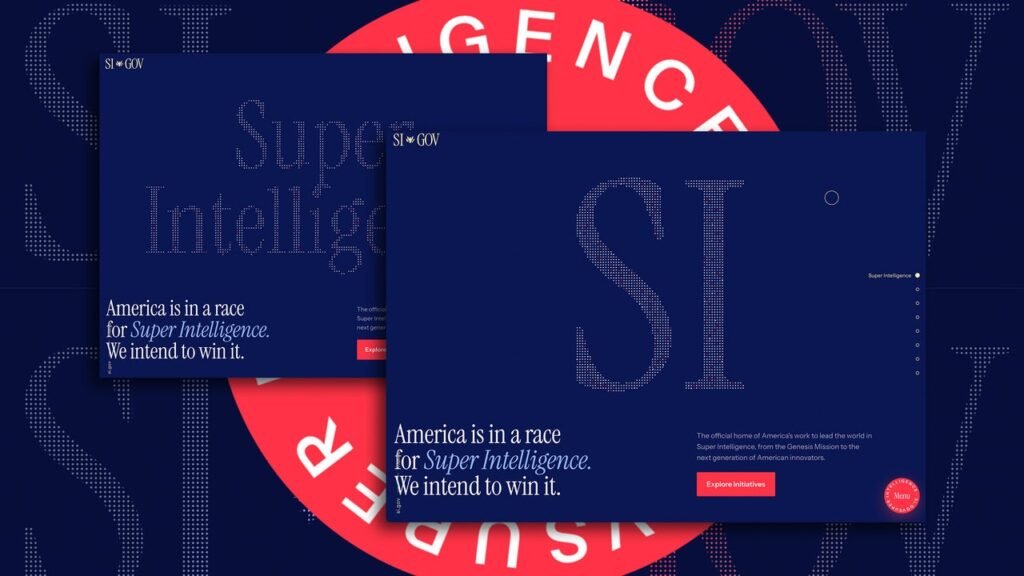
The Trump administration launched SI.gov on Tuesday, a narrative microsite that promotes the administration’s AI policies and initiatives. The old AI.gov, which formerly linked to the administration’s AI action plan and executive orders now, redirects to the new site.
As a work of marketing, the website is slick and graphically compelling. The overarching message is that the U.S. is a superintelligence leader. But the overall site design is otherwise sugarcoating a major issue Trump isn’t polling well on.
The site welcomes visitors with an interactive element that depicts the letters “SI” at the top of the page. The letters, each made up of a grid of dots, respond to your cursor or tap, and rearrange into the words “Super Intelligence” spelled out in full, capturing users’ attention with an engaging effect that’s visible in other background illustrations as users scroll down page.
“Whoever builds the largest SI ecosystem will set the global standards and reap the economic and security rewards,” the site says under a header that reads “Why it matters.” “Under President Trump, the nation aims to usher in a new golden age of innovation, human flourishing and technological achievement for the American people.”
The site highlights the administration’s priorities by focusing on Trump’s AI executive orders, the federal permitting of data centers, and the launch last year of the Genesis Mission, a public-private partnership through the Department of Energy to “double the productivity and impact of American science and engineering within a decade” using AI technology.
Further down the page, there’s a link to more information about initiatives such as Melania Trump’s First Lady Seal of SI Readiness for schools to develop guidelines around AI usage in the classroom, and her challenge for students to develop a project using AI to solve problems.
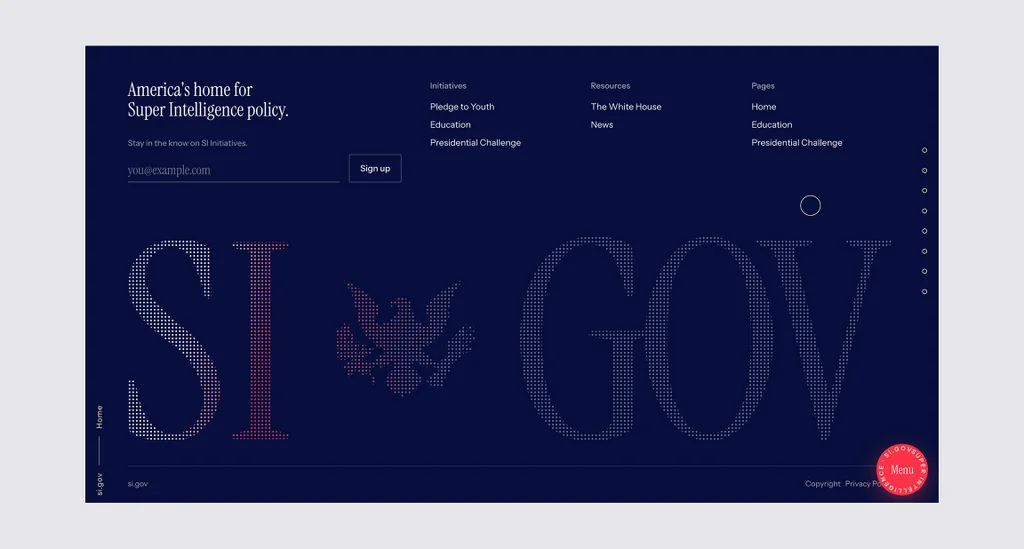
The microsite has an oversized footer which showcases an SI.gov word mark in the administration’s font, Instrument Serif, although the letterforms are made up of a tight grid of dots to call back to the animations throughout the page. The word mark also has an animated red, white, and blue gradient that shifts from left to right. An eagle from the presidential seal takes the place of the typical dot found in a URL.
Unlike many of the administration’s past microsites, including the AI chatbot America.gov, this page doesn’t indicate it was designed by National Design Studio. The White House did not respond to a request for comment.
The Trump administration launched AI.gov during Trump’s first term. It was redesigned twice when then-President Joe Biden was in office. Under both presidents, the site has been used to promote the government’s AI work and priorities.
Trump’s new SI.gov rebrand, however, also tries to make his preferred term, “SI,” a part of the zeitgeist. So far, it’s not going well. YouGov polling found 53% prefer the term “artificial intelligence” compared with just 9% for “superintelligence.” And while Elon Musk renamed his company from Space XAI to SpaceXSI to follow Trump’s lead, others like OpenAI, the maker of ChatGPT, aren’t planning to change names. (Even though Trump has called anyone who doesn’t buy his SI rebrand an “enemy.”)
A Reuters/Ipsos poll released last week found about 57% of registered voters believe the Trump administration has not taken AI risks seriously enough or at all, and the new site seems to prove them right.
At a time when a majority of Americans don’t want a data center built near them, SI.gov promotes data center construction as a positive. And although the biggest school district in the country, the New York City public schools, just banned AI for students up through 8th grade, SI.gov promotes AI challenges for students. Most Americans don’t trust Trump’s handling of AI or AI in general, but the site’s messaging indicates everything’s going great.
And that gap, as showcased on the rebranded website, indicates an administration out of step with public opinion. Though perhaps that should be expected from a website that uses an acronym most Americans don’t.