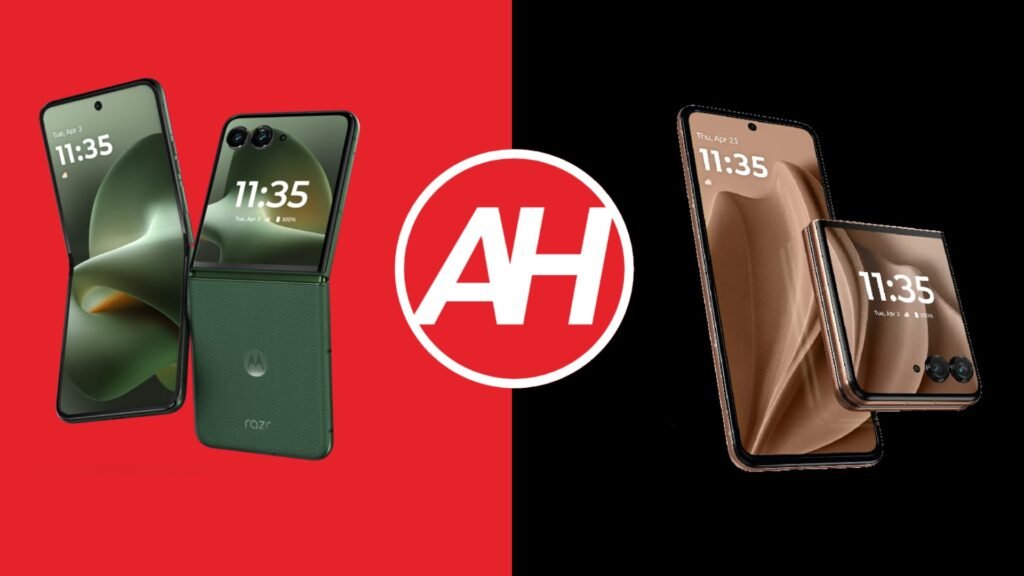

In this article, we’ll be comparing two ‘Plus’ phones from Motorola. We’ll actually be comparing two foldable ‘Plus’ devices. In other words, this is a Motorola Razr+ 2026 vs Motorola Razr+ 2025 comparison. The 2026 model was announced in April and became available in May. The Motorola Razr+ 2025 arrived about a year prior to that and has been available for quite some time.
Yes, these two smartphones are quite similar, as you may have guessed. Still, there are some improvements on the new model. We’ll first list the specs of both phones, and following that, we’ll compare them across a number of categories. Those categories include design, display, performance, battery, cameras, and audio. Let’s get to it, shall we?
Specs

Motorola Razr+ 2026

Motorola Razr+ 2025
| Motorola Razr+ 2026 | Motorola Razr+ 2025 | |
|---|---|---|
| Dimensions (unfolded/folded) | 171.4 x 74 x 7.1 mm / 88.1 x 74 x 15.3 mm | 171.4 x 74 x 7.1 mm / 88.1 x 74 x 15.3 mm |
| Weight | 189 grams | 189 grams |
| Main display | 6.9-inch LTPO AMOLED (165Hz) | 6.9-inch Foldable LTPO AMOLED (165Hz) |
| Cover display | 4-inch AMOLED (165Hz) | 4-inch LTPO AMOLED (165Hz) |
| Resolution | 2640 x 1080 / 1272 x 1080 | 2640 x 1080 / 1080 x 1272 |
| Chipset | Qualcomm Snapdragon 8s Gen 3 | Qualcomm Snapdragon 8s Gen 3 |
| RAM | 12GB | 12GB |
| Storage | 256GB (UFS 4.0) | 256GB (UFS 4.0) |
| Main camera | 50MP (f/1.8 aperture, 1/1.95-inch sensor size, OIS, PDAF) | 50MP (f/1.7 aperture, 1/1.95-inch sensor si ze, dual pixel PDAF, OIS) |
| Ultra-wide camera | 50MP (f/2.0 aperture, 1/2.76-inch sensor size, 122-degree FoV) | N/A |
| (Periscope) telephoto camera | N/A | 50MP (f/2.0 aperture, 1/2.76-inch sensor size, PDAF, 2x optical zoom)) |
| Selfie camera | 32MP (f/2.4 aperture) | 32MP (f/2.4 aperture, 1/3.14-inch sensor size) |
| Battery size | 4,500mAh | 4,000mAh |
| Charging | 45W wired, 15W wireless, 5W reverse wired (charger not included) | 45W wired, 15W wireless, 5W reverse wired (charger not included) |
| Colors | Pantone Mountain View | PANTONE Mocha Mousse, PANTONE Midnight Blue, PANTONE Hot Pink |
Motorola Razr+ 2026 vs Motorola Razr+ 2025: Design
These two smartphones look very similar. In fact, many people wouldn’t even be able to tell the difference, in all honesty. The colors are the main differentiating point between the two devices. They both have a centered display camera hole up top, on the main display. The bezel thickness around the display is very similar between the two phones. They both have power/lock and volume up and down buttons on the right side, in the same spot, basically.
The frames on both phones are not flat; they’re slightly rounded. Some people will prefer that, others not so much. It’s a matter of preference. The point is, both phones are quite comfortable to hold, that’s for sure. You’ll find silicon polymer, aka eco leather on the back of both of these phones. That’s a good thing, in my opinion, as it makes both phones grippier. You quite frankly don’t need to use a case with either one of these, as they’re grippy enough. Protection is another thing, of course.
The two devices even have the same dimensions. Yes, the exact same dimensions, which only goes to say about how similar they are. Motorola basically didn’t change the design at all. The two phones even have the same weight. Both of them are also IP48 certified for water and dust resistance.
Motorola Razr+ 2026 vs Motorola Razr+ 2025: Display
Motorola decided to keep the same displays from the Motorola Razr+ 2025, on the Razr+ 2026. The displays are identical, and there are two of them per phone, of course. There is a 6.9-inch Foldable LTPO AMOLED display. That is the foldable panel, and it supports a refresh rate of up to 165Hz. It supports Dolby Vision and HDR10+ as well. The peak brightness on this panel is 3,000 nits. The resolution you’re getting is 2640 x 1048.

The cover display on the two phones measures 4 inches. That panel is an OLED unit as well, and it supports a refresh rate of up to 165Hz. It can show 1 billion colors, and it has a peak brightness of 2,400 nits. The resolution here is 1272 x 1080 pixels, while the Gorilla Glass Victus is in charge of protecting this display.
All displays on these two phones are quite good. They’re all vivid and have good viewing angles. You also won’t miss any sharpness on them. A high refresh rate is also here, and almost everything you could want. Yes, there are better displays out there, but there’s not much to complain about here. They’re also bright enough, so no worries there.
Motorola Razr+ 2026 vs Motorola Razr+ 2025: Performance
Motorola didn’t even upgrade the processor for the new model. Both smartphones use the same chip. It’s the Snapdragon 8s Gen 3, which is a 4nm processor from Qualcomm. Both of them also come with 12GB of LPDDR5X RAM and UFS 4.0 flash storage. Both of them come with only one storage model, a 256GB unit. There is also no storage expansion, so you’re stuck with that storage.
In all honesty, both phones perform about the same. We did not notice a difference with the new model, which is not exactly surprising, as the performance-related specs are identical. The two phones not only have the same processor, but they also include the same RAM and storage. The performance in general is quite good, though. They’re both quite snappy during day-to-day use and can also multitask with ease.
What about gaming? Well, these are not exactly phones made for gaming, but they can easily run games. Yes, that goes for higher-end games as well, though don’t expect flagship-grade performance when it comes to games. If you’re planning to run through graphically demanding titles often, these are not exactly the phones for that.
Motorola Razr+ 2026 vs Motorola Razr+ 2025: Battery
The Motorola Razr+ 2026 does include a bigger battery. It comes with a 4,500mAh battery, compared to a 4,000mAh unit inside the Motorola Razr+ 2025. That is a notable difference, and yes, the difference is noticeable in actual use. Neither phone will win awards in the battery life department, but the newer phone does last longer. You’ll be able to get around an hour of extra screen-on time; at least that was the case for us.
Do note that neither phone offers great battery life, though. If you’re a heavy user and use the main display a lot, you’ll kill the battery on both phones before the end of the day. Flip foldables are made for mixed use, and most of the time, the newer model was able to get us through a single day with ease. The same cannot really be said for the 2025 model.
What about charging? Well, both smartphones support 45W wired and 15W wireless charging, on top of supporting 5W reverse wired charging. The Motorola Razr+ 2025 can be fully charged in around 50 minutes, while it will take a bit longer for the newer model, a bit over an hour. That’s not bad, but it’s not exactly blazing fast either. It’s also worth noting that neither phone includes a charger in the retail box.
Motorola Razr+ 2026 vs Motorola Razr+ 2025: Cameras
We’ve talked about many similarities between these two phones, and the same goes for cameras, actually. The newer model has a slightly narrower aperture on the main camera, but other than that, things have not changed. Both phones include a 50-megapixel main camera with a 1/1.95-inch sensor size, PDAF, and OIS. The newer model has an f/1.8 aperture, while last year’s model offers an f/1.7 aperture.

Both smartphones include a 50-megapixel ultrawide camera on the back. That camera has an f/2.0 aperture lens and a 1/2.76-inch sensor size. It also offers a 122-degree FoV. A 32-megapixel snapper sits on the main display on both smartphones and includes a 1/3.14-inch sensor size.
Neither of these two phones is great in the camera department, but they’re both good enough. During the day, both cameras do a good job, though the main one has the edge. The images are mostly pleasant, vivid, and sharp. Things do take a hit in low light, but the shots from the main camera still look quite good. They cannot compare with the best camera phones out there, but they look good and very similar from both devices, which is not surprising.
Audio
Yes, both of these phones include stereo speakers. Those speakers are more than loud enough, and the sound output they offer is also quite good. We don’t really have any complaints in that regard.
What is not included is an audio jack, but we’re used to that at this point. You can connect your wired headphones to their Type-C ports, though. Both phones also support Bluetooth 5.4 for wireless audio connectivity.
The post Phone Comparisons: Motorola Razr+ 2026 vs Motorola Razr+ 2025 appeared first on Android Headlines.