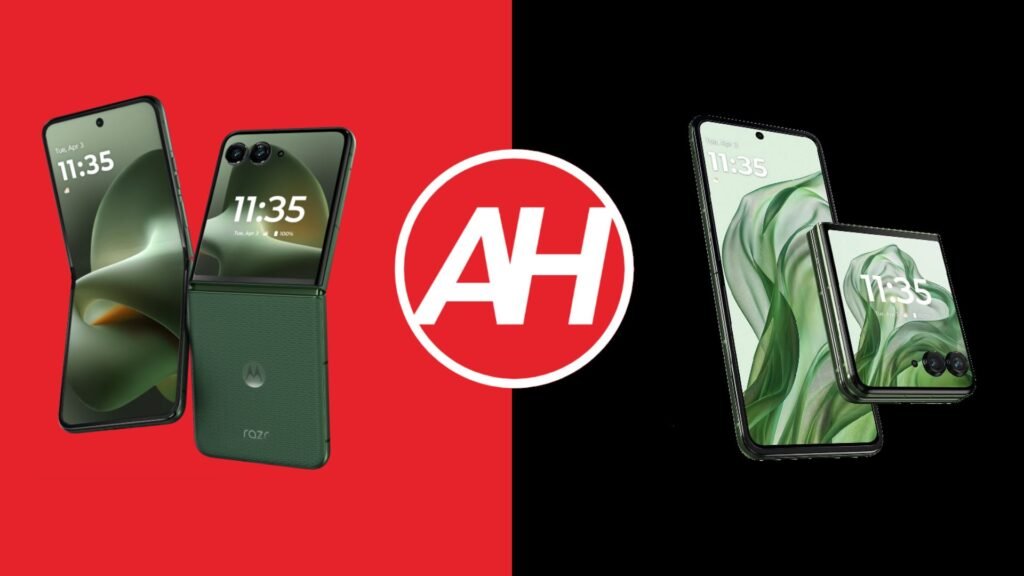

Motorola announced three flip foldable smartphones this year. The Motorola Razr+ 2026 is the middle-of-the-road one, and we’re here to compare it with one of its predecessors. This is a Motorola Razr+ 2026 vs Motorola Razr+ 2024 comparison. The Motorola Razr+ 2024 arrived back in June 2024. These two phones do look quite similar, but there are other differences here, of course.
We will first list the specs of both phones. Following that, we’ll move to compare their designs, displays, performance, battery life, cameras, and audio output. There’s a two-year difference between these two devices, so keep that in mind. The Motorola Razr+ 2026 is, of course, notably pricier at this point in time.
Specs

Motorola Razr+ 2026

Motorola Razr+ 2024
| Motorola Razr+ 2026 | Motorola Razr+ 2024 | |
|---|---|---|
| Dimensions (unfolded/folded) | 171.4 x 74 x 7.1 mm / 88.1 x 74 x 15.3 mm | 171.4 x 74 x 7.1 mm / 88.1 x 74 x 15.3 mm |
| Weight | 189 grams | 189 grams |
| Main display | 6.9-inch LTPO AMOLED (165Hz) | 6.9-inch Foldable LTPO AMOLED (165Hz) |
| Cover display | 4-inch AMOLED (165Hz) | 4-inch AMOLED (165Hz) |
| Resolution | 2640 x 1080 / 1272 x 1080 | 2640 x 1080 / 1272 x 1080 |
| Chipset | Qualcomm Snapdragon 8s Gen 3 | Qualcomm Snapdragon 8s Gen 3 |
| RAM | 12GB | 12GB |
| Storage | 256GB (UFS 4.0) | 256GB (UFS 4.0) |
| Main camera | 50MP (f/1.8 aperture, 1/1.95-inch sensor size, OIS, PDAF) | 50MP (f/1.7 aperture, 1/1.95-inch sensor size, dual pixel PDAF, OIS) |
| Ultra-wide camera | 50MP (f/2.0 aperture, 1/2.76-inch sensor size, 122-degree FoV) | 50MP (f/2.0 aperture, 1/2.76-inch sensor size) |
| (Periscope) telephoto camera | N/A | N/A |
| Selfie camera | 32MP (f/2.4 aperture) | 32MP (f/2.4 aperture, 1/3.14-inch sensor size) |
| Battery size | 4,500mAh | 4,000mAh |
| Charging | 45W wired, 15W wireless, 5W reverse wired (charger not included) | 45W wired, 15W wireless, 5W reverse wired (charger not included) |
| Colors | Pantone Mountain View | Midnight Blue, Hot Pink, Spring Green, Peach Fuzz, Paris Hilton Edition |
Motorola Razr+ 2026 vs Motorola Razr+ 2024: Design
These two smartphones do look the same. In fact, if you don’t know what color belongs to which model, you’d be hard-pressed to tell them apart. Motorola has not changed the design since 2024. Both phones include a flat display with a centered display camera hole up top. The corners are rounded, while the power/lock and volume up and down keys can be found on the right-hand side of the device.
The bezels are the same across the two phones. The frame is not flat on either phone, it’s slightly rounded. The frame is made out of metal, while you’ll find eco leather on the back. That makes both phones quite grippy, which is a good thing. The eco leather on the Motorola Razr+ 2024 help up really well since launch. That’s usually the case with eco leather, though it’s quite durable, as it’s essentially silicone polymer.
You’ll notice that the cover display covers half of the back side on these devices. Looking at the phone when it’s unfolded, of course. When it’s folded, it basically covers the entire front. Two horizontally aligned cameras sit on both cover displays in the top-left corner. There’s also an LED flash next to them. These two phones have the exact same dimensions and weight. The Motorola Razr+ 2026 is IP48 certified, while the Motorola Razr+ 2024 comes with an IPX8 certification.
Motorola Razr+ 2026 vs Motorola Razr+ 2024: Display
Another thing that Motorola did not change at all over the last two years are the displays. The Motorola Razr+ 2026 actually has the exact same panels as the Motorola Razr+ 2024. There’s a 6.9-inch Foldable LTPO AMOLED main display. That panel supports Dolby Vision and HDR10+ content, while it has an adaptive refresh rate of up to 165Hz. The peak brightness here is 3,000 nits, while the resolution is 2640 x 1080. The screen-to-body ratio is at around 85%.

The cover display on both smartphones is a 4-inch AMOLED unit. That panel has a refresh rate of up to 165Hz, while the peak brightness is 2,400 nits. The display supports Dolby Vision and HDR10+ content, and it has a resolution of 1272 x 1080 pixels. The panel is protected by the Gorilla Glass Victus.
All four of these displays are quite good, actually. They’re not only vivid and more than sharp enough, but they have good viewing angles too, and good touch response as well. The refresh rate is more than high enough on all of them, and they’re all a pleasure to use, in all honesty. They’re also bright enough when they need to be. The performance between them is basically the same.
Motorola Razr+ 2026 vs Motorola Razr+ 2024: Performance
Believe it or not, but Motorola also did not change the processor over the course of two years. The same Snapdragon 8s Gen 3 chip fuels the two smartphones. That’s a 4nm chip, and it’s paired with 12GB of LPDDR5X of RAM and UFS 4.0 flash storage. That goes for both smartphones, actually. Neither phone offers storage expansion, so you’re stuck with 256GB of storage.
Considering that the performance-related specs are the same, one would guess that the performance is as well. Well, you’d be right. These two phones basically offer the same performance. They’re quite fluid day-to-day; there’s not much to complain about, in all honesty. That Snapdragon 8s Gen 3 chip is still more than powerful enough to get the phones going through anything you throw at them.
There are many better phones out there when it comes to gaming. However, they can both handle games without a problem. They may not be running the most demanding games as well as flagships, but in general, they’re not bad when it comes to gaming. Still, do note that neither of these two phones is made with gaming in mind.
Motorola Razr+ 2026 vs Motorola Razr+ 2024: Battery
The Motorola Razr+ 2026 includes a 4,500mAh battery, while the Motorola Razr+ 2024 comes with a 4,000mAh unit. That’s one thing that Motorola did upgrade between the two phones, and it’s nice to see that, for sure. The newer phone does offer better battery life, in case you’re wondering. The difference is not monumental, but it’s there. You can get over 30-45min of extra screen-on-time on the newer model, based on what we’ve seen.
There are a lot of factors in there, considering that each phone has two displays. If you use the cover display most of the time, chances are you’ll find the battery life good enough on both phones, especially on the newer one. However, if you use the main display a ton, well, you may wish for better endurance out of both of them. It all depends on your usage.
The charging speed is the same between the two phones; they both support 45W wired, 15W wireless, and 5W reverse wired charging. The Motorola Razr+ 2024 will charge a bit faster, however, as it has a smaller battery on the inside. It can be fully charged in around 47-48 minutes, while its newer counterpart will take about an hour to get there. Do note that neither phone comes with a charger in the box.
Motorola Razr+ 2026 vs Motorola Razr+ 2024: Cameras
Did Motorola at least upgrade the same hardware? Well, no, not really. These two phones are way too similar in general. The two phones have the same camera hardware, except for the lens aperture, which is barely different. They both include a 50-megapixel main camera with a 1/1.95-inch sensor size, dual pixel PDAF, and OIS. The aperture on the newer model is f/1.8, while the older model has an f/1.7 aperture.

There is also a 50-megapixel ultrawide camera located on the back of both phones. That camera has an f/2.0 aperture and a 1/2.76-inch sensor size. The FoV here is 122 degrees, in case you were wondering. There is also a 32-megapixel camera included on the main display on both of these phones.
The camera performance is alright, but it’s nowhere near the best camera phones out there. We did notice that the newer model does have a slight edge in terms of camera performance, for some reason. Both of them do a very good job in good lighting, with very good colors and plenty of detail. The ultrawide cameras are a level below the main cameras, and that becomes very obvious when you shoot in low light.
Audio
You’ll find stereo speakers on both of these phones. Neither pair is particularly loud, but they’re both loud enough; that’s for sure. We never found ourselves wanting more volume. The sound output quality is good enough.
There is no audio jack on either of the two phones. You can always use their Type-C ports to connect your wired headphones, though. Bluetooth 5.4 is supported on both devices for wireless audio connectivity.
The post Phone Comparisons: Motorola Razr+ 2026 vs Motorola Razr+ 2024 appeared first on Android Headlines.