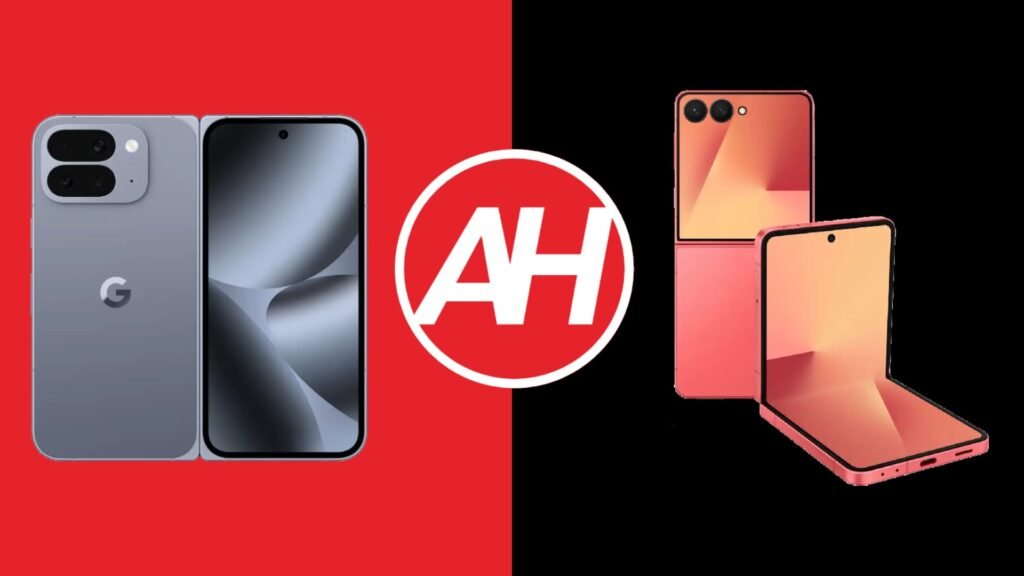

Both Google and Samsung have some compelling foldable smartphones to offer at the moment. We’ve already compared Google’s best book-style foldable with Samsung’s. This time around, we’re comparing that same offering from Google with Samsung’s flip phone. In other words, we’ll be comparing the Google Pixel 10 Pro Fold vs Samsung Galaxy Z Flip 7. Both of these are foldable phones, but they’re notably different.
As we usually do, we’ll first list the specs of both smartphones. Following that, we’ll compare their designs, displays, performance, battery life, cameras, and audio output. These two phones are aimed at completely different consumers. The Pixel 10 Pro Fold is a phone that unfolds into a tablet, while the Galaxy Z Flip 7 is a phone that folds down into a square half its size. Let’s get to it, shall we?
Specs

Google Pixel 10 Pro Fold

Samsung Galaxy Z Flip 7
| Google Pixel 10 Pro Fold | Samsung Galaxy Z Flip 7 | |
|---|---|---|
| Dimensions (unfolded/folded) | 155.2 x 150.4 x 5.2 mm / 155.2 x 76.3 x 10.8 mm | 166.7 x 75.2 x 6.5 mm / 85.5 x 75.2 x 13.7 mm |
| Weight | 258 grams | 188 grams |
| Main display | 8-inch Foldable LTPO OLED (1-120Hz) | 6.9-inch Foldable Dynamic LTPO AMOLED 2X (120Hz) |
| Cover display | 6.4-inch OLED (120Hz) | 4.1-inch Super AMOLED (120Hz) |
| Resolution | 2076 x 2152 / 2364 x 1080 | 2520 x 1080 / 1048 x 948 |
| Chipset | Google Tensor G5 | Samsung Exynos 2500 |
| RAM | 16GB (LPDDR5X) | 12GB (LPDDR5X) |
| Storage | 256GB/512GB/1TB (UFS) | 256GB/512GB (UFS 4.0) |
| Main camera | 48MP (f/1.7 aperture, 1/2.0-inch sensor size, 0.8um pixel size, dual pixel PDAF, OIS | 50MP (f/1.8 aperture, 1/1.57-inch sensor size, dual pixel PDAF, OIS) |
| Ultra-wide camera | 10.5MP (f/2.2 aperture, 1/3.4-inch sensor size, 127-degree FoV, PDAF) | 12MP (f/2.2 aperture, 1/3.2-inch sensor size, 123-degree FoV) |
| (Periscope) telephoto camera | 10.8MP (telephoto, f/3.1 aperture, 1/3.2-inch sensor size, dual pixel PDAF, OIS, 5x optical zoom) | N/A |
| Selfie camera | 10MP (f/2.2 aperture, 1/3.94-inch sensor size, PDAF) x2 | 10MP (f/2.2 aperture, 1/3.0-inch sensor size, 1.22um pixel size) |
| Battery size | 5,015mAh | 4,300mAh |
| Charging | 30W wired, 15W wireless (Qi2), Bypass charging (charger not included) | 25W wired, 15W wireless, 4.5W reverse wireless (charger not included) |
| Colors | Moonstone, Jade | Blue Shadow, Jet Black, Coral Red |
Google Pixel 10 Pro Fold vs Samsung Galaxy Z Flip 7: Design
The moment you lay your eyes on these two phones, you’ll be able to see how different they are. In its folded state, the Pixel 10 Pro Fold looks like a thicker regular smartphone. It has a display with a centered display camera hole. When unfolded, it offers a large display with a near 1:1 aspect ratio. The Galaxy Z Flip 7 is a small, square gadget when folded, with a small display where its main cameras sit. When unfolded, a larger display comes to light, which also has a display camera hole up top.
Both phones have flat frames, which are made out of aluminum. The Pixel 10 Pro Fold includes a power/lock button above the volume up and down keys on the right side. The Galaxy Z Flip 7’s buttons are also on the right side, but the orientation is the opposite of what the Pixel 10 Pro Fold offers. The Pixel 10 Pro Fold does weigh considerably more than the Galaxy Z Flip 7, there’s a 70-gram difference between them.
Their backplates are also different. They’re both flat, but they’re different. The Pixel 10 Pro Fold has a squarish camera island in the top-left corner. There are two horizontal cutouts, pill-shaped ones, in there. The Galaxy Z Flip 7 has its display on the back (in an unfolded state), along with a flat backplate. Inside its display, in the top-left corner, two horizontally aligned cameras sit, along with an LED flash.
Both phones are quite slippery in the hand, as they’re made out of metal and glass. The Galaxy Z Flip 7 is easier to handle and use, though. The Pixel 10 Pro Fold is IP68 certified for water and dust resistance. The Galaxy Z Flip 7 is IP48 certified for water and dust resistance.
Google Pixel 10 Pro Fold vs Samsung Galaxy Z Flip 7: Display
The Google Pixel 10 Pro Fold includes an 8-inch Foldable LTPO OLED display with up to a 120Hz refresh rate. HDR10+ content is supported here, while the peak brightness is 3,000 nits. The screen-to-body ratio is at around 88 percent. The resolution here is 2152 x 2076 pixels, while the display aspect ratio is 1:!. The cover display measures 6.4 inches, and it’s an OLED panel with a 120Hz refresh rate. HDR10 content is supported, while the Gorilla Glass Victus 2 protects it. The peak display brightness is 3,000 nits.

The Samsung Galaxy Z Flip 7 features a 6.9-inch Dynamic LTPO AMOLED 2X main display, which is foldable. It offers a refresh rate of up to 120Hz, and it supports HDR10+ content. The peak brightness here is 2,600 nits, while the screen-to-body ratio is at around 89%. The resolution is 2520 x 1080 pixels, while the display aspect ratio is 21:9. The cover display measures 4.1 inches, and it’s a Super AMOLED panel. It offers a refresh rate of 120Hz, and the peak brightness is 2,600 nits. The resolution here is 1048 x 948, while the Gorilla Glass Victus 2 protects the panel.
All four of these displays are very good. They’re not only vivid and sharp enough, but they have good viewing angles too. The touch response is good on all of them, while all displays also get bright enough, though they’re not the brightest around. What we’d love to see is high-frequency PWM dimming on them, but that’s not the case, unfortunately. Most of you won’t care about that, though, so… chances are that either pair will serve you well.
Google Pixel 10 Pro Fold vs Samsung Galaxy Z Flip 7: Performance
The Google Pixel 10 Pro Fold is fueled by the Google Tensor G5 processor. That’s the company’s 3nm chip, and it’s paired with 16GB of LPDDR5X RAM inside this smartphone. Google also offers UFS 4.0 flash storage here, which is not expandable. You have storage options up to 1TB to choose from, though.
The Samsung Galaxy Z Flip 7, on the other hand, is fueled by the Samsung Exynos 2500 chip. That’s also a 3nm processor, and it’s paired with 12GB of LPDDR5X RAM inside this phone. Samsung also offers UFS 4.0 flash storage, which is not expandable. The phone comes in 256GB and 512GB storage options.
The performance from both of these phones is quite good. No, they’re not the fastest phones around, but they’re up there. Day-to-day performance is reliable and snappy with no lag. Neither device is made for gaming, though they can play basically any game you throw at them. If you’re into very demanding games, though, there are better options out there for that. Both of these will do great for casual gamers, though.
Google Pixel 10 Pro Fold vs Samsung Galaxy Z Flip 7: Battery
The Google Pixel 10 Pro Fold includes a 5,015mAh battery on the inside. The Galaxy Z Flip 7, on the flip side, comes with a 4,300mAh unit. Neither phone utilizes silicon-carbon battery tech, unfortunately. The battery life is not exactly great on either phone, though the Pixel 10 Pro Fold does a bit better in that regard. Well, at least it did for us. It all depends on what the ratio of display use for you is, as both phones have vastly different displays. Using the smaller ones more will do good things for battery life.
Power users may find themselves in need to top up these phones before the end of the day. It all depends on how much you end up using the larger display in the process and what your actual usage is, of course. What I can say is that we used a charger less for the Pixel 10 Pro Fold in such situations, but the difference was not that big in terms of battery life.
When it comes to charging, the Pixel 10 Pro Fold supports 30W wired, 15W wireless (Qi2), and bypass charging. The Samsung Galaxy Z Flip 7, on the other hand, supports 25W wired, 15W wireless, and 4.5W reverse wireless charging. The Pixel 10 Pro Fold can reach a full charge in around an hour and 35 minutes. The Galaxy Z Flip 7 can get there in about an hour and a half. Neither phone comes with a charger in the box, though.
Google Pixel 10 Pro Fold vs Samsung Galaxy Z Flip 7: Cameras
The Google Pixel 10 Pro Fold includes three cameras on the back. Its main camera is a 48-megapixel unit with an f/1.7 aperture, 1/2.0-inch sensor size, dual pixel PDAF, and OIS. The second camera is a 10.5-megapixel ultrawide unit with an f/2.2 aperture, 1/3.4-inch sensor size, and a 127-degree FoV. The last camera is a 10.8-megapixel periscope telephoto unit with an f/3.1 aperture, 1/3.2-inch sensor size, dual pixel PDAF, OIS, and 5x optical zoom.

The Samsung Galaxy Z Flip 7, on the other hand, has two cameras on the back. Its main unit is a 50-megapixel camera with an f/1.8 aperture, 1/1.57-inch sensor size, dual pixel PDAF, and OIS. The second camera is a 12-megapixel unit with an f/2.2 aperture, 1/3.2-inch sensor size, and a 123-degree FoV.
Out of the two, the Pixel 10 Pro Fold tends to take more contrasty shots. The Galaxy Z Flip 7 does love vivid pictures as well, however. Its processing is tuned that way. During the day, they both do a good job, while it’s a toss-up for low-light images. It all depends on the scene, though the Galaxy Z Flip 7 does have a larger sensor. The Pixel 10 Pro Fold generally does better with ultrawide shots in low light, even though they’re far from great. Google’s phone has the advantage in the telephoto department, as the Galaxy Z Flip 7 does not have a telephoto camera.
Audio
You’ll find stereo speakers on both of these smartphones. The ones on the Pixel 10 Pro Fold are slightly louder than the ones on the Galaxy Z Flip 7. Both sets do provide good audio quality output, though.
There is no audio jack on either of the two phones. You can connect your wired headphones to their Type-C ports, though, if you want. The Pixel 10 Pro Fold supports Bluetooth 6.0 for wireless audio connectivity, while the Galaxy Z Flip 7 offers Bluetooth 5.4.
The post Phone Comparisons: Google Pixel 10 Pro Fold vs Samsung Galaxy Z Flip 7 appeared first on Android Headlines.