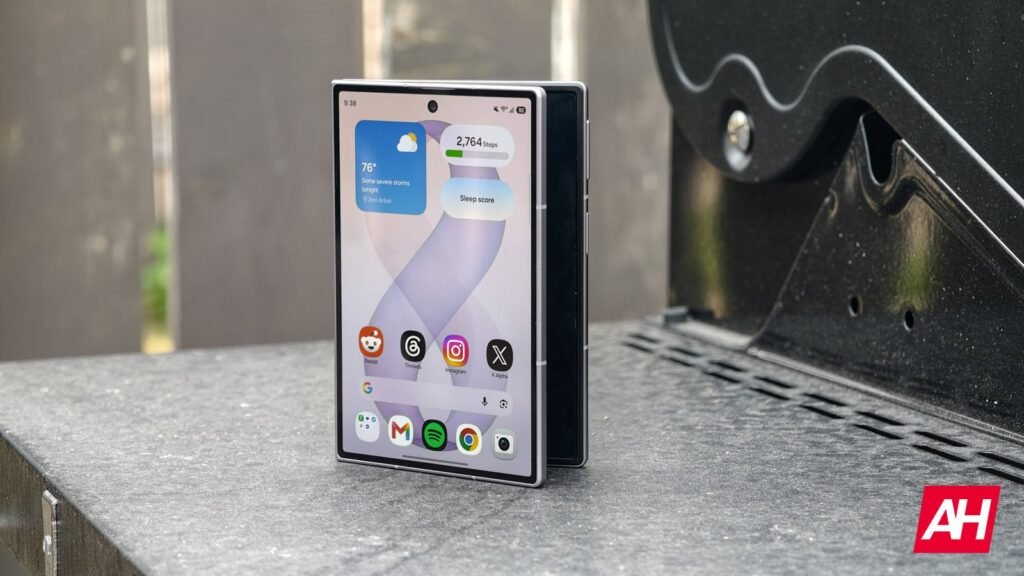

Samsung Display has officially pulled back the curtain on the next-generation foldable OLED panels powering the Galaxy Z Fold 8 and Galaxy Z Fold 8 Ultra. Rather than chasing surface-level marketing gimmicks like marginal brightness bumps, Samsung completely re-engineered the display stack from the ground up. The result is a series of structural, optical, and circuit-level upgrades that tackle real-world pain points like screen creases, panel durability, and battery drain.
Flex Titanium architecture and a 12% thinner module
The most significant physical change is Samsung’s switch from traditional plastic support films to an ultra-thin titanium alloy layer. Dubbed Flex Titanium, this new structural film boasts roughly 20 times the intrinsic rigidity of polymer films. That extra structural stiffness allows Samsung to trim down the overall display module thickness by about 12%.
Making the panel thinner isn’t just about crafting a sleeker chassis—it brings massive mechanical benefits for a foldable. Flexing multiple layers of material creates intense internal tension during everyday folding. By keeping the module slimmer, Samsung reduces shear stress across constituent layers, protecting inter-layer stability and significantly dampening long-term crease formation (via Ice Universe).
Redesigned micro-hinges and monolithic bonding
To keep the screen looking flat when unfolded, engineers overhauled the etched micro-aperture pattern in the metal support plate beneath the folding area. Instead of larger openings that leave unsupported gaps, the new pattern uses smaller, denser perforations. This provides continuous support beneath the OLED panel in order to avoid local indentations over time.
Samsung also introduced a monolithic bonding process across its entire display stack. Combining the OLED emitters, adhesive layers and titanium support plate into a single structure distributes physical impacts over a larger surface area. This smoother force distribution drops peak pressure points, helping the center crease stay subtle throughout years of daily use.
Sharp 422 PPI density and 10% lower power draw
Visual clarity gets a major bump, particularly on the Z Fold 8 Ultra. Its inner display jumps to 422 PPI—a total pixel count increase of over 30%—matching the pixel density of the outer cover screen so your eyes don’t struggle when unfolding. Meanwhile, the standard Z Fold 8 moves to a 4:3 main panel rated at roughly 403 ppi.
To prevent a higher pixel density from tanking battery life, Samsung upgraded its OLED organic material formulation for better luminous efficiency. On top of that, engineers implemented Data-Line Mapping technology. By optimizing signal routing across the driver ICs, the new panels cut overall display power consumption by nearly 10% while delivering higher resolution and brightness.
The post Galaxy Z Fold 8 Display is Sharper, Stronger, and More Efficient: Samsung Explains How appeared first on Android Headlines.