[Disclosure: AgFunderNews’ parent company is AgFunder.]
The security of the global food system is top of mind in 2026 as environmental and geopolitical pressures on supply chains intensify. These pressures aren’t new, but they are accelerating faster than conventional approaches to growing, processing, and distributing food can absorb.
The result is an urgent need for things like drought- and disease-resistant crops, faster laboratory R&D, better crop protection inputs, and new ingredients capable of closing the protein gap in developing markets.
These are, at their core, scientific problems. And solving them requires deeper science and engineering tools than the agrifood industry has traditionally drawn on (GMOs being one exception), which is why a growing number of agrifood startups are turning to deeptech.
“For years, agrifood adopted technology cautiously because margins were thin and systems were complex,” explains Manuel Gonzalez, managing partner at VC firm AgFunder. But today the pressure is existential: labor shortages, geopolitical fragmentation, resource constraints, and the structural change caused by AI are forcing the industry to modernize at speed. Deep tech is no longer optional, it is rapidly becoming core infrastructure.”
We define deeptech as companies where the core defensibility sits in biology, chemistry, robotics, hardware, advanced computation, or scientific IP; this does not include basic AI applications.
Slowly but surely, investment money is starting to follow deeptech startups into agrifood.
Deeptech in agrifood funding
Deeptech’s share of agrifood funding has fluctuated between 21% and 59% over the past decade, according to AgFunder’s recent Global AgriFoodTech Investment report.
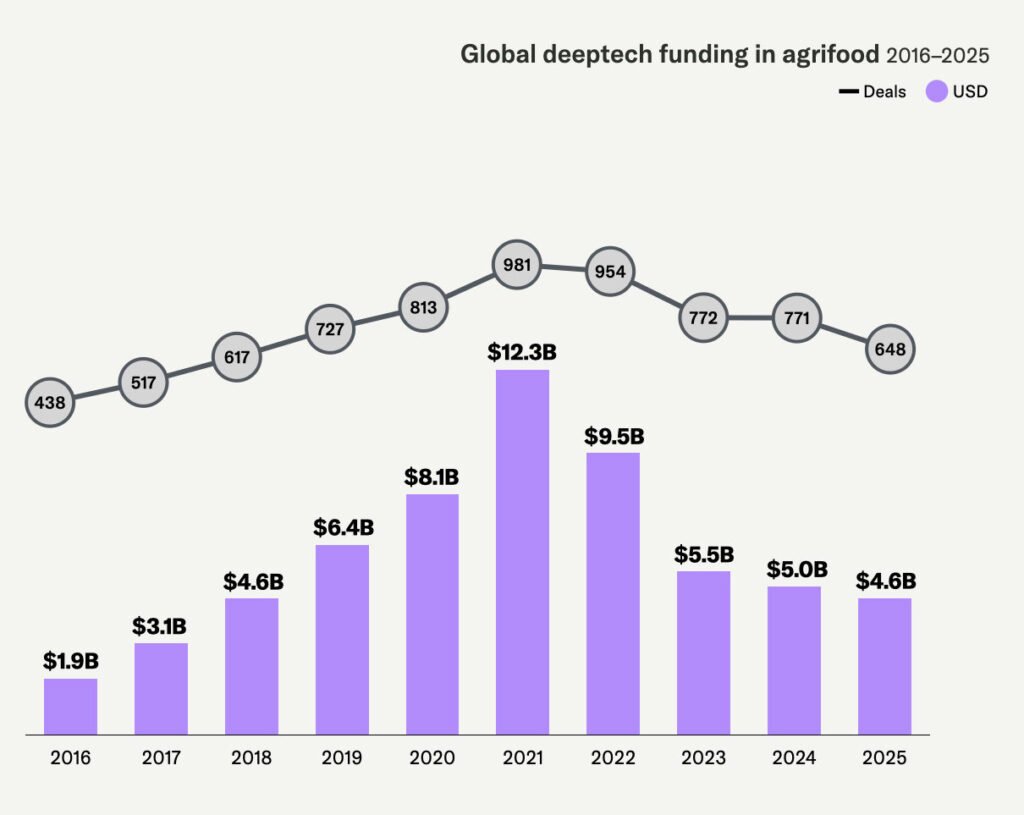
At the 2021 peak, deeptech deal share accounted for 34% of agrifoodtech investment. By 2025, it was 59%. The topline fell, but the deeptech share nearly doubled. All agrifoodtech funding has dropped around 70% since 2021. However, deeptech startups have fared a little better than non-deeptech ones in that time, with funding dropping 62% versus 73%.
Deeptech companies can raise bigger seed rounds. The median deeptech seed round is 78% larger than non-deeptech. Investors can still price scientific promise. They can fund a team, a technical insight, a dataset, a lab result –and scientific promise. But the premium fades from Series B onward where has to price manufacturing, regulation, adoption and scale-up.
But with the advent of agentic AI alongside breakthroughs in synthetic biology, gene editing, molecular discovery, and advanced sensing, timelines are compressing and R&D cycles that used to take a decade into timelines investors can underwrite.
Where deeptech matters in agrifood
Deeptech is not, however, the end-all, be-all answer to all of agrifood’s challenges.
That broadness of the category means startups and investors alike should take care when considering deeptech tools in the context of agrifood.
AgFunder founding partner Rob Leclerc suggests startups and investors alike should consider deeptech on a case-by-case basis, rather than simply turning to such tools by default.
“The best applications of deeptech in agrifood are less about a specific area than about a specific job,” he notes: “Areas where there is too much information for humans to process and areas that require a lot of labor, both skilled and unskilled.”
“Deeptech tools often combine physical technologies with AI, which makes them far more capable and interesting that technologies in the past that lacked the necessary intelligence layer to make them robust, adaptive, and ultimately useful in fuzzy industrial settings,” he adds.
“The highest near-term impact is likely in R&D, where AI and computational tools can compress years of experimentation into months or weeks,” adds Gonzalez. “We’re seeing this across crop genetics, biologicals, ingredient discovery, materials science, fermentation, and food formulation. Scientific discovery itself is becoming a never ending loop working at speed.”
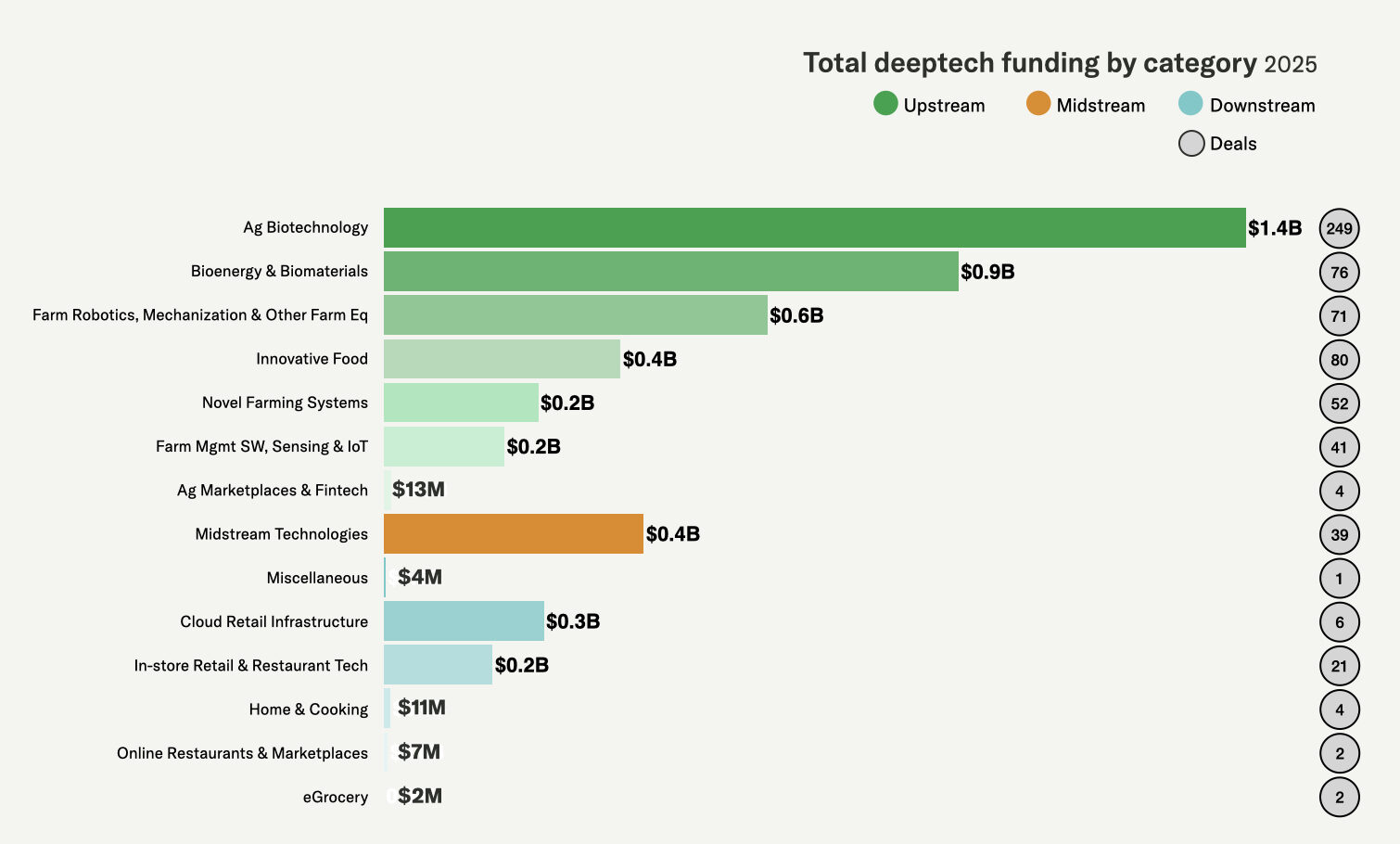
He says the biggest opportunities are where scientific complexity intersects with economic pressure—ag biotech, bioenergy, upstream automation, supply chain digitization, and food-as-health platforms being a few specific areas.
Other investors responding to a recent AgFunder survey cited caution around “AI-washing” in agrifood.
“Seeing pitches where AI is presented as the product rather than a tool. If the tech doesn’t solve a soil, yield, or financial gap, it’s just noise,” wrote one investor.
“AI buzzword” paired with “open source data” – this does NOT make a defensible venture case,” said another.
It’s also worth noting that some deeptech categories—most notably alternative protein and vertical farming—all but collapsed after inflated valuations and promises, and investors still feel the burn. It behooves both startups and those with capital to carefully consider where their time and money is going, and how these tools are implemented.
The post Environmental and geopolitical pressures are driving deeptech’s steady growth in agrifood appeared first on AgFunderNews.