Biosphere—a California-based startup developing UV-sterilized bioreactors it claims can slash biomanufacturing costs—has won a grant from the US Dept of Defense (DoD) awarding $9 million over 3.5 years to fund the development of portable bioreactors producing protein via gas fermentation.
The move reflects a strategic focus on biomanufacturing at the DoD, which is exploring distributed production across multiple scales from skid-sized units to larger facilities for food, materials, and therapeutics in “contested” environments where securing supplies via normal channels is challenging.
This initiative will culminate in a prototype capable of continuous operation with UV sterilization protocols, water and media recycling systems, and downstream processing, says the firm, which was founded in 2022 by materials scientist Brian Heligman PhD and molecular biologist Arye Lipman.
While Biosphere’s core business is providing bioreactor tech to the fermentation industry enabling firms to ditch costly and complex steam-in-place sterilization systems, it has recently acquired IP from a distressed gas fermentation company making “protein from air” that it will deploy in the DoD project, Heligman tells AgFunderNews.
“We made a strategic acquisition that we will be announcing in the near future, but our focus is on making robust hardware systems that can reliably operate in automated ways with streamlined maintenance and operations.”
UV sterilization
For aseptic production biomanufacturing, bioreactors are typically sterilized between batches using capex-intensive steam-in-place sterilization systems characterized by a vast array of pipes and valves, boilers, and a lot of water.
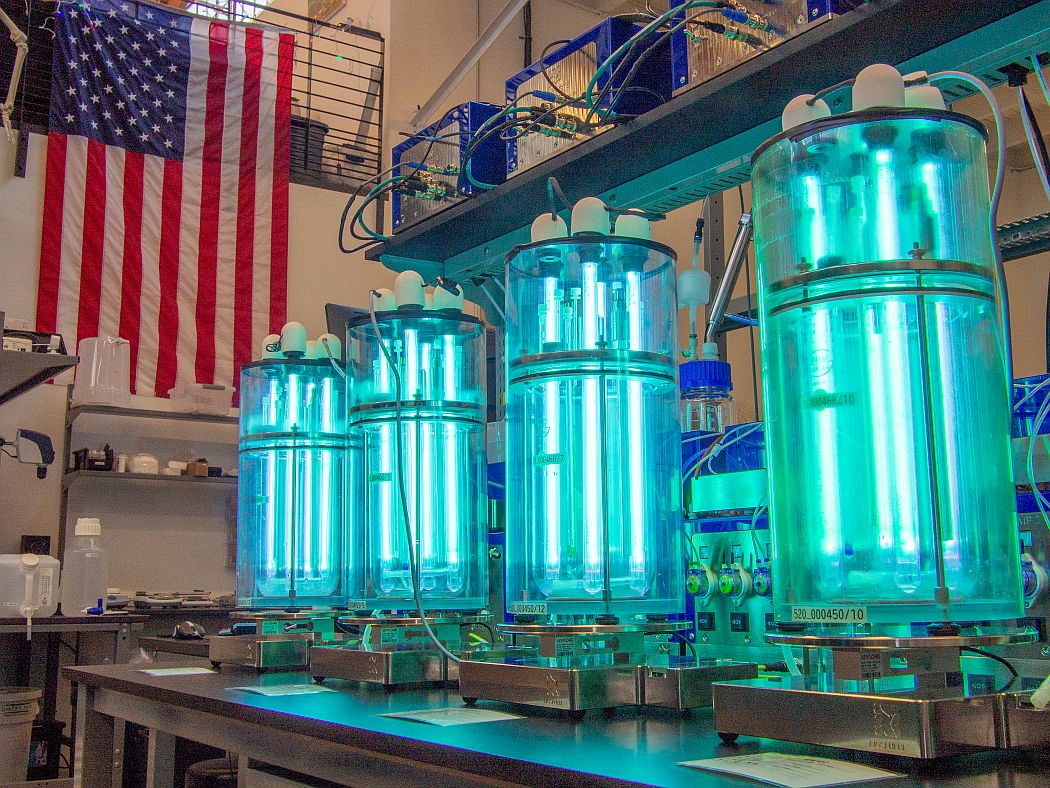
By killing contaminants with UV light instead, firms can reduce capex and maintenance costs, speed up the sterilization process, and develop smaller, more productive bioreactors unconstrained by steam sterilization protocols, says Heligman.
To date, Biosphere has validated the tech at benchtop-scale, advanced pilot scale clean in place systems, and is now working on a 20,000-L demo scale facility, he explains.
Gas fermentation: not for the faint-hearted
The DoD contract around gas fermentation—using gases instead of sugars as feedstocks for microbes—creates room to experiment with more exotic bioreactor designs that would be harder to fund in purely commercial settings, says Heligman.
While gas fermentation technology is best-known for making fuel and chemicals (LanzaTech, Phase Biolabs, and Again), it is also being used by several firms (Calysta, Circe, Solmeyea, Air Protein, Solar Foods, Unibio, Jooules) as a platform for food and feed production. LanzaTech is also moving into food and feed, having honed its tech for ethanol and specialty chemical production.
Using gases instead of sugars to feed microbes can lower input costs and allow for longer campaigns (because there is less risk of contamination), and potentially leverage waste or byproduct gases.
It’s not for the faint-hearted, however. Specialized bioreactors optimized for effective gas-liquid mixing and safety measures for handling gases can add to capital costs, and some of the sustainability claims don’t necessarily apply to first-generation plants.
Scaling the technology is also expensive, and finding affordable, sustainable sources of “green” hydrogen can be challenging, say key stakeholders in the space, which has seen some high-profile failures over the past couple of years (Novonutrients, Arkeon).
According to Heligman: “We see our technology as helping address some of the challenges facing gas fermentation around bioreactor designs for mass transfer [getting poorly soluble gases from bubbles into the liquid phase and then into microbial cells quickly enough to sustain high productivity], around sterility, around low cost, less capital-intensive scale up.
“The hard part with gas fermentation is that dissolving things like hydrogen, carbon monoxide, and carbon dioxide in water is challenging as they have pretty limited solubility. How do you get the types of liquid mixing, gas delivery and heat removal that are even more pressing in gas fermentation?
“If it were not for this public sector opportunity [the DoD grant], it’s hard to prioritize gas fermentation as the scale that’s required is [typically] much larger, but it is a sector that we believe in.”
Down the road, he adds: “We could very much imagine partnering with a gas fermentation company on a technology licensing or joint venture type deal in the future. [The public money] provides us with more ability to explore more exotic bioreactor designs, whereas for the private sector, a lot of our focus has landed on more conservative approaches that people are familiar with.”
The picks and shovels of biomanufacturing
Ultimately, a variety of enabling technologies from UV sterilization to tech from firms such as Fermeate and Enduro Genetics to make cells more productive will help unlock more favorable unit economics in biomanufacturing, says Heligman.
“I see a bunch of both vertically integrated companies pursuing innovations and companies with enabling technologies. What Enduro Genetics is doing is in a lot of ways, complimentary to what we’re doing. Its whole focus is how do you improve the genetic stability of strains for long fermentations? And if we can provide more performant reactors that are well instrumented with advanced controls, that’s highly synergistic. ”
He adds: “It’s always tricky with multiple early-stage companies to figure out the right way to collaborate, but I have a lot of respect for what they are developing. And if someone ever were to run a strain with their technology in our reactor, I think that would be a very performant process.”
Further reading:
Arkeon CEO delivers postmortem on ‘protein from air’ startup: ‘We just simply ran out of time’
The post Biosphere lands Pentagon funding to build portable “protein from air” bioreactors appeared first on AgFunderNews.