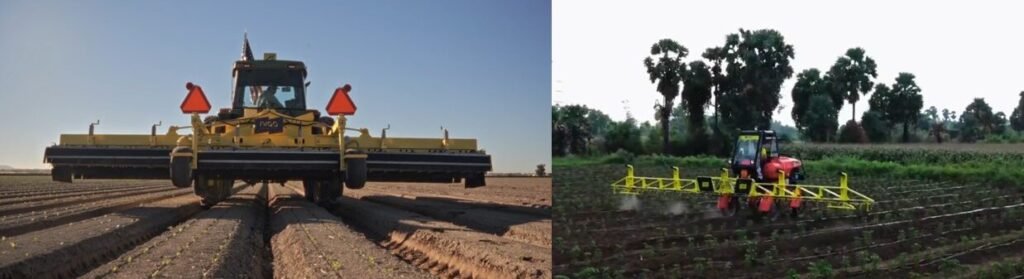
Indian ag robotics startup Niqo Robotics is expanding its US operation beyond lettuce into a broader range of specialty crops and launching an upgraded version of its weeding robot later this year, says the firm, which is “on track for profitability for financial year 2026-27.”
The next-generation RoboWeeder “is an evolution of our current platform, focused on advancing AI performance, operational efficiency, and versatility in the field,” says founder and CEO Jaisimha Rao, who says new crop libraries also enable existing models to tackle crops including onions, tomatoes, broccoli, kale, melons, and turf grass.
Founded in 2015 by Jaisimha Rao as Tartan Sense before rebranding as Niqo Robotics in 2022, the firm now has 50-plus units operating in India and 11 deployed in California, Arizona and Georgia, Rao told AgFunderNews. The next area of focus is turf grass in the Pacific Northwest.
But AI does not dominate the pitch, said Rao, who says some growers are feeling a little jaundiced when it comes to agtech and AI-laden pitches: “Are growers ag-teched out? Yeah, there’s bit of that. It’s here we go again, here’s another video. AI is going to change the world, robots are the guardians of your land…
“We know not to over-sell AI. Farmers. When they invest in a robot, just want to know when it will pay off, what’s the maintenance like, and how it will make me money or save me money. I grow coffee [in India]; I’m a farmer myself, and at the end of the day, it’s all about how much do I put in and when do I get it back?”
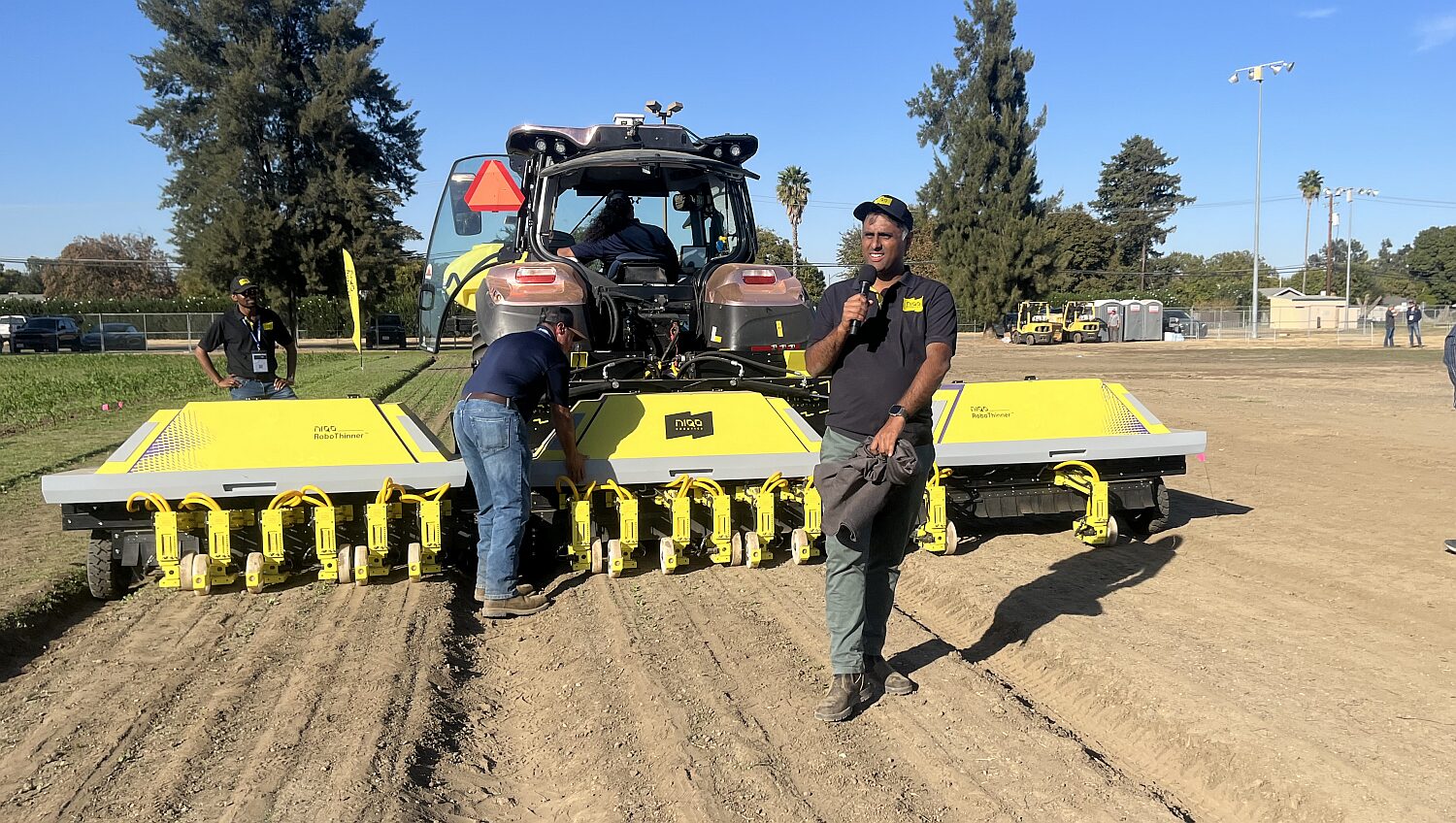
He added: “Essentially, I tell people we are in the farm implements business. It’s a machine that attaches to a tractor. Ours is about 20 feet wide, and in that 20 feet there are 12 cameras that are able to discriminate between a crop and a weed.”
Payback in 12-18 months
Payback time depends on the implementation, he said: “In California and Arizona, it’s mainly about labor savings. So currently, the way lettuce is thinned and weeded is manual, and you can estimate that costs $185 to $200 an acre, and our unit costs $350,000.
“Before heading into the season we thought each one of the units would do about 1,000 acres. But on average, our first five units averaged about 1,500 acres [per season]. And if you do 1,500 acres times $200 an acre, that’s $300,000 you could spend on a hand crew. Now our machine is able to completely replace them.
“So when you think about ROI we think it’s anywhere between 12 to 18 months.”
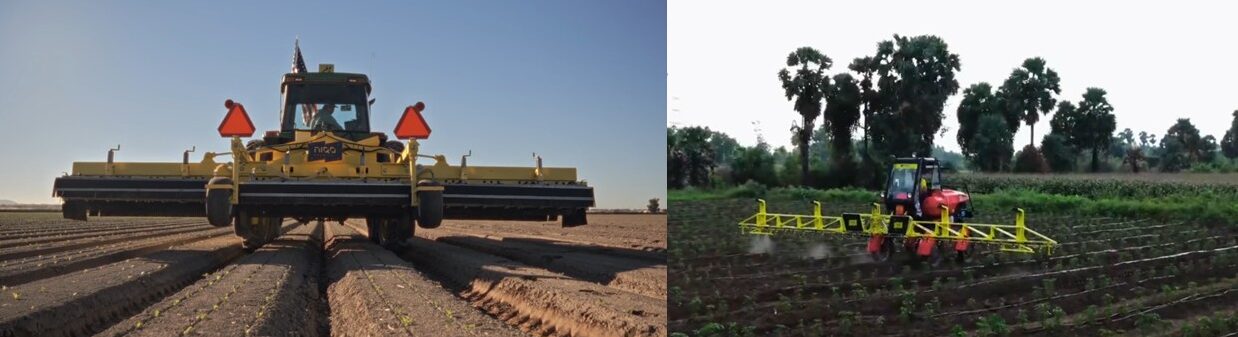
Niqo Robotics has two core products:
👉 RoboWeeder (left): spot spray system for precision weeding, thinning, and beneficial spraying in a single pass using Niqo Sense, a proprietary computer vision system. The tech is retrofitted onto a tractor and targets specialty crops such as lettuce, onions and broccoli.
👉 RoboSpray (right): spot-spray offering also using Niqo Sense, with the tech stack integrated into a self-propelled boom sprayer. The flagship product in India, it is designed to spray beneficials such as pesticides, insecticides, and fungicides, optimized for crops such as cotton and chili peppers, and engineered for small- to mid-sized farms in emerging markets.
The business model
While some players are deploying a “robotics as a service” or RaaS model, this doesn’t make sense for Niqo, said Rao.
“You’re basically subsidizing the farmer. Plus, if you go to a farmer and say, I’ll charge you $250 an acre for robots as a service, any farmer will say yes, because he’s buying a very small ticket size, so you never get a true, clear indication of whether you have product market fit.
“Only when you go to a farmer and say it’s $350,000 to buy this do you get a clear answer on that.”
Similarly, Niqo does not sell directly to farmers “because you cannot compete with the relationship that a dealer has with the farmer,” he claimed. “Yes, the dealer takes a commission, 20 to 25% is standard, but it’s the only way to handle scaling up, and also the reality is: Will Salinas growers trust a bunch of Indians selling them a product at $350k?
“The answer [from farmers] is ‘I’m going to buy a tractor from this dealership that’s been in this game for multiple generations and I trust him over you,’ so we don’t try to reinvent the wheel.”
The competitive landscape
For spot spraying specialty crops in the US, Niqo is competing with Verdant Robotics [disclosure: AgFunderNews’ parent company AgFunder is an investor], Ecorobotix (precision spraying), and Carbon Robotics (laser weeding), he said. “Probably it’s the four of us right now trying to win wallet share of farmers. All of us are offering farm implements that can be attached to any tractor.”
Unlike other players in the space, meanwhile, Niqo does not charge a recurring subscription fee for software, he said. “Once you buy the unit, it’s yours, although we do sell a maintenance package that covers anything that goes wrong with the cameras, the in-cab display and so on.”
That said, Niqo’s equipment is pretty robust, he claimed: “We have sprayed 200,000 acres in India and we have the Indian monsoon, and out of 250 cameras deployed over three years, eight failed. So we’re pretty happy with the robustness of it.”
Manufacturing and scale up
Manufacturing for Niqo Robotics products sold to US customers has now moved from India to the US, although the cameras still come from India, said Rao.
“We moved production to the US before the tariffs kicked in, mainly for grower satisfaction, but thank God we did that. Had we not done that, for a time, being in India would have been the biggest liability because Trump decided to put 50% tariffs on India, although that changed subsequently.”
Asked about production costs, he said: “There are a lot of supply chain headwinds. It almost feels like covid is coming again, mainly because we run on Nvidia chips.”
Surging demand from hyperscale data centers is soaking up Nvidia chips and memory, leaving smaller robotics firms facing higher costs with longer lead times and limited bargaining power, he claimed.
“The amount of capital that is going into AI data centers, all the chips, all the memory, they’re getting sucked in, and a dinky little robotic startup is bottom of the totem pole.”
Next steps
Looking ahead at where to focus resources, he said: “We see a big opportunity in turf grass in Washington and Oregon. Onions in the US are also a big crop, but that is more of a chemical reduction story right now [rather than a labor-saving story] as right now there’s not too many humans involved.
“We are also extremely bullish on the Global South, where the biggest problem is finding dedicated high-quality labor to do weeding.”
John Deere See & Spray is a “wonderful piece of technology,” he said, but Niqo and Verdant Robotics et al are not competing directly with this tech, which has thus far focused on broad-acre crops such as corn and soy, he claimed.
“Our growers generally want way higher precision, and they’re okay with less speed, so we go at four miles per hour, whereas on row crops, growers don’t even like going as slow as 14 mph. They want to go at 18mph. The level of complexity and engineering [needed] for row crops is a different animal.”
He added: “I think the US business will keep the lights on, pay our salaries. But ultimately, the real growth comes in the Global South, where the go to market is probably a little bit different. Is it directly with an OEM? Is it white labeling? Is it us selling direct? These are the things we need to navigate, but that’s the way we’re looking at it.”
The road to profitability
While some other precision ag robotics players got into the US market earlier, he said, “I’d say there’s a second and third mover advantage, and the reason I say that is there is some amount of education that the previous guys have done. They have managed expectations.”
Niqo’s “sales target for this financial year [2026-7] is to become profitable as a group entity, and that’s a big deal for us,” said Rao.
“The biggest benefit is we control our destiny. We love our investors, but venture capital has its pros and cons. As soon as you’re profitable, you get to decide whether you get more capital for growth, or do you run your business frugally with the current cash flows coming in?”
Further reading:
Ecorobotix doubles down on AI software for precision spraying after $150m raise
Frontier AI heads to the farm with Carbon Robotics’ Large Plant Model
Solinftec’s self-refilling spray robots close the loop on 24:7 autonomy on the farm
Exclusive: RootWave bags $15m to expand its chemical-free weeding platform to Europe, US
The post Niqo Robotics expands reach, targets profitability in 2026/7: ‘Farmers don’t want AI hype—they want ROI’ appeared first on AgFunderNews.