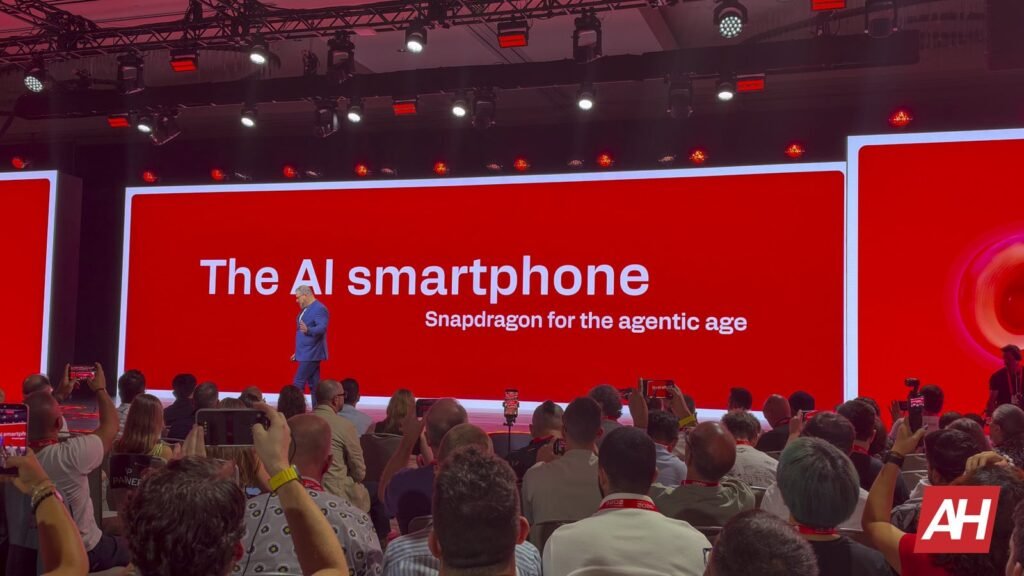

For years, many have speculated about what comes next after the phone. Many think we’ll move towards smart glasses or some other type of wearable, but Qualcomm’s CEO, Cristiano Amon, believes the phone will remain the hub.
Interestingly, we heard Apple say something similar to kick off its iPhone event earlier this month.
In our Q&A with Chris Patrick, SVP and General Manager of Handsets at Qualcomm, following today’s keynote, he agreed that the phone will remain the hub, even if the form and name change in a few years. Qualcomm’s incoming SVP and GM of its Premium Mobile Tier, Dino Bekis, shared this sentiment, even though others at Qualcomm have different views, including PC-first and watch-first visions.
Patrick expects some form of the phone to remain the central device, explaining that it may eventually have a different name or change modestly, but users will still need a device with battery, storage, WiFi, and enough computing capability to aggregate other devices. Essentially, the industry has arrived at a useful form factor, although a distributed collection of devices could still replace it in a more radical future.
While other form factors are trying to replace the phone, what really sets the phone apart is its visual aspect. An example given during our Q&A was a navigation request from Starbucks, which would still benefit from a screen showing which location the system selected. Maybe you don’t want the one on Main St., but one a bit further away, and you don’t know the name of the street it is on. This extends beyond navigation, as a display would give users a practical way to check details.
Apps will coexist with agentic interfaces
Another feature that Patrick believes will stick around is apps. They’ll need to stick around for the agentic interface. In many of the demos, you’ll see Qualcomm telling the Agent to “call me an Uber” rather than “call me a ride” or simply “a car”. So it needs apps like the Uber app to get that done.
Patrick believes that eliminating apps will be very difficult and the transition will be long, though some developers are building app-free interactions through WebSockets and other mechanisms. It’s unclear whether those approaches will become universal.
App and service owners would also need to distinguish between human and agent activity. Automated user-interface control could work with almost any app, but Chris called that method crude. Large services are more likely to expose APIs, MCPs, and similar mechanisms. These could let them identify, segment, throttle, or enrich agent interactions.
Agents could disrupt existing business models. Spotify and similar services derive value from user behavior, advertising, screen exposure, and subscriptions. If agents choose songs, pizza, or other products without showing the source, they shift attention and value between companies. Chris expects network effects to push major providers into the agent economy. Companies that refuse could lose distribution, much as sellers can lose channels by avoiding Amazon.
While we have other computing devices, the phone’s not going anywhere
This is a pretty stark contrast from a few years ago, when many thought that the phone would go the way of the dinosaurs in a few years, due to AI becoming the UI and replacing your personal device. But to be honest, your phone is going to get even more personal over the next several years.
The post Despite AI and Smart Glasses, Qualcomm Believes the Phone Will Always Be the Hub appeared first on Android Headlines.