In places where one tectonic plate dives beneath another, immense earthquakes—and destructive tsunamis—can readily result. Researchers have now looked into the maw of one such subduction zone to better understand its thermal structure. By examining a rock from Papua New Guinea, the team learned that temperature increased more rapidly than expected in the shallow parts of a subduction zone before following a more usual gradient. This finding—of two kinds of subduction recorded in the same rock—could help refine models of subduction zones, the researchers suggest. Their work was published in Nature Geoscience.
Down and Up Again
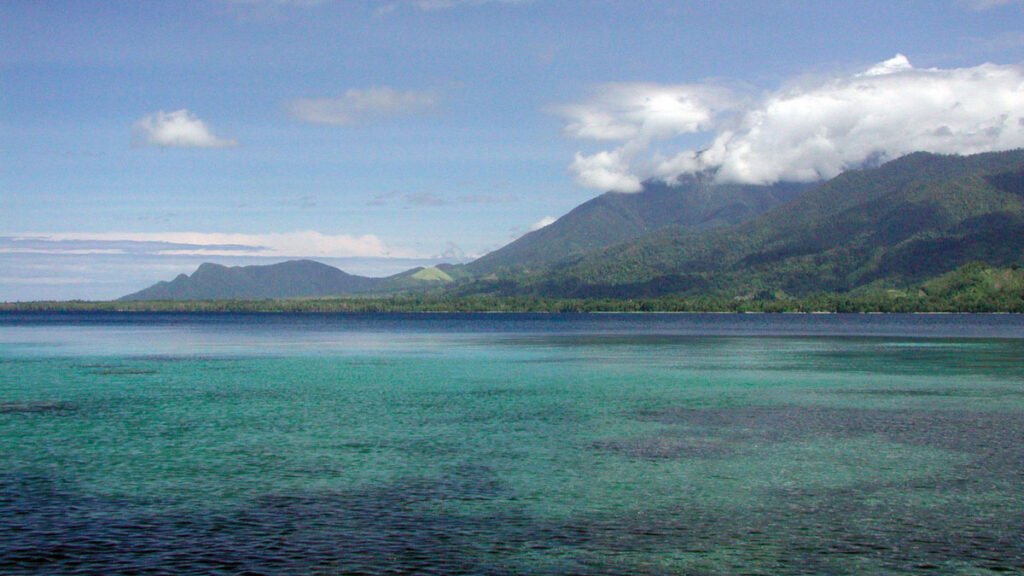
Papua New Guinea, located north of Australia, is an island nation caught in the throes of subduction. There’s a veritable mash-up of tectonic plates there, said Suzanne Baldwin, a geologist at Syracuse University. “It’s extremely complicated.” For several decades now, Baldwin and her colleagues have been visiting Papua New Guinea and studying its rocks, some of which have journeyed deep into Earth and then returned to the surface.
“You have rocks that are being actively exhumed.”
Such deep-diving rocks can help reveal the inner workings of a subduction zone, and there’s no shortage of such material in Papua New Guinea, said Silvio Ferrero, an Earth scientist at the University of Cagliari in Italy. “You have rocks that are being actively exhumed.”
Baldwin and Ferrero are part of a team led by Jan Schönig, a geologist at the University of Göttingen in Germany, that recently analyzed one such rock. The specimen, collected in the early 2000s from Goodenough Island in eastern Papua New Guinea, is what is known as an eclogite. Eclogites are characteristically red and green in color, and they are often composed of minerals such as garnet and omphacite. They’re a hallmark of high-pressure conditions, like those found within subduction zones.
Minerals All the Way Down
Schönig and his collaborators focused on mineral inclusions within the eclogite’s garnets. “The garnets contain mineral inclusions themselves,” said Baldwin. “It’s nested minerals.”
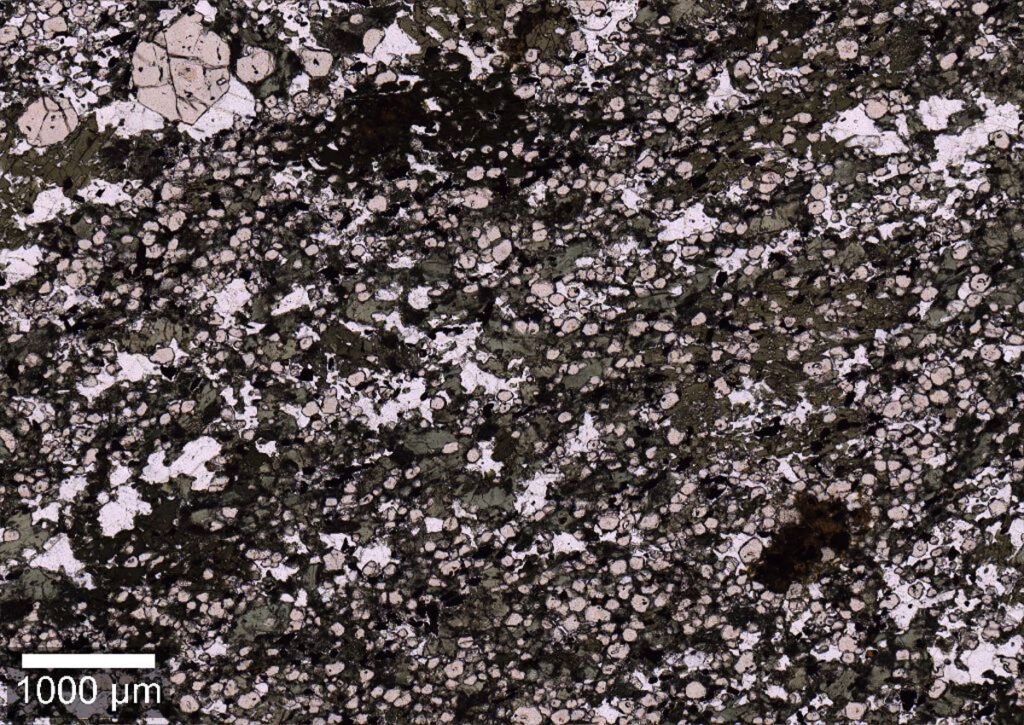
Those inclusions were coesite, a type of quartz that forms only deep within Earth under extreme pressures. “That phase is unequivocally evidence for very high pressure,” said Ferrero.
Schönig and his team showed that coesite and other pressure- and temperature-sensitive minerals varied in abundance depending on where in the garnets the researchers looked. For instance, the deep interiors of the garnets showed no coesite, suggesting that those regions formed at relatively shallow depths in Earth’s mantle, at pressures insufficient to produce coesite. The more peripheral regions of the garnets, on the other hand, contained coesite in abundance, strongly hinting at higher-pressure conditions.
“This garnet was preserving two different moments of its trajectory.”
Using a combination of laboratory analyses and modeling, the researchers estimated that their rock recorded temperature and pressure conditions at two distinct locations along its subsurface journey—one at a depth of about 45 kilometers and one at a depth of about 90 kilometers. “We were lucky enough to find this garnet was preserving two different moments of its trajectory,” said Ferrero.
It’s rare to have that much information preserved in one specimen, said Cailey Condit, a geologist at the University of Washington not involved in the research. This rock’s metamorphic history was likely preserved because it traveled relatively rapidly through Earth’s mantle—Schönig and his colleagues estimated that it traversed more than 60 millimeters per year in the vertical direction. “That’s very fast,” said Condit. “There’s not time for [prior conditions] to be overprinted.”
Why So Hot?
Schönig and his colleagues used their estimates of temperature and pressure to calculate the geothermal gradients experienced by this rock. The team found that at relatively shallow depths, their sample had been heated much more rapidly than models of subduction would suggest. “The first gradient is much hotter than anything else that has been proposed,” said Ferrero.
One explanation for this finding is a familiar one, albeit applied on a grand scale: frictional heating. Untold quantities of cold rock are moving past one another in the first few tens of kilometers of a subduction zone, before they begin melting at greater depths. “You have massive volumes of stuff that are scraping by,” said Ferrero. Capturing such heating in models is complex because its magnitude depends on factors such as the velocities at which rocks are moving and the geometry of the subduction zone.
There’s also an idea that the thermal properties of a subduction zone might be affected by its age. The region of the mantle surrounding the downgoing slab might be hotter in a younger subduction zone for the simple reason of dilution—cold crustal material hasn’t had as much time to descend and mix into the mantle.
These findings add to our knowledge of subduction zones and their inner workings, said Condit. But investigating whether these results hold true beyond Papua New Guinea will be important, she added. “It would be really nice to see this reproduced across more samples.”
—Katherine Kornei (@KatherineKornei), Science Writer
Citation: Kornei, K. (2026), Deep-diving rocks reveal a subduction zone’s thermal secrets, Eos, 107, https://doi.org/10.1029/2026EO260353. Published on 6 November 2026.
Text © 2026. The authors. CC BY-NC-ND 3.0
Except where otherwise noted, images are subject to copyright. Any reuse without express permission from the copyright owner is prohibited.