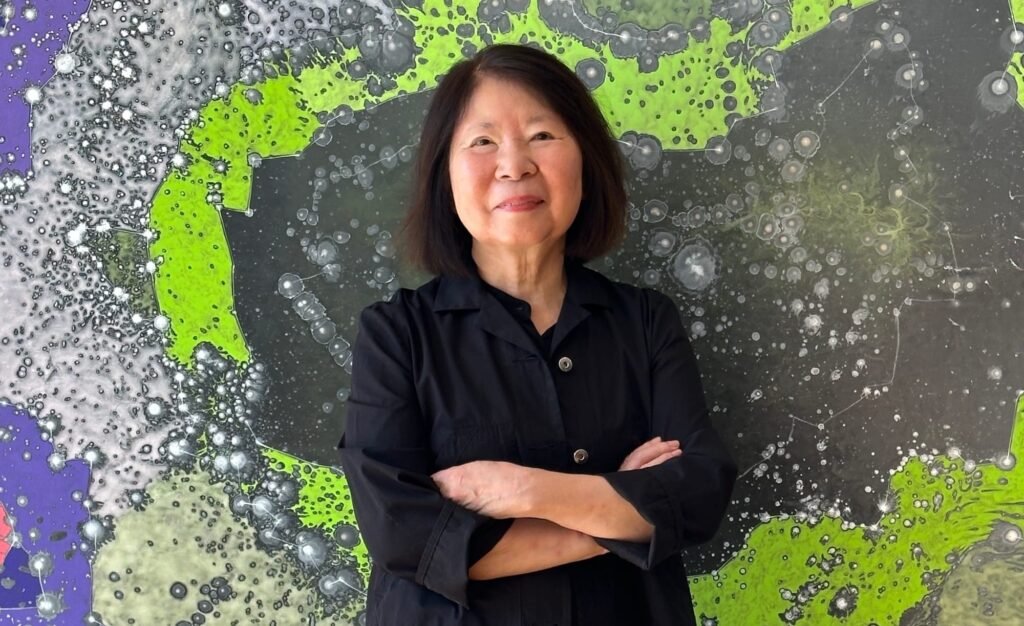
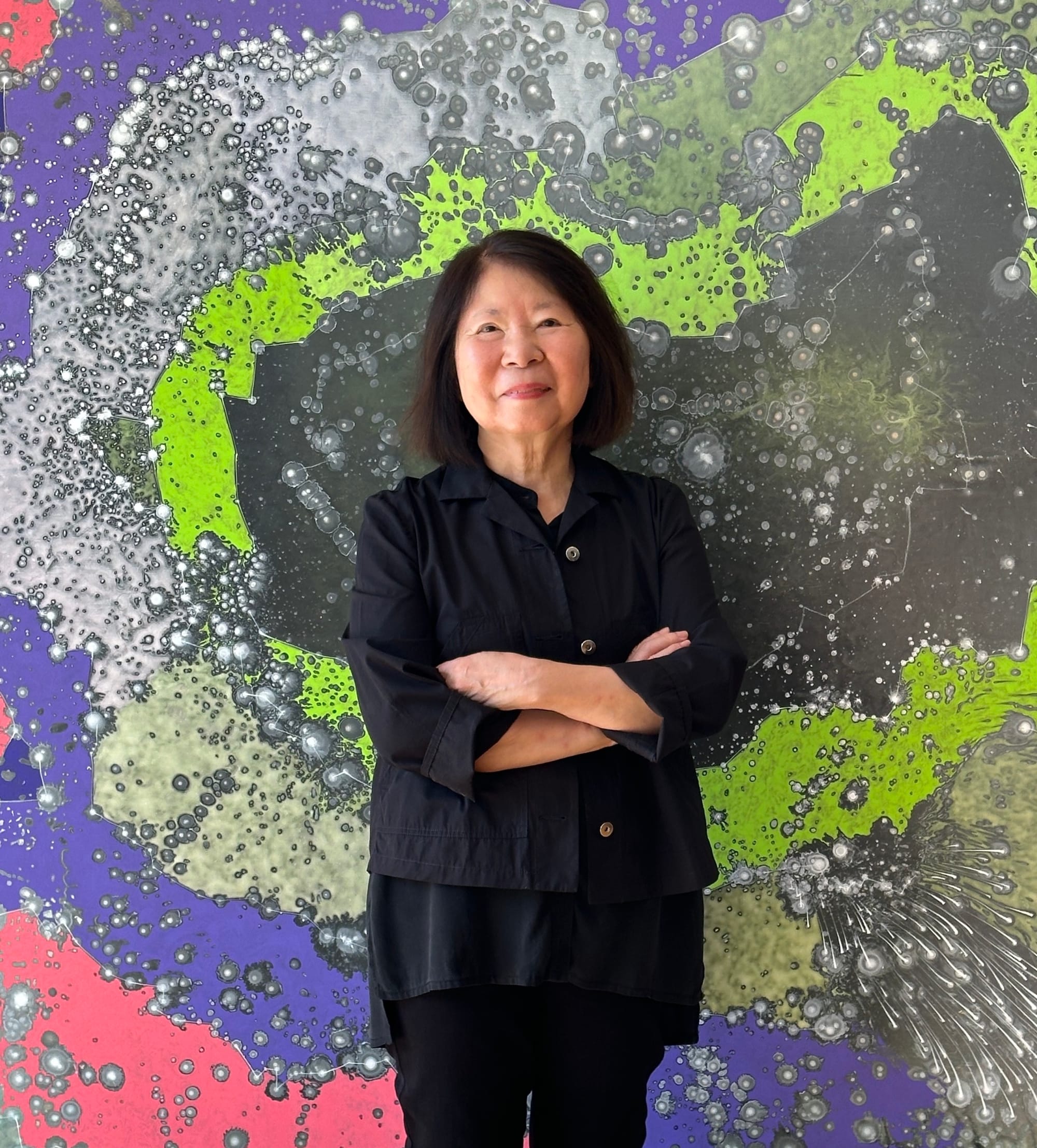
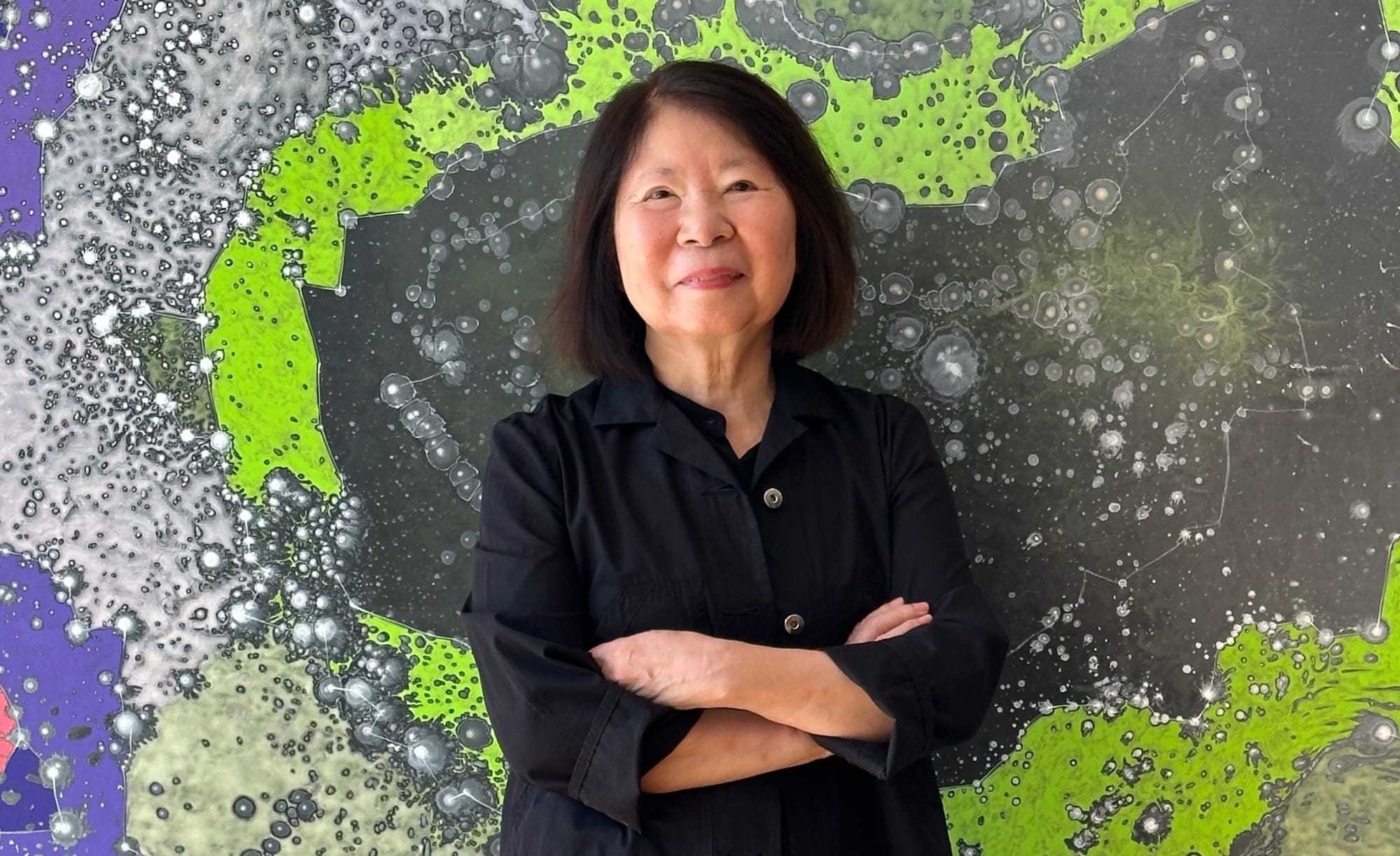
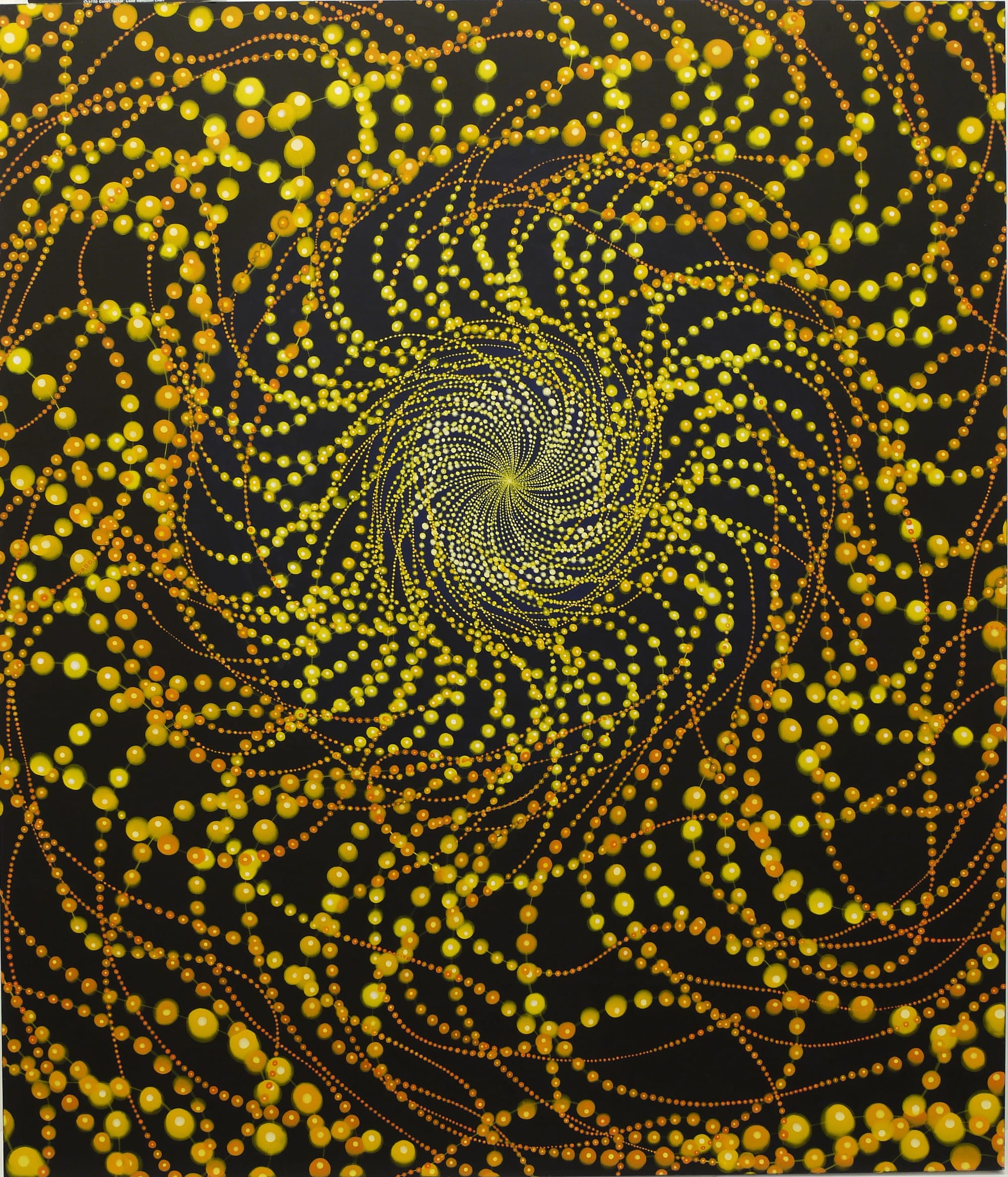
With tiny filaments of paint that repeat into monumental surfaces, Barbara Takenaga’s paintings thrill and seduce but do not rest in their elegance. They suggest menacing storms, disintegrating shapes, unknowable black holes, awkward interactions, and bodily processes. Takenaga describes herself as a process painter, and her work requires a stunning amount of labor. But it isn’t perfection that she is after: She values the fourth-wall breaks that disrupt illusions and the elements that throw off purist systems. As a person, she has a wry sense of humor and a humility that connects to the humanity and interruptions visible in her work.
One side of Takenaga’s Manhattan studio is loaded with all of her tools — careful stacks of acrylic paint jars, cups, baskets of small brushes, and books and reproductions posted on the wall — while the other side is completely open, its wood floors leading to windows overlooking the Flatiron District, lined with potted plants soaking up the light. In some ways, it feels like an echo of her paintings’ composition, with their deep space, dramatic horizon lines, patterns that coalesce into voids, and shapes that mass into tornado-like forms.
Takenaga and I spoke about her childhood in Nebraska and her overwhelming ambition to fit in as one of the only Japanese Americans in her school. But over time, her work has more freely acknowledged her identity as Asian American in conversation with the Midwest landscape. Her recent paintings embrace a longstanding interest in Asian art. They riff off woodblock prints of kabuki actors in kimonos, turning undulating folds of textiles into abstracted, universally evocative shapes. Her time studying literature in Boulder, Colorado, continues to influence her painting, where she looks for a balance of opposites.
Takenaga was born in North Platte, Nebraska, in 1949 and received her BFA and MFA from the University of Colorado, Boulder. She taught art at Williams College from 1985 to 2018 and has been the subject of museum exhibitions including Barbara Takenaga: 20 Year Survey (2017), curated by Debra Bricker Balken at the Williams College Museum of Art; SPACE | 42 (2017) at the Neuberger Museum of Art, in Purchase, New York; and a 2015–17 large-scale wall installation at the Massachusetts Museum of Contemporary Art. In October, the Kemper Museum of Art in Kansas City, Missouri, will open a major survey of Takenaga’s work from the past 25 years.
Hyperallergic: You grew up in Nebraska. Did you look at art, or draw as a child?
Barbara Takenaga: I grew up in North Platte, Nebraska, and I only saw art in reproductions in books. In those days, there weren’t after-school art programs for kids in my town. But my mother picked up on my interests and tried to help foster my creativity. When I was about 10 years old, she took me to the next-door neighbor, who was making artificial flowers.