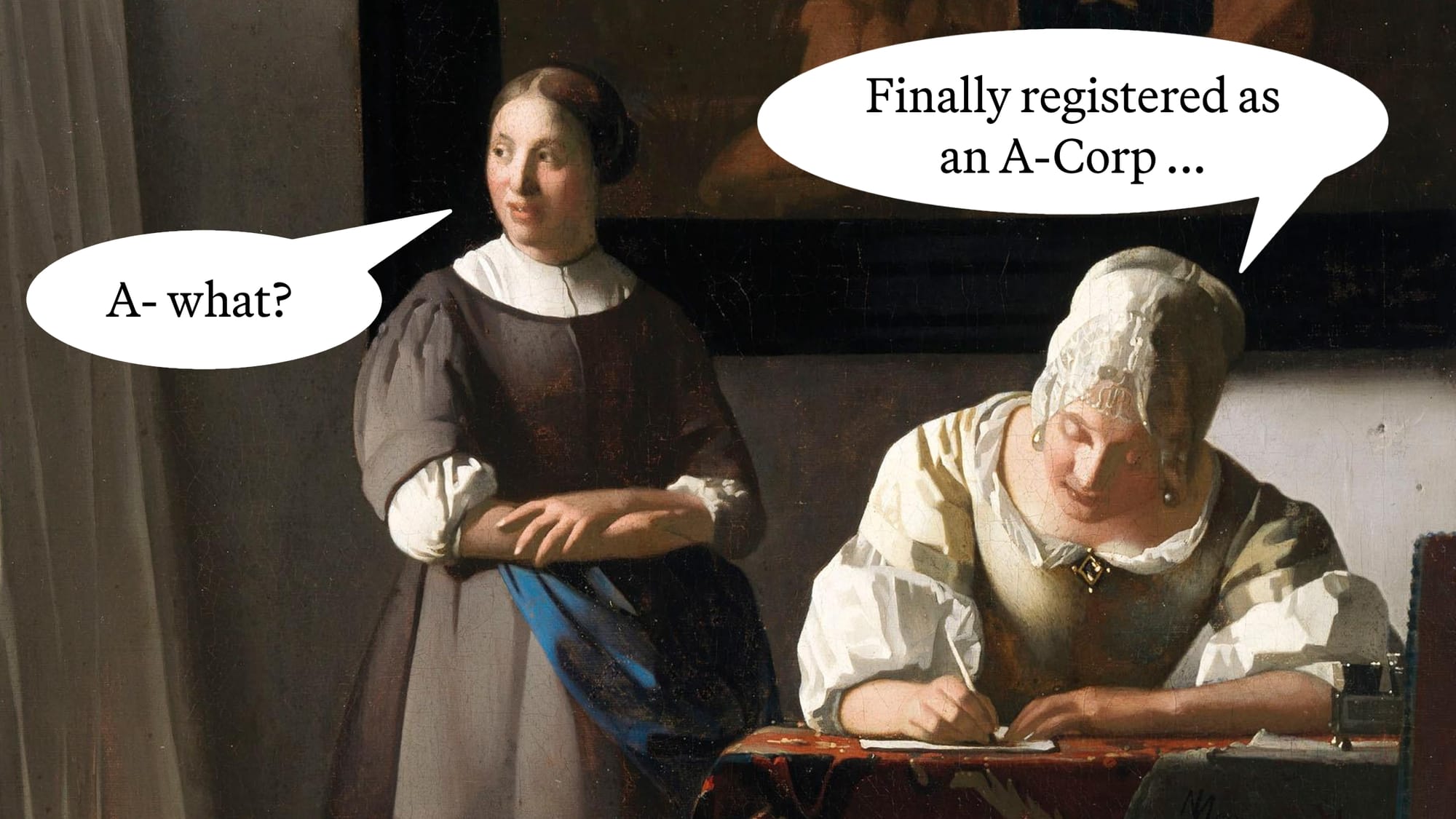
I keep reading about this A-Corp thing in Colorado, but I still don’t know what it is, let alone if I need it. Can you help? —Confused in Colorado
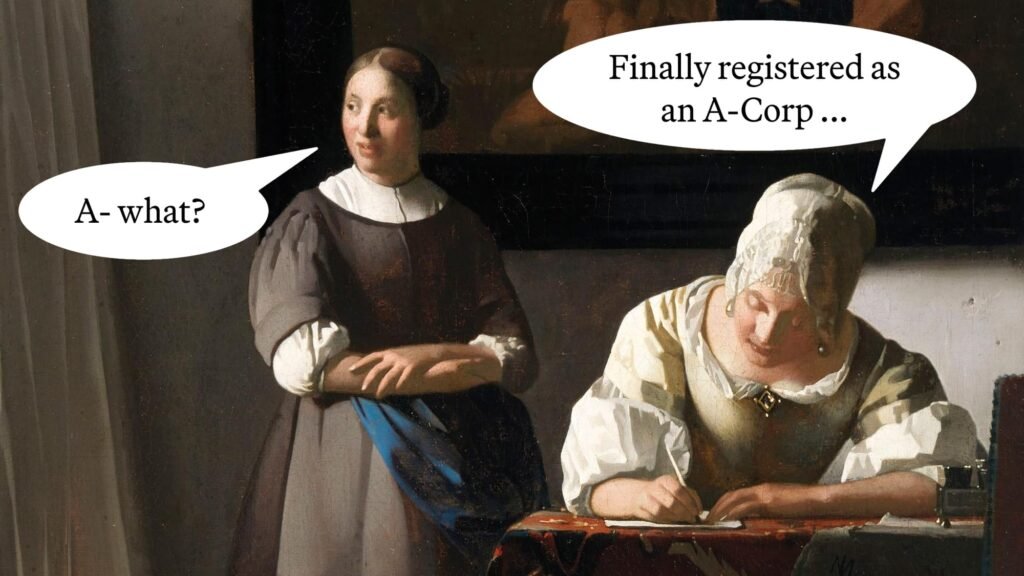
I sure can. An Artist Corporation or A-Corp is a new type of business structure for artists in a bill introduced in the Colorado state legislature, first proposed by entrepreneur Yancey Strickler. To understand why it’s relevant to you, we need to back up a little.
As an artist, you are a small business owner. You choose what type of business you’ll operate when you start making money. For most visual artists, this means filing taxes as a sole proprietor, which means all you need is your Social Security number. Filing as any other type of business requires paperwork to receive the status.
You’ve heard of all the other types of businesses before — corporations, nonprofits, and LLCs, just to name a few. All require lawyers and administrative work to form, which may be worth it, if you want the benefits.
That’s the main problem the A-Corp solves. It allows you to create a business specifically designed for creative people without hiring a lawyer. All you need to do is fill out a form. Easy!
Now, you’re probably wondering why you need a special business designation in the first place, if the sole proprietorship was working just fine for you.
Most visual artists actually don’t need an A-Corp. However, you might want some of the benefits. At a minimum, it creates a legal separation between you and the business, which means if someone decides to sue, they’d go after the company, not your personal assets. If you’re making any kind of public art, you’d want this protection. You can get this from a regular LLC, too, but the A-Corp formation is easier because it allows you to fill out a legally binding form that creates an operating agreement without needing to hire a lawyer.
The good news is that you don’t have to live or operate your business in Colorado to form an A-Corp. If the bill passes in Colorado, artists living anywhere in the United States and potentially beyond will be able to create one. Strickler told listeners of the podcast New Creative Era that it’s on track to be on the governor’s desk by mid-May and enacted within six months. So, you can’t form one now, but if all goes well, you should be able to before the end of the year. (Strickler hinted that five or six other states have expressed interest in the A-Corp bill, including New York, on that same podcast.)
The rest of the benefits currently better suit musicians, filmmakers, NFT artists, and large collectives like Meow Wolf — artists with predictable, recurring revenue streams. In these cases, it makes sense for an investor to purchase shares to buy into the company’s future earnings. It makes sense, then, the A-Corp requires artists to maintain 51% voting rights and have a stated artistic mission. The last thing you want is a bunch of investors deciding what your art should look like.
But what if the A-Corp isn’t about what art looks like today but rather what it could look like tomorrow? Ultimately, the A-Corp isn’t about cutting down on paperwork. Instead, it aims to lay the groundwork for a more equitable business environment for everyone.
Here’s the problem as Strickler sees it: We’ve lived through several stages of business developments that have had catastrophic consequences across industries, including the arts. That includes a world run by social media giants that platform and incentivize extremist views, destroy the media environment, and make it impossible to find reliable information. We’ve moved to a subscription-based world that has also resulted in many of us over-subscribing to everything. And now we’re moving to smaller, moderated, private platforms.
If we moved to private communities where we owned our content and could monetize it ourselves, perhaps we wouldn’t be so beholden to giant tech companies. Maybe more extreme views wouldn’t be incentivized because they don’t tend to work well in smaller groups that require accountability to function, as well.
As it turns out, Strickler’s next project, Dark Forest Operating System, purports to offer just that. The idea is to create an entire ecosystem of collaborative artist-led communities, which would own their creative materials and charge for them. They would be able to join together to create a federation of A-Corps, pooling members to hit the thresholds that unlock true group insurance — the kind tied to employment, not the individual market plans most artists are stuck with. If you’re an artist unable to afford a good healthcare plan, a structure like this could be transformative to your life.
Of course, all of this is currently theoretical, including the bill proposing A-Corp itself. As Andrea Yang writes in the Cardozo Law Review, “Until this structure passes into law and artists begin to implement A-Corps into their lives, it is unclear whether the structure outlined will provide all the solutions that it proposes to solve.” We don’t know how A-Corps will operate in practice, nor what the online world will look like even three months from now. Yet, the willingness to think long term in an Amazon-Meta-AI media environment models a bravery worth emulating.
In the latest episode of New Creative Era, “Cake in a box,” Strickler laid out what I believe is the most compelling argument for the A-Corp. “The soul of a project is defined from how it starts,” he said. “It’s about who it is, it’s about what their motivation was, how that brought people in … Things that you don’t think will show up, end up showing up over time.”
Think of all the projects started by artists with no thought about long-term sustainability. So often, those projects are stunted by founders who didn’t pay themselves, setting a precedent that got baked into the business model. I’m not saying that every project needs to have a profit motive, but if you decide that art is what you want to do for the rest of your life, then you have to figure out how you’ll make money. In that case, maybe forming a slightly tedious LLC that forces you to make a few decisions about how to sustain yourself early on isn’t such a bad idea.
Editor’s Note: If you have a problem you’d like advice on, send your questions to paddy@vvrkshop.art. Include your name and location, or a request to remain anonymous. Letters may be edited.