
Now that the iPhone is officially out and available worldwide, let’s take a look at how it compares to the Galaxy S26 Ultra, Samsung’s flagship slab phone for 2026.
There are a lot of similarities between the two: the same-size display, though Apple has a larger battery and a newer process node for its A20 Pro than the Galaxy S26 Ultra. Unfortunately, Qualcomm has not yet announced its 2nm processor (that’s expected next week at Snapdragon Summit, so this isn’t going to be a totally fair comparison.
Let’s find out which one is worth your hard-earned money. Keep in mind, with Apple’s price increase this year, both phones now have the same MSRP. But as usual, Samsung offers plenty of promos, so you’ll never really pay full price for the Galaxy S26 Ultra.
Apple iPhone 18 Pro Max vs Samsung Galaxy S26 Ultra: Specs

Apple iPhone 18 Pro Max

Samsung Galaxy S26 Ultra
| Apple iPhone 18 Pro Max | Samsung Galaxy S26 Ultra | |
|---|---|---|
| Dimensions (unfolded/folded) | 163.4 x 78 x 8.8 mm | 163.6 x 78.1 x 7.9 mm |
| Weight | 249 grams | 214g |
| Display | 6.9-inch LTPO Super Retina XDR OLED, 3000nits peak | 6.9-inch LTPO AMOLED 2X, 2600nits peak |
| Resolution | 1320 x 2868 | 1440 x 3120 |
| Chipset | Apple A20 Pro | Qualcomm Snapdragon 8 Elite Gen 5 for Galaxy |
| RAM | 12GB | 12GB/16GB |
| Storage | 256GB/512GB/1TB/2TB | 256GB/512GB/1TB |
| Main camera | 48 MP, f/1.5-4.0, 24mm, 1/1.28″, dual pixel PDAF, sensor-shift OIS | 200 MP, f/1.4, 23mm, 1/1.3″, multi-directional PDAF, OIS |
| Ultra-wide camera | 48 MP, f/2.2, 13mm, 120˚, 1/2.55″, PDAF | 50 MP, f/1.9, 120˚, 1/2.5″, dual pixel PDAF, Super Steady video |
| (Periscope) telephoto camera | 48 MP, f/2.8, 100mm, 1/2.55″, PDAF, 3D sensor‑shift OIS, 4x optical zoom | 10 MP, f/2.4, 67mm (telephoto), 1/3.94″, PDAF, OIS, 3x optical zoom 50 MP, f/2.9, 111mm (periscope telephoto), 1/2.52″, PDAF, OIS, 5x optical zoom |
| Selfie camera | 18MP | 12MP |
| Battery size | 5,391mAH (Global), 5,567 (eSIM model) | 5,000mAh |
| Charging | 60W wired, 25W wireless | 60W wired, 25W wireless, 4.5W reverse wireless |
| Colors | Black, Silver, Glacier, Burgundy | Cobalt Violet, Sky Blue, Black, White, Silver Shadow, Pink Gold |
Apple iPhone 18 Pro Max vs Samsung Galaxy S26 Ultra: Hardware
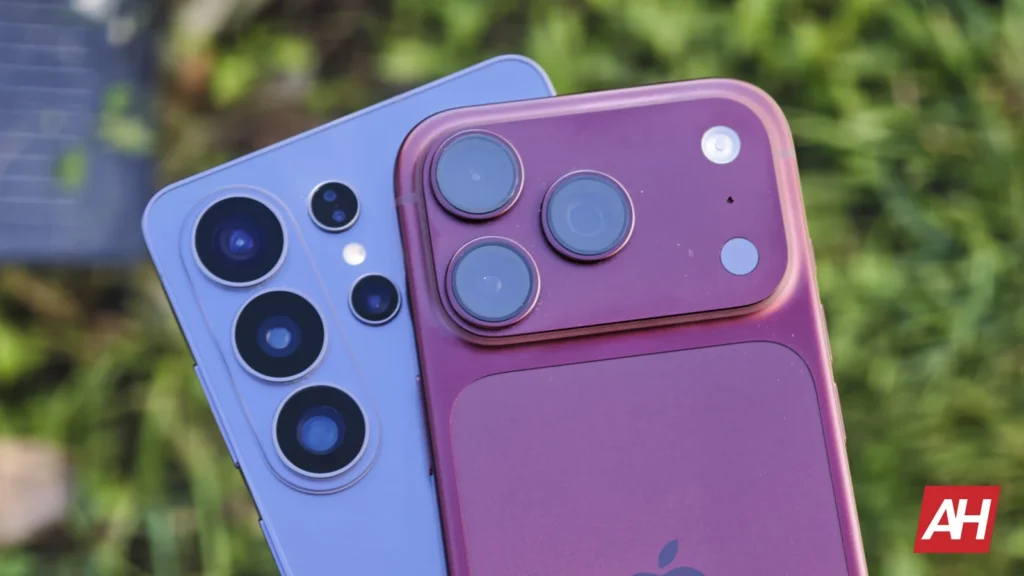
When it comes to hardware and build quality, both phones are somewhat similar, though they do use their own design cues. Samsung has a vertical camera layout on the left side, while Apple has a camera plateau with a triangle-shaped camera module. But both use an aluminum frame, with Samsung using a fully glass back and Apple using a glass window. The reason for both using glass is for wireless charging.
Speaking of wireless charging, this is where Apple gets a point. While both support Qi2.2 25W wireless charging, Samsung did not include magnets, so MagSafe or any form of Magnetic charging is not available. You can do it with a case; however, with the camera layout the way it is, most MagSafe accessories don’t line up properly. Not so much an issue for wallets and tripods, but definitely an issue for battery packs.
In the hand, I have to say, Apple’s iPhone 18 Pro Max does feel better. Thanks to the curved edges on the back, it just feels nicer to hold. But on the flip side, it’s also far heavier at 249g, while the Galaxy S26 Ultra is 214g. Quite the difference in weight.
Overall, I’d have to give the win to Apple here on the hardware front. It just feels like a better-built phone, and the S Pen isn’t for everyone.
Winner: Apple iPhone 18 Pro Max

Apple iPhone 18 Pro Max vs Samsung Galaxy S26 Ultra: Performance
Performance is a bit skewed right now, since Samsung is using a 3nm processor and Apple has moved up to a 2nm processor, which does have some real advantages with performance and efficiency. But we’re still going to compare the two.
The Apple iPhone 18 Pro runs on Apple’s own A20 Pro chip, manufactured by TSMC. This is a 6-core chip with a max clock speed of 4.93 GHz, combined with 12GB of RAM. The Galaxy S26 Ultra uses Qualcomm’s Snapdragon 8 Elite Gen 5 for Galaxy, a 3nm processor manufactured by TSMC. It has a max clock speed of 4.74GHz, also combined with 12GB of RAM.
Now, let’s talk about some benchmarks. I only have the iPhone 18 Pro and not the Pro Max, so benchmark scores may be a bit higher on the iPhone 18 Pro Max. First, 3DMark’s Wildlife Extreme Stress Test. This is a good way to show how much each phone throttles in intense gaming sessions, and how well the vapor chambers work. It runs a loop of a 60-second-long test 20 times, giving us the highest loop score, the lowest loop score, and also a stability percentage. Here’s how it shaped out for both phones:
Apple iPhone 18 Pro
- Best Loop: 7,666
- Lowest loop: 5,258
- Stability: 68.6%
Samsung Galaxy S26 Ultra
- Best Loop: 7,115
- Lowest loop: 4,056
- Stability: 57%
So as we can see here, higher scores, and it sustained the higher scores longer on the new A20 Pro chip. A big reason for this is the new vapor chamber inside. Below, you can see how the vapor chamber is pushing the heat away from the A20 Pro inside the iPhone 18 Pro as its supposed to do. So while it’s not much cooler than the Galaxy S26 Ultra, it is moving the heat and keeping the chip from throttling as much.

Now let’s talk about Geekbench 7. This is the latest version of Geekbench, which yields different (typically lower) scores than Geekbench 6. This test will show us the raw power of the processor in single-core and multi-core as well as the GPU power. Here’s how the two stacked up.
| Device | Geekbench 7 – CPU Single-Core | Geekbench 7 – CPU Multi-Core | Geekbench 7 – GPU |
|---|---|---|---|
| Apple iPhone 18 Pro | 3,976 | 11,252 | 62,091 |
| Samsung Galaxy S26 Ultra | 3,261 | 10,964 | 19,835 |
So what does this tell us? Well, 2nm is the real deal. That’s quite an improvement, even over last year’s A19 Pro from Apple. This does have me pretty excited for the Snapdragon 8 Elite Gen 6 that is being announced next week. Essentially, the A20 Pro does have far better performance than the Snapdragon 8 Elite Gen 5 for Galaxy.
The bottom line is, if you want a phone you can keep for years and not worry about performance, the iPhone 18 Pro (Max) is the one to get.
Winner: Apple iPhone 18 Pro Max

Apple iPhone 18 Pro Max vs Samsung Galaxy S26 Ultra: Software
On the software front, this is obviously going to be a tie, since they are two totally different ecosystems. Samsung’s One UI has come a long way in recent years, going from one of my least favorite Android skins to now being in the top three (alongside ColorOS and Pixel UI). Samsung really excels at giving you options for literally everything. And if you couldn’t find an option for something, Good Lock most likely has what you’re looking for. Customization on the Galaxy S26 Ultra is truly unmatched.
That’s a stark contrast to the iPhone, which has added a good amount of customization in recent years, but it’s not up to the iPhone’s standards, at least not yet.
Finally, let’s talk updates. Samsung is promising 7 years of updates for its phones, but it’s not always the fastest to roll them out. Apple, however, doesn’t promise a specific number of years, but it does generally do six to eight years of updates. In fact, it just updated the iPhone 11 (2019) to iOS 27. And Apple does roll out the update to all iPhones on day one. So you’re not waiting for months like you are with most Android OEMs.
Winner: Tie
Apple iPhone 18 Pro Max vs Samsung Galaxy S26 Ultra: Cameras
When it comes to the cameras, spec-wise, they are pretty similar. Samsung does have a bit more resolution on its main camera at 200MP, but in all honesty, the iPhone still takes better photos. Samsung’s do tend to be a bit more saturated and don’t look as natural as what the iPhone is able to take.
Here’s how the camera specs stack up for these two:
| Camera | Apple iPhone 18 Pro Max | Samsung Galaxy S26 Ultra |
|---|---|---|
| Main | 48 MP, f/1.5-4.0, 24mm, 1/1.28″, dual pixel PDAF, sensor-shift OIS | 200 MP, f/1.4, 23mm, 1/1.3″, multi-directional PDAF, OIS |
| Ultrawide | 48 MP, f/2.2, 13mm, 120˚, 1/2.55″, PDAF | 50 MP, f/1.9, 120˚, 1/2.5″, dual pixel PDAF, Super Steady video |
| Telephoto | 48 MP, f/2.8, 100mm, 1/2.55″, PDAF, 3D sensor‑shift OIS, 4x optical zoom | 10 MP, f/2.4, 67mm (telephoto), 1/3.94″, PDAF, OIS, 3x optical zoom 50 MP, f/2.9, 111mm (periscope telephoto), 1/2.52″, PDAF, OIS, 5x optical zoom |
The iPhone’s big advantage this year is its new variable aperture. Fun fact: Samsung actually did this first with the Galaxy S9 and S9 Plus, though it only switched between two apertures, not four like the iPhone can this year. Though as we’ve seen in early photo testing with the iPhone 18 Pro models, the variable aperture doesn’t make a huge difference on this sensor size.
Video also remains a strong point for the iPhone this year, despite Samsung offering Super Steady Video and Horizon Lock on the Galaxy S26 Ultra. Video on the iPhone is smoother and looks better.
Winner: Apple iPhone 18 Pro Max
Which should you buy?
The question of which one you should buy really depends on the ecosystem you’re in, or want to be in. If you’re an Android user, you most likely won’t switch to an iPhone, and vice versa if you’re a current iPhone user. The iPhone does have a clear advantage right now, mostly because it has newer tech than the Galaxy S26 Ultra that launched 6 months ago. I know it’s not fair to compare it to a 6-month-old phone, but if we wait for the Galaxy S27 Ultra, the iPhone 18 Pro will also be 6 months old, and we’re back to the same unfairness. So we can only compare what we have right now.
The post Apple iPhone 18 Pro Max vs Samsung Galaxy S26 Ultra: Which 2026 Flagship Is Actually Worth It? appeared first on Android Headlines.