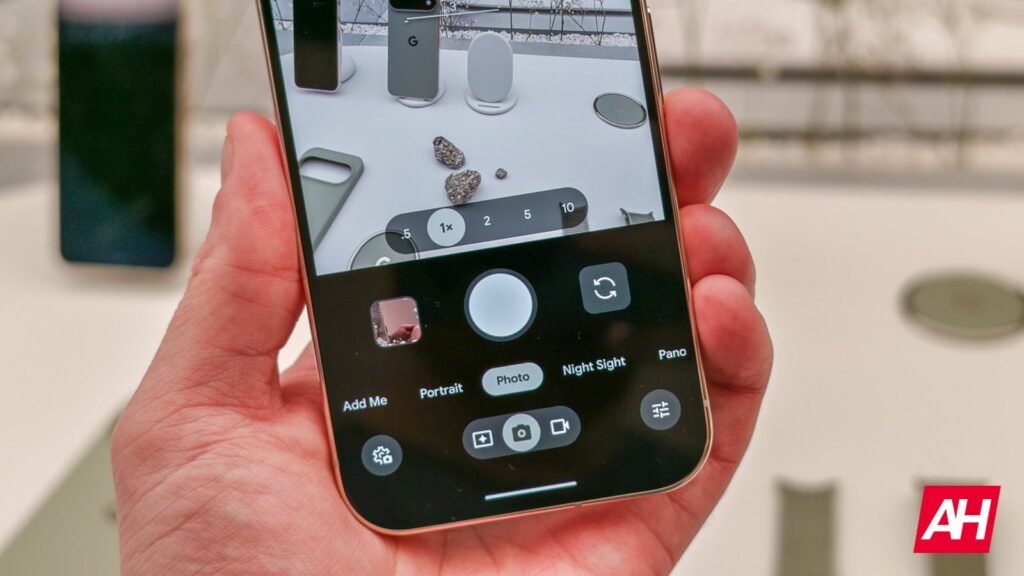

Google officially launched the long-awaited Pixel 11 series today. And, the baseline Google Pixel 11 camera setup got a major hardware upgrade over last year’s model by introducing a significantly larger main sensor designed to capture superior low-light shots.
This hardware bump translates into a powerful triple rear camera system backed by updated computational photography algorithms and Google’s new Tensor G6 processor.
Triple rear camera hardware breakdown
The centerpiece of the Pixel 11 camera array is its upgraded 48-megapixel main camera sensor. It has an f/1.7 aperture, Quad PD autofocus, Optical Image Stabilization (OIS) and a larger 1/1.56-inch optical format. The bigger size enables the component to absorb substantially more light to deliver sharper details and cleaner night photography. For reference, last year’s Google Pixel 10 featured a smaller 1/2.0-inch main camera size—more typical of mid-rangers. So, camera-wise, the new Pixel 11 officially re-enters the flagship territory.
Assisting the primary camera is a 13-megapixel ultrawide sensor with an f/2.2 aperture and a wide 120-degree field of view. This one is ideal for expansive landscape shots and group photos. Completing the rear camera trio is a 10.8-megapixel telephoto lens with an f/3.1 aperture, Dual PD autofocus, OIS, and 5x optical zoom.
The telephoto and ultrawide lenses share underlying hardware specs with last year’s generation. Still, image quality receives a boost thanks to updated software processing pipelines and the enhanced ISP on the Tensor G6 chip.
Optical stabilization and spectral color accuracy
The camera system combines Optical Image Stabilization (OIS) and Electronic Image Stabilization (EIS) to keep photos sharp and videos fluid. This hybrid method reduces the handheld camera shake for shooting at night and high-action video recording.
The Pixel 11 also features a dedicated spectral and flicker sensor. This hardware analyzes the lighting of the surroundings to deliver accurate color tones and remove the flickering of artificial lights. It reduces luminescent aberrations and dark banding across indoor shots.
Front camera and selfie capabilities
For selfie lovers and video calls, the Google Pixel 11 comes with a 10.5-megapixel front-facing camera. It has a 95-degree field of view, Dual PD autofocus and an f/2.2 aperture to make sure your portraits are crystal clear and in focus.
The Google Pixel 11 is available in two internal storage tiers: 256GB priced at $899 and 512GB priced at $1,019. Both models ship standard with 12GB of RAM to handle computational photography and system tasks smoothly. Unlike the higher-priced Pro variants in the lineup, there are no 16GB RAM or 1TB storage configurations available for the standard model. Pre-orders are open now across major carriers and retailers.
The post Google Pixel 11 Camera appeared first on Android Headlines.