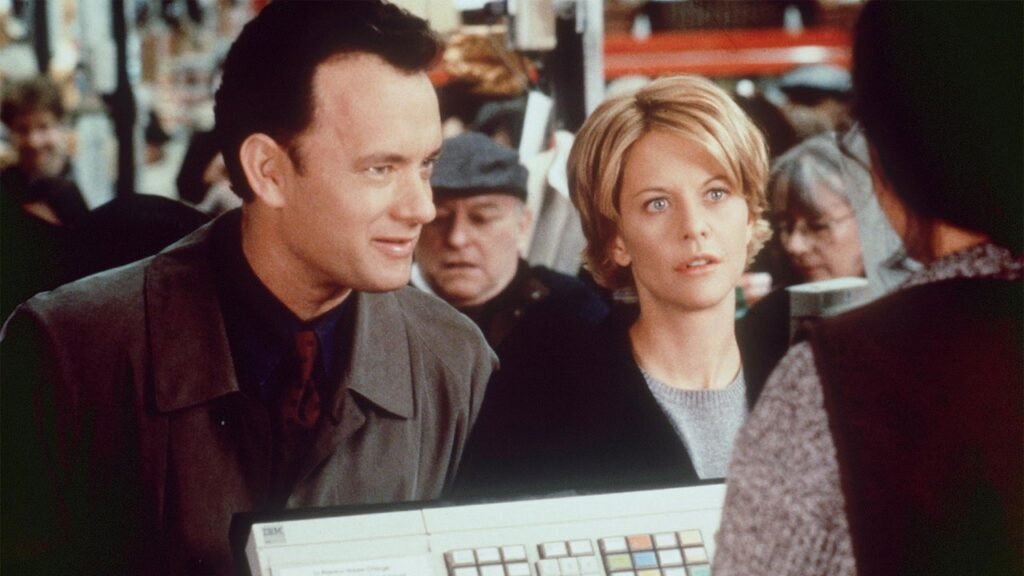
There are plenty of reasons to not remake a movie. Maybe it’s a stone-cold classic that seemingly can’t be improved upon. Sometimes it’s a foreign film that worked well enough already without photoshopping American faces into the lead roles. Other times, it’s an older movie with a recognizable title that nobody actually cares about anymore, or a movie made so recently, remaking it serves no discernible purpose. These are all legitimate critiques, frequently ignored by studios enamored of intellectual property, to varying artistic and box office success.
You’ve Got Mail is a different situation altogether.
While it’s perhaps impossible to replicate the star wattage, irresistible charm, and effortless chemistry of 1998 Tom Hanks and Meg Ryan, or the whip-smart comedic precision of filmmaker Nora Ephron (RIP), that isn’t even the main strike against a remake. Never mind that You’ve Got Mail reunited this trio five years after their funny, tearjerking smash, Sleepless in Seattle, giving it the rom-com equivalent of a Marvel movie’s magnitude. What makes You’ve Got Mail uniquely un-remake-able is that technology, social norms and economics have changed so much in the last 28 years, everything about this movie now feels like a relic of the distant past.
Gen Z moviegoers—currently, the most active and coveted demographic—have likely never even heard the AOL notification that lent You’ve Got Mail its name. (It finally faded away for good last year when AOL discontinued its dial-up internet service, but the audio file had fallen out of cultural relevance sometime in the early-aughts.) If the words ‘You’ve got mail’ now mean anything to young people, it’s likely in the context of ‘That old movie my parents like.’
An extremely 1998 film
Title aside, not much is known about the new Warner Bros. project. It will be directed by Jason Orley, the creative visionary behind Pete Davidson-led Peacock series Bupkis, but plot details have yet to be announced. Possibly because those details threaten to turn the new film into something bearing scant resemblance to the original.
You’ve Got Mail, itself a remake of 1940’s The Shop Around the Corner, is centered around Kathleen Kelly (Ryan), an idealistic Upper West Side independent bookstore owner, and Joe Fox (Hanks), the cynical scion of a Barnes & Noble-coded bookstore dynasty. The pair meet anonymously in an AOL chatroom, those early precursors to social media, and strike up a tastefully flirty friendship that drives them to consider leaving their current romantic partners (Greg Kinnear and Parker Posey, respectively.) The dynamics of their quasi-courtship change, however, when Fox realizes his unnamed potential paramour is actually the woman his new store on the Upper West Side is about to put out of business. It’s a Montagues-and-Capulets-caliber obstacle that forestalls the inevitable happy ending.
The plot of this warm blanket of a movie hinges on two intertwined ideas: that strangers can connect over the internet and not turn out to be creeps, and that enormous chain bookstores are the mortal enemy of independents. Both ideas now seem quaintly, adorably naïve.
Dating? On the internet??
In 1998, the internet was a mysterious novelty. Only 41% of adults had even logged on at all. While early adopters swore it would eventually change everything, most Americans were still wrapping their heads around just the concept of email. Now, of course, the internet is the infrastructure modern society is built upon, and the filter through which many people experience the world. About 97% of adults under the age of 50 are now connected to it at all times through smartphones, a technology that was nearly a decade away when You’ve Got Mail was made.
In retrospect, it’s a miracle that a person of Nora Ephron’s age—she was 56 at the time—perfectly depicted the moment when meeting strangers on the internet first broached mainstream acceptability. Prior to then, meeting people online was considered sordid, shameful business. Ephron both grounded her film in that perception and circumvented it by having her two leads fall ass-backwards into internet romance.
There was something interesting and even sort of sweet about the idea of potential soulmates accidentally finding each other within the randomness of a non-sexual Web 1.0 chatroom. It now sounds like the kind of meet-cute one of those elderly couples in the Ephron-penned When Harry Met Sally might share if that film came out today.
What could possibly be an organic way for two attached people in 2026, though, to accidentally strike up a relationship online that retains the innocent curiosity of the 1998 internet?
There’s no longer anything interesting about meeting someone online. A chance encounter with a stranger on the r/Pringles subreddit could potentially lead to a hookup, which is something everyone has known or at least intuited for a very long time. Internet dating has long been well past mainstream status. It’s something so pervasive as to no longer require any handwringing or soul-searching–you either do it or don’t do it, and nobody cares much either way. According to a 2019 study from Stanford University, over 39% of heterosexual couples now meet online, making the internet the most popular destination for sparking a new relationship.
But even if the filmmakers found a plausible scenario in which the two leads chastely meet online, they will now no longer face the dilemma that occupies the first half of the original movie—whether to physically meet someone who digitally swept you off your feet. After multiple decades of normalized internet dating, that question no longer carries any tension. Without it, the remake will just be about whether two people in unfulfilling relationships should turn their emotional infidelity into something more—essentially the plot of any generic romantic comedy.
Borders: Now there’s a name I haven’t heard in a long time
Although You’ve Got Mail correctly portrays the two leads’ ongoing anonymity as a red flag, the mutual identity firewall makes sense given the pair’s hesitation to go any further. But the idea that both parties in a more modern online flirtation would emotionally invest several months in someone who insists on keeping their identity a secret is ludicrous.
The actual offline identities of the two main characters present an even bigger narrative challenge for a modern update than keeping each from finding out.
In 1998, an indie bookseller going up against a big-box bookstore would have been a genuine David-and-Goliath conflict. Barnes & Noble and Borders represented an existential threat to any local shop who struggled to keep up with the bottomless inventory, discounted pricing, and piping hot coffee those chains had in spades. Little did either side know they’d soon be united together in a battle for brick-and-mortar bookstore survival against Amazon, which launched just three years before You’ve Got Mail.
Now, all bookstores are fighting for their lives, with Barnes & Noble cribbing notes from indie bookshops to stay relevant in the BookTok era. (Borders did not survive Amazon’s ascendance, having reached its final chapter back in 2011.)
Affinity for independent booksellers was no match for the convenience and savings of a Barnes & Noble back in 1998, which is why Kelly eventually loses her shop in the film. That’s no longer necessarily the case. Anyone setting foot in a bookshop now has generally made an intentional choice to not buy a book from Amazon for cheap, and to instead experience human curation and customer service while supporting a local business. Meanwhile, Barnes & Noble is now more likely to buy a struggling independent bookshop than put one out of business.
The only way the major conflict in You’ve Got Mail would work in a modern update is if the plot moved out of the book world entirely, which is what will likely happen. But current options for a David-and-Goliath-esque business conflict that poignantly capture a changing world, mid-transformation, aren’t exactly inspiring. Maybe it will involve a celebrity podcaster at a major network launching a new show with the exact same idea as a well-established indie podcast—a concept I’m already mad about just having thought of. Maybe it will be the creator of a hot new AI chatbot financially ruining the founder of a once-great search engine. It might even be something even dumber. Unfortunately, the resulting movie could accidentally provide some incisive metacommentary about the moment enshittification came for Hollywood.
Whatever happens, any remake of You’ve Got Mail that’s even vaguely faithful to the source material will have a title that no longer has any meaning, a premise that no longer matters, and a conflict that no longer exists.
The only way to fix these problems would be to change so much about the original that what’s mainly being remade is the definition of what can reasonably be considered a remake. At that point, why not just start from scratch? The resounding box office lesson of 2026 is that audiences are tired of being treated like seals who reliably clap at the dangled fish of familiar IP. Original hits like Obsession, You Can See Everything, and The Drama inspired as much conversation this year as they did box office returns.
Unrecognizable remakes of beloved classics, on the other hand, seem more like the modern descendants of another relic of the late-1990s: the straight-to-video sequel.