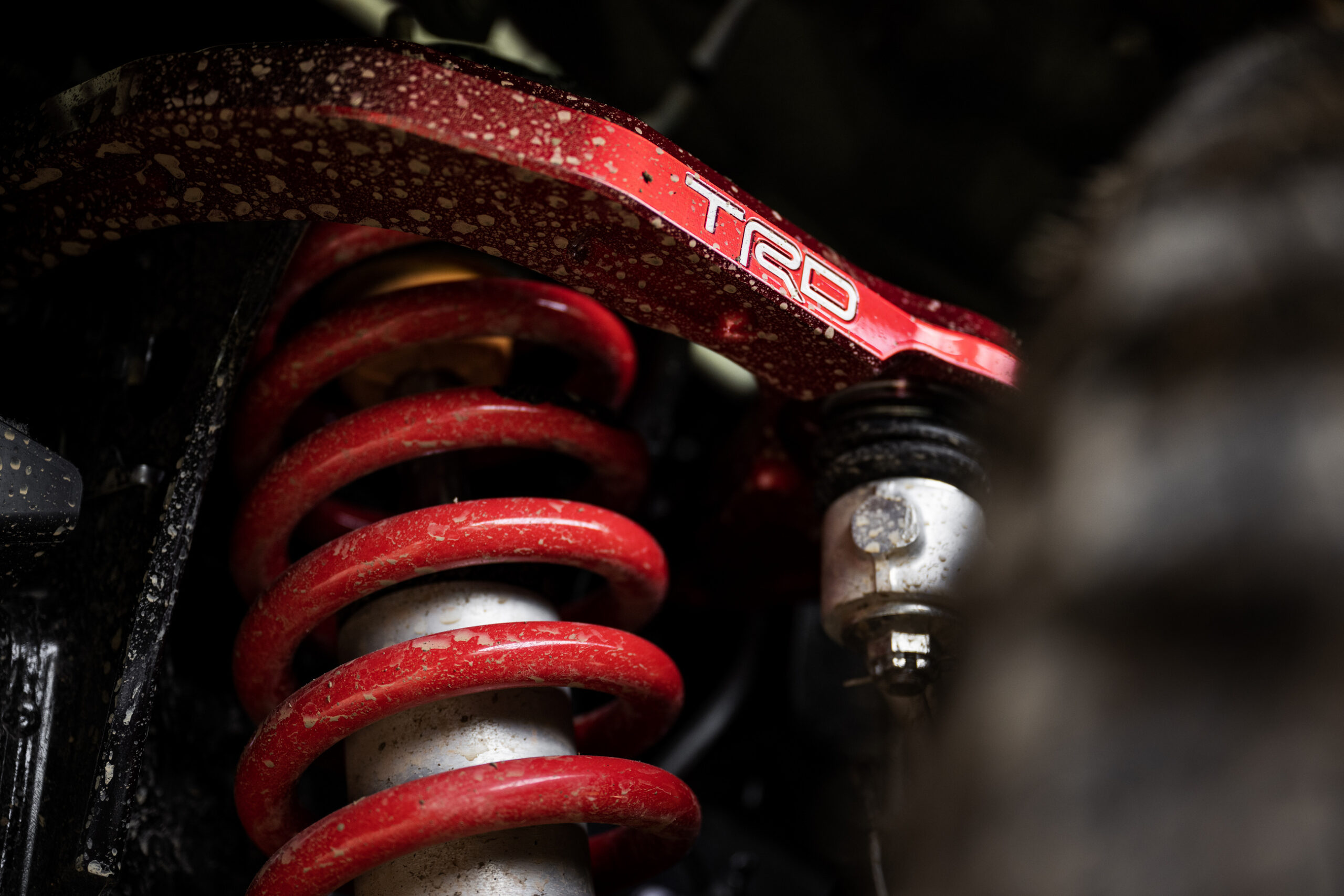
- Tacoma TRD Off-Road’s remote reservoir shocks could fall off due to corrosion.
- Dealers have been instructed to replace rear shock assemblies as required.
- Owners should expect a recall notice to reach them by early October.
The Toyota Tacoma TRD Off-Road exists to go where a standard Tacoma can’t, and it earns that with a stack of upgrades meant to sharpen its off-road ability. A new recall notice, though, has flagged one of those key suspension changes as the very part that could fail.
Toyota announced the recall in a release late last week, but at the time of writing, the campaign had yet to be launched on the National Highway Traffic Safety Administration (NHTSA) website, meaning some details have yet to be confirmed.
Read: Tacoma Prices Climb Again But Toyota Tries To Soften The Blow
What we do know is that roughly 48,000 vehicles are recalled, though the manufacturing date range is still pending. Toyota says the oil reservoir on the shock absorbers of affected 2024-2025 Tacoma TRD Off-Road models can corrode over time, and once that corrosion sets in, the reservoir could eventually break away from the truck entirely.
Toyota says this could create a road hazard, potentially increasing the risk of a crash for other motorists. However, it doesn’t mention any increased risk of a crash for Tacoma drivers themselves, presumably because the suspension still works, albeit not as it should, even without the remote reservoir.
Owners of impacted models will be alerted to the recall by early October and told to take their truck to a Toyota dealer where the front and rear shock absorber assemblies will be inspected. If necessary, affected shock absorbers will be replaced with improved ones at no cost.
Another Tacoma Recall
This isn’t the only recent recall to impact the Toyota Tacoma. Earlier this month, some older 2014-2021 models were recalled in the United States after it was revealed they may have been fitted with faulty replacement airbags after an accident. According to Toyota, the supplier of these airbags may not have correctly secured the airbag to its mounting bracket during assembly, meaning sections of the airbag may not deploy into their correct positions, minimizing the airbag’s effectiveness.