The NAACP is calling on Black student-athletes and fans to boycott public universities in Southern states following a Supreme Court decision that weakened the Voting Rights Act.
On Tuesday, the NAACP launched the “Out of Bounds” campaign, a nationwide call urging Black athletes, alumni, and fans to withhold all athletic and financial support from public southern universities.
The campaign prioritizes boycotting flagship universities in eight states that it says have “moved to limit, weaken, or erase” Black voting representation in the wake of the Supreme Court’s decision: Tennessee, Louisiana, Alabama, Florida, Mississippi, South Carolina, Texas, and Georgia.
The NAACP’s announcement does not go into detail about the various ways each state’s government is specifically working to roll back voting rights. A representative referred Fast Company to the campaign’s landing page.
As explained by the NAACP, the list of 13 schools generate more than $1.5 billion annually while recruiting Black athletic talent to states where Black political power is being dismantled.
“Out of Bounds” was created following the recent Supreme Court ruling Louisiana v. Callais, which dismantled protections against racial discrimination in redistricting under the Voting Rights Act of 1965.
In this decision, the court struck down Louisiana’s majority Black congressional map, ruling that the map established an unconstitutional racial gerrymander.
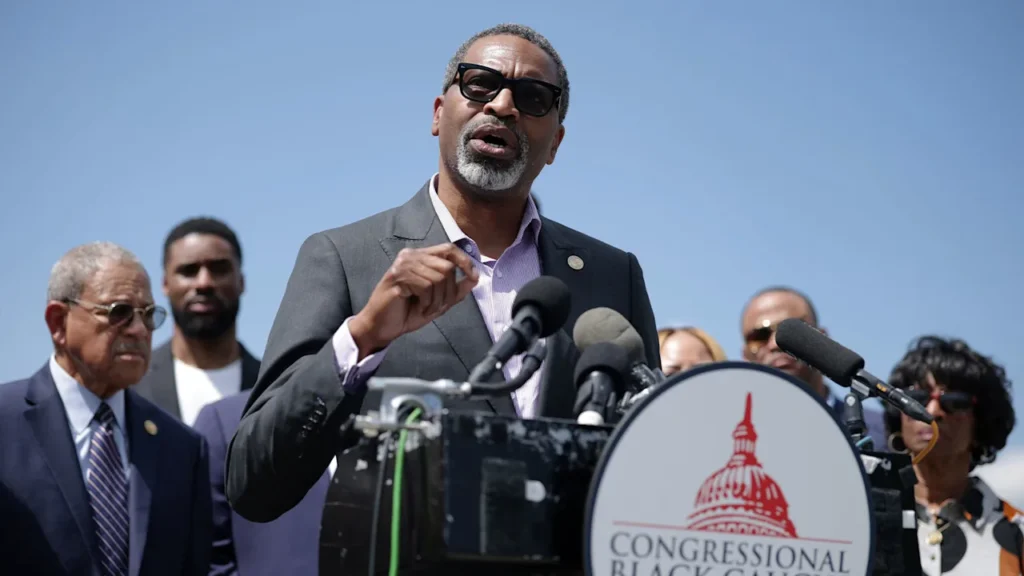
“What these states have done is not a policy disagreement,” Derrick Johnson, president and CEO of the NAACP, said in a statement. “It is a sprint to erase Black political power.”
Johnson said the ruling will further erode Black political representation, and that the NAACP will not watch institutions that depend on Black athletes remain silent while states deprive Black communities of their voice.
The NAACP’s primary ask for Black student athletes is for those actively being recruited by the targeted athletic programs to withhold their commitments until the states restore fair congressional maps.
The group also called on current college athletes to consider transferring to a historically Black college and asked fans to stop purchasing game tickets and apparel instead redirecting their spending to a HBCU program.
Support for the boycott
The Congressional Black Caucus (CBC) joined the NAACP’s call to action, saying that public southern universities that remain silent should suffer economic consequences.
The CBC’s support comes one day after it unanimously opposed the SCORE Act, a bill that sought to provide a legal framework for compensation of student athletes for usage of their name, image, and likeness. The bill faces an uncertain future after a vote on it was postponed on Tuesday.
“The Congressional Black Caucus cannot support legislation benefiting major athletic institutions that continue to remain silent while Black voting rights and Black political power are being systemically dismantled across the South,” the CBC said in a statement.
During a press briefing in Washington on Tuesday, House minority leader Hakeem Jeffries called out the Southeastern Conference—the NCAA Division I collegiate athletic conference that consists of 16 member universities.
“We are here standing in solidarity with the NAACP and its call for athletes to boycott institutions within the SEC that belong to states that have unleashed these Jim Crow-like, racially oppressive tactics, which is unacceptable, unconscionable and un-American,” Jeffries said during the press briefing as reported by The Guardian.
According to a report from the NCAA, Black students account for 16% of all student athletes, with a total of 89,090 Black student athletes competing across three NCAA divisions during the 2024-25 academic year. This total is the highest on record, a 3.1% increase from the previous year.
Over the past decade, the number of Black student athletes participating overall in college sports increased by 17%. Black student athletes are strongly represented in basketball, with increasing participation in volleyball, soccer, lacrosse, and baseball.