The Paris Agreement, adopted in 2015, hopes to limit global warming by 2100 to well below 2°C above preindustrial levels. This goal requires at least a net zero, if not net negative, balance between greenhouse gas emissions and carbon removal by natural sinks and technologies.
To achieve this objective, techniques for marine carbon dioxide removal (mCDR) are being investigated for their potential to sequester carbon dioxide (CO2) emissions and mitigate climate change.
Ocean alkalinity enhancement (OAE), which involves increasing alkalinity in the marine environment, is an abiotic mCDR approach that seems to have great potential for CO2 sequestration and long-term storage [Ho and Bopp, 2024]. The enhancement is done primarily by adding to the ocean alkaline substances that come from natural minerals, human-made chemicals, or industrial waste products [National Academies of Science, Engineering, and Medicine (NASEM), 2022].
The process chemically modifies seawater composition, including by decreasing the concentration of CO2. This decrease enables seawater to absorb more CO2 from the atmosphere. Chemical changes brought by OAE also increase seawater’s buffering capacity, or ability to neutralize, before a significant change in pH occurs. In this way, OAE can also help mitigate ocean acidification.
However, scientists have not fully established measurement and monitoring methods to evaluate the effects of OAE efforts. Without such methods, OAE risks becoming a promise we cannot keep.
Beyond Carbon: Societal and Ethical Dimensions
Implementing OAE, like all CDR methods, requires thorough investigation before any deployment. Ensuring both the absence of biochemical and ecological side effects and the efficiency of long-term CO2 sequestration is crucial for such efforts.
It is crucial that the deployment of marine carbon dioxide removal (mCDR) technologies does not detract from the urgent need to drastically reduce carbon dioxide (CO2) emissions to address climate change.
It is also essential to address social, environmental, and ethical considerations associated with mCDR technologies. The expansion of mining activities to procure alkaline mineral supplies for OAE is, for example, expected to cause environmental and social impacts such as air and water pollution and local demographic changes [NASEM, 2022]. Moreover, because the scalability of mCDR techniques is unproven, it is crucial that the deployment of mCDR technologies does not detract from the urgent need to drastically reduce CO2 emissions to address climate change [Anderson et al., 2023].
Our focus, however, is specifically on needs associated with measurement methodology (metrology) that will arise with the development of OAE and could contribute to the reliable assessment of its efficiency.
Monitoring as Cornerstone
To address the aforementioned technical challenges and accurately determine the amount of CO2 removed from the atmosphere, a robust monitoring, reporting, and verification (MRV) system for mCDR is needed [Ho et al., 2023]. Establishing a reliable system is especially critical in the context of a developing CDR market in which credits can be traded. The existing market for carbon credits is poorly regulated, although some companies are already implementing mCDR techniques on relatively small scales.
As they develop, OAE activities—and mCDR generally—will increasingly be subject to specific legal frameworks to ensure safe and responsible implementation. These frameworks will vary across national legal systems, but international laws such as the London Convention and Protocol offer a minimal set of rules [Steenkamp and Webb, 2023]. With respect to large-scale OAE implementation, legal metrology may play a role in ensuring compliance.
Legal Metrology for the Environment
Legal metrology is the “practice and process of applying statutory and regulatory structure and enforcement to metrology,” according to the International Vocabulary of Terms in Legal Metrology. It aims to enable states to establish effective, mutually compatible, and internationally recognized infrastructures for measurement, facilitating trade and harmonizing levels of protection for citizens and the environment. Legislation surrounding legal metrology, for example, is one of the pillars of the European Union’s single market for goods.
Rigorous sets of rules must apply for mCDR and must ensure that the amount of CO2 removed from the atmosphere by mCDR practices is thoroughly quantified.
Legal metrology is achieved essentially through the establishment of traceability to the International System of Units, through regulation of measurements and measuring instruments, and by guaranteeing confidence in testing and measurement results via certification and standardization by recognized organizations.
As an example, measuring amounts of substances in water, soil, and the atmosphere makes it possible to determine the environmental impacts of human activities. We can have confidence in these measurement results as long as they comply with the framework set by the International Organization of Legal Metrology. National metrology institutes (NMIs) ensure the traceability and comparability of measurements over space and time.
Similar, equally rigorous sets of rules must apply for mCDR and must ensure that the amount of CO2 removed from the atmosphere by mCDR practices is thoroughly quantified and relies on robust MRV systems.
Acquiring accurate and robust data with explicit uncertainty budgets (defined as the assessment of the sources of variation or error of a measurement result) and complying with principles of metrology are therefore of utmost importance, allowing MRV systems to rely on comparable measurement results.
Total Alkalinity: A Metrological Case Study
Measurement of total alkalinity (TA) in seawater is an example of where robust metrology would be beneficial.
TA measurements are recommended for assessing OAE for several reasons [Iglesias-Rodríguez et al., 2023]: They provide short-term checks that help to quantify background alkalinity before OAE implementations and, afterward, to evaluate the implementations’ efficiency. Combined with measurements of other variables relevant to the marine carbonate system, TA measurements also allow researchers to compute essential carbonate chemistry parameters, which are needed for validating numerical models used in OAE efficiency assessments.
The diffusion of added alkalinity in the open ocean leads to very small variations in TA. These variations are assessed using numerical models but should also be confirmed as much as possible with in situ measurements to validate and inspire confidence in the models. Gathering these measurements represents a real metrological challenge. Unfortunately, a comprehensive and robust metrological traceability chain has not yet been fully established for TA measurements.
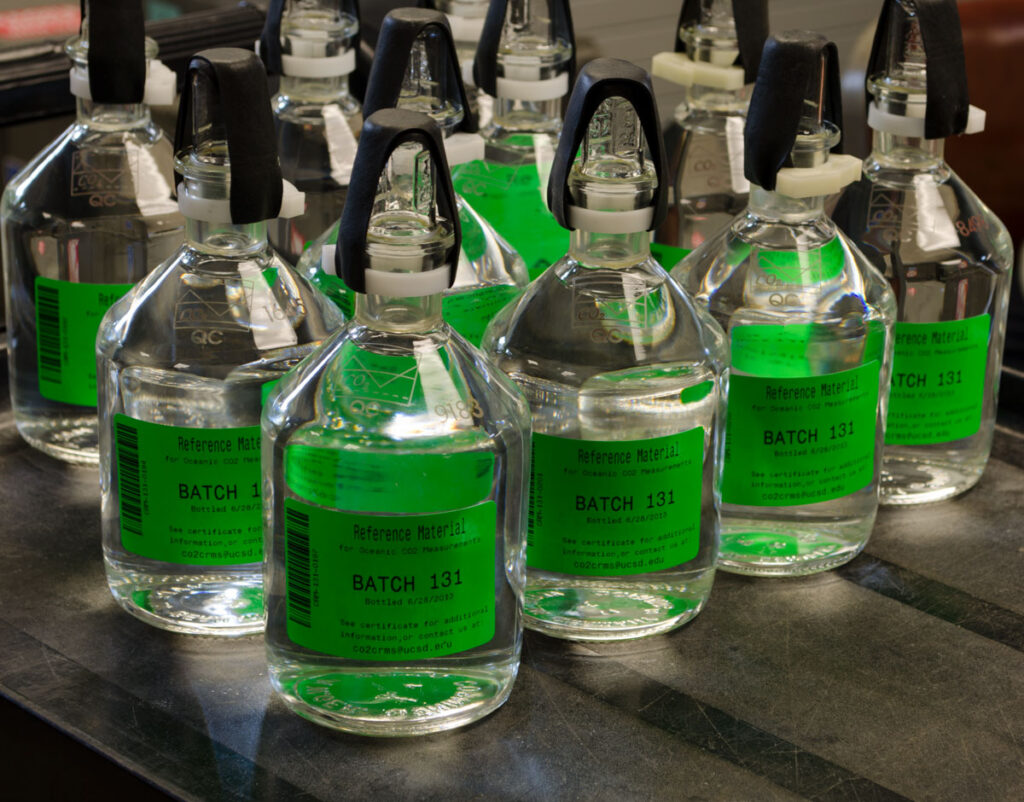
Today, oceanographers’ measurement methods for TA are validated using reference materials for measurements of CO2 in seawater produced by the Scripps Institution of Oceanography (SIO) [Dickson, 2010]. Although the quality controls performed with SIO’s reference materials, which comprise samples of stabilized natural seawater from the Pacific, are important in guaranteeing the comparability of measurements from different users, the materials are not totally traceable.
One traceability pitfall is that a full uncertainty budget is not provided for the TA reference value of the reference material. An uncertainty estimated from the standard deviation (i.e., precision) of a definite number of analyses is given, providing some confidence. However, a complete uncertainty budget—including a list of all sources of measurement variation or possible error—is needed to control for the trueness of end user procedures in a more robust manner.
Relying on a single laboratory to produce reference materials for total alkalinity measurements on a regular basis can create vulnerabilities.
Another pitfall is that a system relying on a single laboratory to produce reference materials for TA measurements on a regular basis can create vulnerabilities [García-Ibáñez et al., 2025]. If, for whatever reason, the laboratory encounters difficulties producing or characterizing the material, the entire system comes to a halt. (This was the case during the COVID-19 pandemic.) Production by a single laboratory also means that a natural seawater reference material for only one TA value (Pacific seawater, around 2,200 micromoles per kilogram) is produced, which does not allow quality controls for the different salinity, carbon, and TA levels existing around the globe.
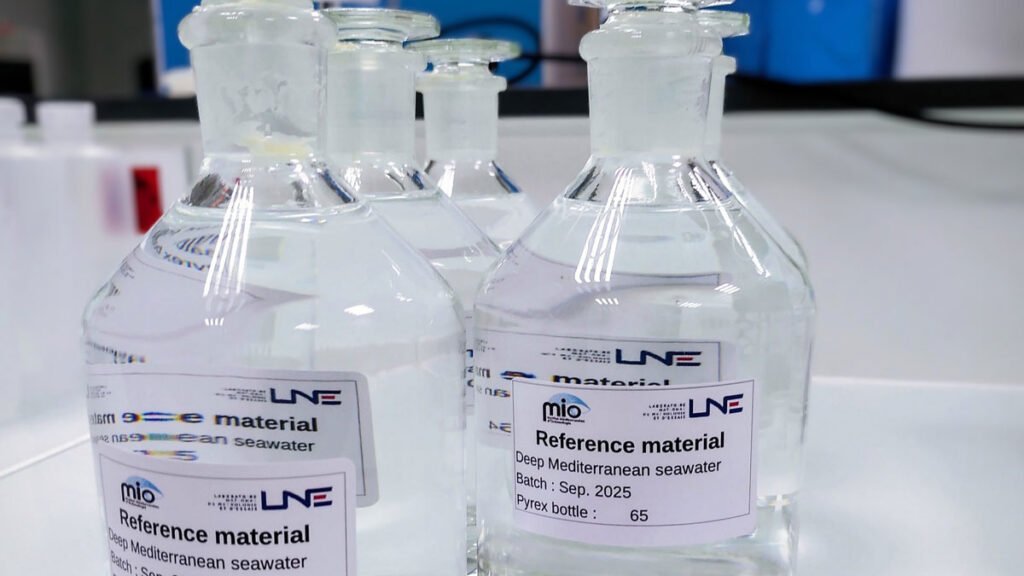
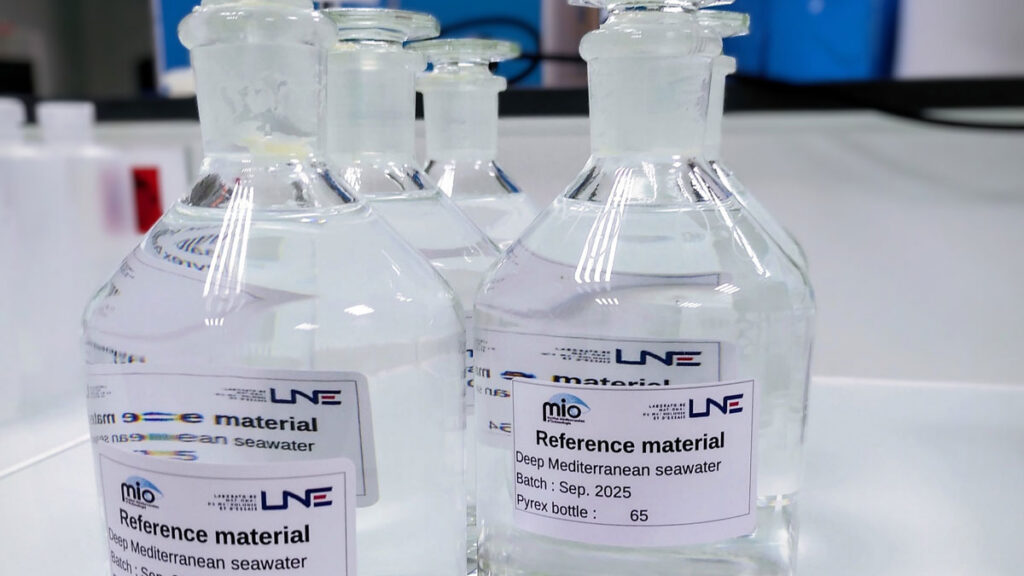
A robust structure has grown up around the development of reference materials by SIO, supporting the oceanographic community worldwide in improving data quality and comparability. A valuable goal lies in developing an artificial reference material, as well as a stabilized natural seawater with an alkalinity value different from SIO’s, which could be distributed along with SIO’s reference materials.
These new reference materials, which should be characterized by a traceable reference method with a thoroughly quantified uncertainty budget to ensure comparability of total alkalinity measurements, could help improve the trueness of TA measurements.
In fact, these considerations were a focus of recent work we carried out with colleagues [Capitaine et al., 2026]. Beyond enhancing traceability, the artificial reference material developed by Capitaine et al. [2026] has the advantage that it can be produced for any desired TA value. This may be highly relevant for OAE MRV systems, as they may require measuring alkalinity levels above typical natural values [Schulz et al., 2023].
It must also be noted that reference materials should preferably be characterized by NMIs, which guarantee international comparability of measurements. Several NMIs (e.g., the National Metrology Institute of Japan, Brazil’s National Institute of Metrology, Standardization and Industrial Quality, and the Czech Metrology Institute) have globally recognized calibration and measurement capabilities for assays of sodium carbonate.
A Call for Metrology at the Heart of OAE
We are currently building carbon markets faster than we are building the measurement systems that should underpin them.
We are currently building carbon markets faster than we are building the measurement systems that should underpin them. In the coming years, metrological concepts must be developed and applied with rigor to assess OAE scientifically. This application is critically needed to support societal debate over its viability and to strengthen the legal and regulatory regimes applicable to carbon credits. It also would have the added benefit of strengthening ocean carbon observations in general.
Without robust, traceable measurements of TA and other seawater variables, we risk missing OAE’s promise as an effective approach to mCDR simply because we cannot verify and regulate it.
References
Anderson, K., et al. (2023), Controversies of carbon dioxide removal, Nat. Rev. Earth Environ., 4, 808–814, https://doi.org/10.1038/s43017-023-00493-y.
Capitaine, G., et al. (2026), Metrological concepts applied to total alkalinity measurements in seawater: Reference materials, inter-laboratory comparison and uncertainty budget, Ocean Sci., 22, 75–99, https://doi.org/10.5194/os-22-75-2026.
Dickson, A. G. (2010), Standards for ocean measurements, Oceanography, 23, 34–47, https://www.jstor.org/stable/24860884.
García-Ibáñez, M. I., et al. (2025), JPI Oceans Knowledge Hub Ocean Carbon Capacities: Roadmap for securing the supply of reference materials for the seawater CO2 system, report, 9 pp., Brussels, https://jpi-oceans.eu/sites/jpi-oceans.eu/files/2025-08/occ_roadmap_august_2025.pdf.
Ho, D. T., and L. Bopp (2024), Marine carbon dioxide removal may be a future climate solution, Dialogues Clim. Change, 1, 56–62, https://doi.org/10.1177/29768659241293223.
Ho, D. T., et al. (2023), Monitoring, reporting, and verification for ocean alkalinity enhancement, State Planet, 2-oae2023, 12, https://doi.org/10.5194/sp-2-oae2023-12-2023.
Iglesias-Rodríguez, M. D., et al. (2023), Laboratory experiments in ocean alkalinity enhancement research, State Planet, 2-oae2023, 1–18, https://doi.org/10.5194/sp-2-oae2023-5-2023.
National Academies of Sciences, Engineering, and Medicine (NASEM) (2022), A Research Strategy for Ocean-Based Carbon Dioxide Removal and Sequestration, 322 pp., Natl. Acad. Press, Washington, D.C., https://doi.org/10.17226/26278.
Schulz, K. G., L. T. Bach, and A. G. Dickson (2023), Seawater carbonate chemistry considerations for ocean alkalinity enhancement research: Theory, measurements, and calculations, State Planet, 2-oae2023, 1–14, https://doi.org/10.5194/sp-2-oae2023-2-2023.
Steenkamp, R. C., and R. Webb (2023), Legal considerations relevant to research on ocean alkalinity enhancement, State Planet, 2-oae2023, 1–19, https://doi.org/10.5194/sp-2-oae2023-10-2023.
Author Information
Gaëlle Capitaine (gaelle.capitaine@lne.fr) and Paola Fisicaro, Laboratoire National de Métrologie et d’Essais, Paris, France; and Thibaut Wagener, Mediterranean Institute of Oceanography, Aix Marseille Université, CNRS, IRD, Marseille, France
Citation: Capitaine, G., P. Fisicaro, and T. Wagener (2026), Why metrology matters for ocean alkalinity enhancement, Eos, 107, https://doi.org/10.1029/2026EO260365. Published on 12 November 2026.
This article does not represent the opinion of AGU, Eos, or any of its affiliates. It is solely the opinion of the author(s).
Text © 2026. The authors. CC BY-NC-ND 3.0
Except where otherwise noted, images are subject to copyright. Any reuse without express permission from the copyright owner is prohibited.