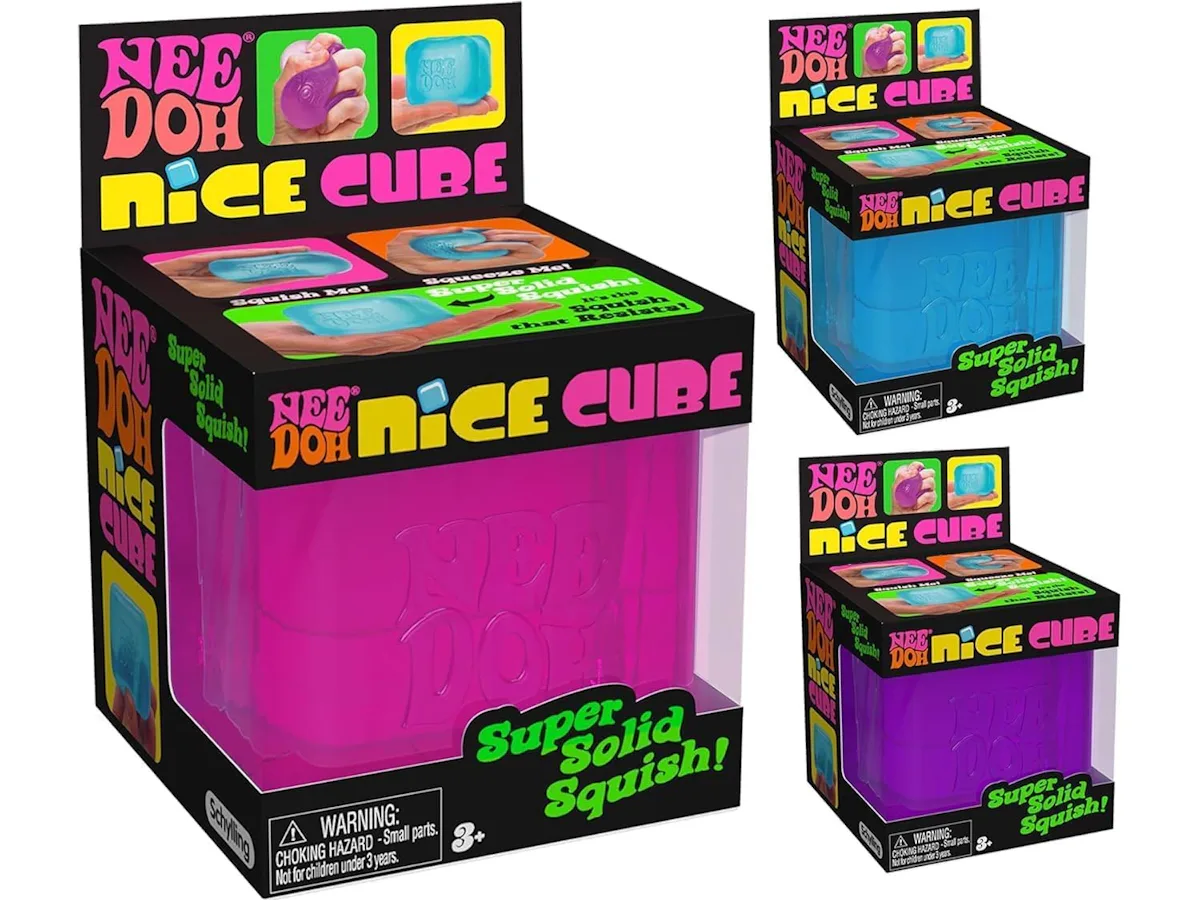
If you have a kid or are on social media, you’ve probably heard of Needoh. The squishy sensory toys, most popularly in the shape of an ice cube and incredibly soft and pliable, have gone viral in recent months — and they are gone from store shelves. Every day, there is a mom in my local Facebook group begging other moms to share where they’re finding Needohs. “It’s all my kid wanted in his Easter basket,” one mom writes. “I can’t find them anywhere.”
Other parents give squishy substitutions, suggesting she look at Five Below or even Ace Hardware to find them. “You really have to hunt for them,” one mom says. “I found three another parent clearly hid and bought them immediately.”
There is a Facebook group called Needoh Lovers — it has over 60,000 members with over 90 posts a day. Within seconds of posting a Needoh to sell, one user had already received 18 comments asking to buy it. Another group, Needoh Restock Alerts and Other Squishies, has over 19,000 members with 70+ posts per day. One post in that group simply asked, “How’s everyone’s day, any luck finding Needohs??” It had nearly 150 comments, some of them featuring photos of the Needohs they found.
One in particular has a photo of a huge Needoh haul with the commenter proudly writing, “Such a great day!” She explained that she went to three different stores, was allowed to buy only three per transaction, and had to split her haul between her and her daughter to buy them all. She says they are for her kids, but she also sells them “at cost” to other moms looking.
But maybe if they’d stayed on the store shelves, another mom would’ve found them?
The Cabbage Patch Kids of the ‘80s, the Tickle-Me-Elmos and Beanie Babies of the ‘90s, the Fingerlings and Hatchimals of the 2010s — moms have a long history of fighting and waiting outside closed Target doors to get our kids something they want. So it should be no surprise now that Facebook groups are flooded with moms asking each other where to buy the viral Needoh sensory balls or begging for just one pack of Pokémon cards because Walmart sold out before they could get there. It’s instinct to want to give your kid something they asked for. We want to be their heroes; we want them to be happy.
But what happens when our shopping urge becomes more about our own personal gain than our kids’?
Moms often spiral to get something “for their kids” before it’s gone forever. Like the Beanie Baby craze, some moms take something their kid loves — like a squishy toy — and make it their entire personality to get their kid more and more and more of these things. Sometimes it starts before a kid even knows about it, like the bamboo pajama craze that turns everyday moms into Facebook group warriors setting alarms on their phones because there’s going to be another limited-edition Toy Story drop from a popular clothing brand.
Sometimes it becomes one thing your kid enjoyed one time — a monster truck, a retired Little People princess set, a Jellycat stuffy — and suddenly you’re meeting up with strangers from Facebook marketplace to pay $75 for a klip klop horse that Fisher Price stopped making in 2014.
We already know that moms rule the economy. In fact, women (whether they are moms or not) are responsible for up to 85% of all consumer purchasing decisions. Companies know what they’re doing by marketing to kids (who will then tell mom they need a Needoh right now) and by slapping something like “limited edition” or “drop coming soon” onto a social media post for moms.
But why do we fall for it? Why are we driving to seven stores on a Sunday looking for a small squishy toy? Why do we have bins of Squishmallows — Squishmallows we spent hours on the internet collecting — that they barely even touch?
“This is so interesting to me because it sits at this intersection of identity, anxiety, and dopamine that people don’t usually connect,” says licensed clinical psychologist Tracy Collins. She says the “have to have it” impulse with moms isn’t really about the item; it’s about what getting the item means.
“There’s a real neurological reward loop happening. The hunt, the refreshing the page, the checkout before it sells out — that whole sequence fires dopamine in the same way gambling does,” she says. “And then you post the haul or the nursery shelfie and get validation on top of it. So now you’ve got a chemical reward and a social one. That’s a powerful combination.”
And while both Collins and I believe not every mom will call it out, there’s obviously a level of competition to some of this shopping obsession. “Especially online,” she says. “You see another mom’s playroom setup and suddenly your kid’s perfectly fine toy collection feels inadequate. I work with moms who know logically that their 3-year-old does not need a $200 wooden kitchen, but emotionally it feels like proof that they’re doing a good job. The purchase becomes evidence of being a good mother, which is a really heavy thing to put on a pair of pajamas.”
Your kid loves Toy Story. You guys watch it every single day, you tuck them in with Buzz and Woody every night, you bond with them over your own memories of the movie as a kid — it makes sense that when Little Sleepies says they’re doing a Toy Story drop, you feel that flutter in your chest and that surge of adrenaline because you just know how much your kid will love them. Pajamas featuring their favorite characters? From a brand you trust? In a style you love?
Your teenager, who never comes out of their room, asks you to take them to Target. They heard there are new Needohs there, and they really want one. You haven’t had one-on-one time with them in forever. They never ask you to do anything. Of course you’re going to want to buy them 8,000 of those squishy little ice-cube-looking things.
It can quickly spiral, though. And it’s hard to remember that your kid is actually OK with the one pair of Toy Story pajamas they already have. It’s hard to remember that it’s really OK to just buy one Needoh. It’s hard to remember that just because your tween loves their cat Squishmallow, that doesn’t mean they need all of the rare ones available.
There’s certainly an element to connecting with your kid through these things as well, and wanting them to keep them forever.
“Behavioral science calls this extended self. The things we buy, and in this case, the things we put on our children, become extensions of our own identity. The kid is a canvas for mom’s self-concept. That’s also why collections keep growing long after the child ages out. The feedback loop was never really about the child,” says Dr. Nicole Arnett Sanders, a PhD consumer behaviorist who studies shopping psychology.
She uses her own home as an example, sharing that she wanted an American Girl doll so badly as a kid, but never received one.
“Fast forward and my 5-year-old now has way too many American Girl dolls plus every accessory, and I was beyond excited the day she finally started playing with them. That is extended self in real time. I wasn’t really buying dolls for her. I was repairing a piece of my own childhood through her. Most ‘have-to-have’ mom purchases are doing some version of that, even when we don’t realize it.”
And once your kid is happy with their own Needoh or their one Jellycat or their one pair of pajamas and has moved on, no longer asking for them, why do we keep going?
“The collecting behavior that continues after the kid has moved on, that’s the part that tells me it was never fully about the child,” says Collins. “At some point it became the mom’s hobby, her identity, her creative outlet, maybe even her coping mechanism. I’ve sat with clients who have closets full of outfits their kids wore once or never wore at all, and they’ll laugh about it, but there’s usually something underneath. Sometimes it’s loneliness. Sometimes it’s that shopping is the one area of their life where they feel in control. Parenthood is so chaotic and unpredictable, but clicking ‘add to cart’ gives you this tiny moment of agency.”
None of this is to say that you aren’t allowed to buy whatever you want for your kids. But as Collins points out, it’s when the urgency to buy these things feels more “compulsive than fun” or when you’re under financial stress (please, some of the women in the Beanie Babies documentary are still struggling with bankruptcy) that you need to take a look at your spending habits.
Sanders points out that these brands also become a “uniform” for moms — and the shopping obsession directly feeds it. “Moms aren’t buying Little Sleepies pajamas; they’re buying social identity and belonging inside a mom in-group. COVID poured gasoline on this with a phenomenon researchers call compensatory consumption, which means that when people feel a deficit in belonging, identity, or control, they spend to close the gap. A whole cohort of first-time moms, me included, had no real-life support system, and routed all of that loneliness into shopping. We looked to our peers on social media, such as mom groups and influencers, who mirrored where we were in life. With influencers, we developed parasocial relationships.”
And that means we have a one-sided emotional bond with someone “we feel like we know, but who doesn’t know us back,” says Sanders. So when an influencer you love on Instagram tells you this is a “must have,” your brain processes it like advice from a “trusted friend, not a marketing message,” she says. “Layer on scarcity cues — limited drops, ‘only 3 left,’ surprise restocks — and completion bias — once a collection starts, your brain wants the set finished, even when the kid has moved on to dinosaurs — and you have a near-perfect storm for overbuying. The dopamine hit, by the way, is in the hunt and the win, not in the having. Which is exactly why the stuff ends up in the attic.”
The hunt and the win, the bonding with your kid, the rush of feeling like a good mom — it’s no wonder marketing agencies know exactly how to make us feel like we’re only a worthy parent if we stop at every Target within 35 miles of us to find a Needoh.
If the thrill of the chase is fun for you and you and your kid can have a great bonding day searching for a Needoh one Saturday, please, go all out. Grab a milkshake after. Then let that stop there. Because you’re a good mom. You got them something they wanted. You had fun finding it.
And now you can move on with your life.