Shares in the space-based internet provider AST SpaceMobile Inc (Nasdaq: ASTS) are sinking this morning after a major mishap occurred with the deployment of its latest satellite from Blue Origin’s most advanced rocket, the New Glenn. Here’s what you need to know.
What’s happened?
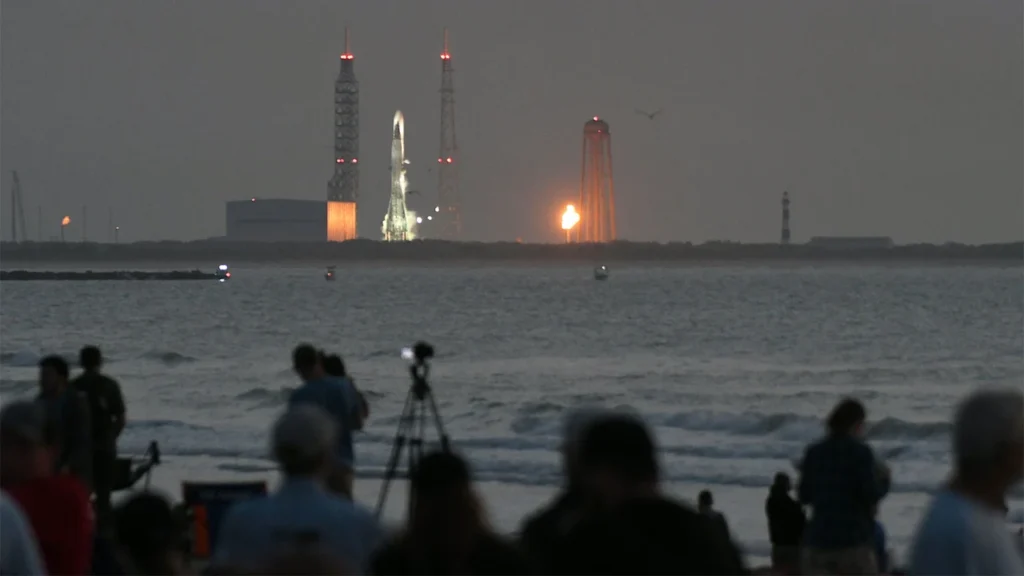
On Sunday, April 19, Jeff Bezos’s Blue Origin space company launched its flagship rocket, the New Glenn, for the third time.
The New Glenn is a partially reusable heavy-lift rocket aimed at directly competing with archrival SpaceX’s Falcon 9 and Falcon Heavy. (This rivalry pits two of the world’s richest people against each other: Bezos, founder of Amazon, and SpaceX CEO Elon Musk.)
All three of these rockets are designed to deliver payloads into space and for their boosters to safely land back on Earth after launch, for reuse in future missions. The New Glenn, named after the U.S. astronaut John Glenn, is much larger than SpaceX’s rockets, allowing it to carry larger payloads.
However, despite this benefit, Blue Origin still plays second fiddle to SpaceX, the premier private spaceflight firm that governments and companies rely on to launch their satellites.
Blue Origin had hoped that the third launch of the New Glenn would begin to change this perception.
For that launch, the New Glenn carried AST SpaceMobile’s BlueBird 7 satellite into space. And while the New Glenn did successfully launch, and its booster did safely touch back down on Earth, the rest of the mission—the part that AST SpaceMobile was relying on—did not go as planned.
BlueBird 7 satellite was misplaced in orbit
The New Glenn’s payload was AST SpaceMobile’s BlueBird 7 satellite, which is part of a constellation the space-based internet provider is building to deliver broadband internet to smartphones on Earth.
When it launches later this year, AST SpaceMobile’s satellite internet service will have the advantage of working with existing, unmodified mobile devices. In other words, you won’t need a special satellite internet-capable smartphone to get satellite internet service.
But before AST SpaceMobile can bring that service back to people on Earth, it needs to put about 45 satellites into space.
While Blue Origin’s New Glenn successfully launched the BlueBird 7 into space, the satellite decoupled from the launch vehicle and powered on, but it was placed in an incorrect orbit, making it unusable.
In a statement after the failed deployment, AST confirmed the New Glenn placed the BlueBird 7 “into a lower than planned orbit by the upper stage of the launch vehicle,” adding that “the altitude is too low to sustain operations with its on-board thruster technology.” As a result, the BlueBird 7 will be “de-orbited.”
Deorbiting is the process by which a satellite is brought back into Earth’s atmosphere in a controlled reentry so that it can burn up.
AST says the cost of the satellite, which is estimated to be in the tens of millions, should be recoverable by the company’s insurance policy.
What went wrong?
For now, it’s too early to tell what went wrong with the BlueBird 7’s deployment. Yet the fact that something did go wrong will serve as a stain on Blue Origin’s capabilities, especially just at the time when the company was hoping to start stealing some of the thunder from its main rival, SpaceX.
AST SpaceMobile has not given any explanation for why the BlueBird 7 was deployed into an incorrect orbit.
As for Blue Origin, in a social media post, the company confirmed that “The payload was placed into an off-nominal orbit,” while noting it was “currently assessing and will update when we have more detailed information.”
Fast Company has reached out to AST SpaceMobile and Blue Origin for comment.
ASTS stock drops after failed deployment
After news of the failed deployment broke, AST SpaceMobile’s stock price plunged.
As of the time of this writing, ASTS shares are currently down nearly 15% in premarket trading to $72.75 each.
Blue Origin is a private company, so its stock is not publicly traded on any market.
Until last week, AST SpaceMobile’s stock price had seen notable growth for the year. As of Friday’s closing price, ASTS shares were up nearly 18% year to date, far outperforming the Nasdaq Composite’s 5.31%. Over the past 12 months, ASTS shares have surged more than 265%.
Investors have high hopes for AST SpaceMobile. If it can successfully deploy its full constellation of satellites, it could bring space-based broadband internet to billions of existing mobile devices across the world.
But in order for the company to do that, its satellites will need successful launches and deployments—and not a repeat of yesterday’s mishap.
The company says it is continuing with its plans, with BlueBird satellites 8 to 10 scheduled to launch in the next 30 days. It says it expects to have approximately 45 satellites in orbit by the end of the year.