ETFs For Beginners
Investing in the stock market is one of the most effective ways to build wealth over time. But picking individual stocks requires extensive research, timing and risk management. Learn why Exchange-Traded Funds (ETFs) offer a simpler, low-cost alternative for both beginners and experienced investors. Find out exactly what an exchange traded fund is. Learn why index exchange traded funds make the most sense for investors. And, unpack how to invest in ETFs in a few minutes.
This article may contain affiliate links which means that – at zero cost to you – I might earn a commission if you sign up or buy through the affiliate link.
What is an ETF?
An exchange traded fund, or ETF, is an investment fund that trades on a stock exchange, much like an individual stock. Think of an ETF like a fruit basket, with each piece of fruit representing one company’s stock. ETFs can own from hundreds to thousands of individual stocks. What’s great about an ETF is, if one stock tanks, there are many more that might rise or hold steady. Whereas, if you buy one or two stocks and one of them drops in price, your whole (or half) of your investment portfolio declines in value.

What’s So Great About Index ETFs
Among the most popular ETFs are those that are modeled after popular stock and bond market indexes.
But why is investing in index ETFs so popular?
On the first day of class in my MBA Finance class, the professor asked who can beat the market by picking and choosing individual stocks (ie active investor). My hand shot up, as I had been a portfolio manager and stock picker for awhile and had performed quite well. Much to my surprise, the professor said that each year, when comparing most stock market indices with comparable actively managed funds, the index funds outperformed the actively managed funds roughly 70% of the time. Now that was several decades ago, but I’ve kept up with the research and index funds continue to outperform actively managed funds.
The reason that indices usually beat actively managed funds is because their fees are lower, and they are not plagued by human emotions of fear and greed. It’s tough for a fund which charges a 1.0% management fee to outperform an index fund with a 0.03% management fee. And, for those funds that do outperform the indexes one year, it’s unlikely that they will repeat their outperformance in successive years.
If you’re interested in learning more about Index ETFs, following are some ETFs that track the returns of popular stock and bond market indices such as:
- Dow (Dow Jones Industrial Average): A price-weighted index that tracks 30 major, publicly traded blue-chip U.S. companies. It is one of the oldest stock market indicators and serves as a snapshot of established, large-cap industry leaders. (DIA, IYY)
- S&P 500 (Standard & Poor’s 500): A market-capitalization-weighted index featuring 500 of the largest U.S. companies. It covers roughly 80% of the U.S. equity market and is frequently used as a benchmark for the U.S. stock market performance. (VOO, IVV)
- Nasdaq (Nasdaq Composite): A market-cap-weighted index tracking almost all stocks listed on the Nasdaq exchange—numbering over 3,000. It is heavily weighted toward technology, internet, and growth-oriented sectors. (QQQ, ONEQ)
- Russell 2000: A market-cap-weighted index that measures the performance of 2,000 small-cap U.S. public companies. It serves as the primary benchmark for smaller, domestically focused businesses and is often used to gauge economic conditions away from global large-cap firms. (IWM, VTWO)
- U.S. Bond Market (Bloomberg U.S. Aggregate Bond Index / “The Agg”): The standard benchmark for the overall U.S. fixed-income market. It tracks investment-grade, U.S. dollar-denominated taxable bonds, including U.S. Treasuries, corporate bonds, and mortgage-backed securities. (BND, AGG)
Benefits of Investing in ETFs and 3 Reasons Experts Recommend ETFs
- Instant diversification – Buying a single ETF instantly spreads your money across hundreds or thousands of companies, sectors, or asset classes, drastically reducing individual stock risk.
- Ultra-Low Fees: Most broad index fund ETFs are passively managed by algorithms tracking an index (like the S&P 500). Expense ratios can be as low as 0.03%—meaning you pay just $0.30 annually per $1,000 invested.
- Flexibility: ETFs trade continuously on the stock market during market hours, letting you buy or sell shares instantly with a single click.
Popular Types of ETFs
ETFs have become so popular that are roughly 4,300 available funds today, according to Bloomberg.com. Whereas the website at data.WorldBank.org pegged the number of U.S. stocks listed in 2025 at roughly 3,900. This contrasts with 8,000 or so in 1996. Given the large number of ETFs, you could find nearly any variety of fund you might imagine. But we’re not going to delve into the deep recesses of ETF investing, but will concentrate on popular Index Fund ETFs useful in creating an all-weather diversified investment portfolio.
- Total Market Index Funds: Funds like Vanguard’s Total Stock Market ETF (VTI) provide broad exposure to large-, mid-, and small-cap U.S. companies in a single fund. (SCHB, ITOT)
- 3-Fund “All-Weather” Portfolios: A classic strategy involves holding three primary core ETFs: a broad U.S. stock ETF, an international stock ETF (IXUS, VXUS), and a broad bond ETF (AGG, BND).
- Sector & Style Funds: Investors seeking specific focus can buy niche ETFs covering growth stocks, value stocks, or targeted industries like artificial intelligence (AI).
- Technology ETF – XLK
- Financial Sector ETF – XLF
- Health Care Sector ETF – XLV
- Energy Sector ETF – XLE
- Real Estate ETF – VNQ (I own this one)
Sample ETF Portfolio Allocations
If you’re just starting out and want to craft a sensible ETF portfolio, on your own, here are some ideas. In general, greater stock allocations will yield higher returns with greater price volatility. While higher fixed income allocations yield lower returns and less price volatility. Younger investors typically invest more in stock market assets, as they have a longer time frame to make up losses. While older investors, seeking capital preservation will lean towards more conservative fixed-income heavy portfolios.
Aggressive / Growth Focus (80/20):
- 50% Total U.S. Stock ETF
- 30% Total International Stock ETF
- 20% Total Bond Market ETF
Moderate / Balanced Focus (60/40):
- 40% Total U.S. Stock ETF
- 20% Total International Stock ETF
- 40% Total Bond Market ETF
Conservative / Capital Preservation Focus (40/60):
- 30% Total U.S. Stock ETF
- 10% Total International Stock ETF
- 60% Total Bond Market ETF
Ready to invest? Here’s how to open a brokerage account in minutes.
Open an Investment Brokerage Account Fast
Here’s an easy way to open a brokerage account and begin investing in ETFs.
Choose an investment brokerage firm. Typical low-fee investment brokerage firms include Schwab, Fidelity and ETrade. There are also many apps such as Robinhood and Webull, for investing. Beware of the apps, which might normalize active trading and excessive risk taking. I have brokerage accounts at Schwab, Fidelity and Vanguard.
Next, choose an account type. The most common are individual or joint taxable brokerage account of a Roth or IRA retirement account. Link your bank account. This makes it easy to transfer funds from your checking or savings account into the investment account. Fund your account – transfer the amount of money you want to invest into the account.
Search for the ticker symbol for the fund and click trade. You’ll access a form to buy the security. Here are the sections you’ll need to complete:
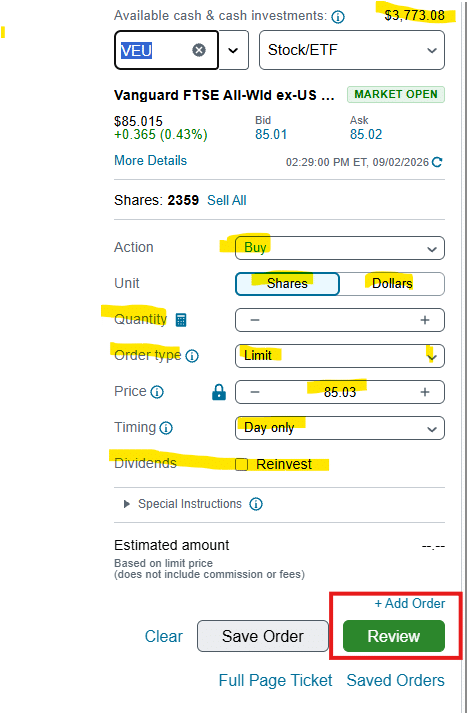
Simply, complete the highlighted sections of the trade ticket. This form was copied from my Schwab account. The ticket is self explanatory, except order type. You’ll typically choose “market order” or “limit order”. A limit order gives you control over the maximum (or minimum) price you’ll pay (or accept, if selling) for the security. A market order specifies that you’ll pay the market price which indicates where the security is trading now. Finally, specify whether you want the dividends in cash or to be reinvested in the security. Review the order, and click place. Within a in few minutes you can visit the “order” page and you’ll see the order status, whether it has been filled and at what price, or not.
Finally, most long-term investors will buy and hold their investments for the long term. Through market price movements, if one ETF becomes too large, or too small a portion of your portfolio, then you’ll buy or sell shares to return to your preferred asset allocation.
How to Buy an ETF Wrap Up
Ultimately, ETFs strip away the friction and complexity of building wealth in the stock market. By offering instant diversification, minimal fees, and simple market accessibility, they allow anyone to build a well-rounded portfolio without spending hours analyzing individual company financials. Choosing a few core index ETFs, contributing consistently, and committing to a long-term strategy remains one of the most reliable paths to financial independence.
One of my favorite ETF analysis tools is Morningstar. Click the link below for a FREE trial:
Start your Morningstar Investor free trial – unlock portfolio insights now!
Related
Actionable Investing Tips – Best Strategies For Long Term Investing
Why You Should Invest In Index Funds
Best Asset Allocation Based On Age And Risk Tolerance
Disclosure: Please note that this article may contain affiliate links which means that – at zero cost to you – I might earn a commission if you sign up or buy through the affiliate link. That said, I never recommend anything I don’t believe is valuable.
The post What Is An ETF? And Why Are They The Easiest Way To Invest? appeared first on Barbara Friedberg.