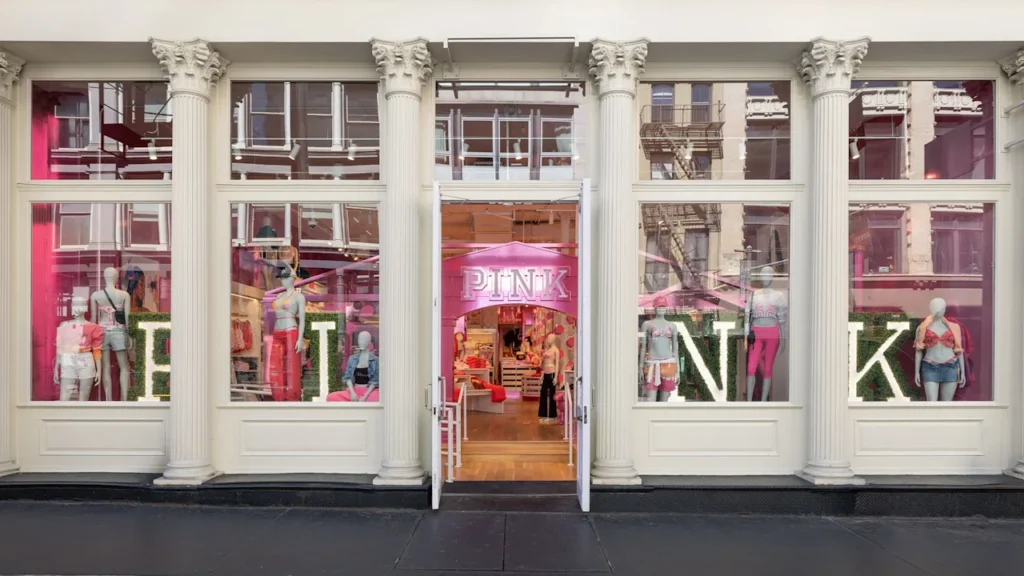
The closest thing to the idealized mall you recall either from personal memory or from cultural lore exists on a block in the Soho neighborhood of New York City, New York Magazine aptly dubbed “Tween Row.”
On a recent spring afternoon, tween girls outfitted in cable knit cardigans, pink camis, hoodies, and lowrise jeans, chatted with each other (or their willing parents) as they popped into favorite shops: Brandy Melville, Edikted, Princess Polly. As of May 14, Tween Row will get a new tenant jockeying for their attention: Victoria’s Secret’s Pink.
The store, the first designed by creative director Adam Selman, points to the retail experiences Gen Z and Gen Alpha want now—and if it works, will establish a playfully bold new identity for the brand, one little design detail at a time.
Retail as springboard for brand differentiation
For a long time, people have perceived the Pink brand to be a little sister to Victoria’s Secret, Selman tells me. This is partly due to what company representatives call “smerging,” when the Pink brand started to merge a bit with Victoria’s Secret’s brand codes: light pinks, a more muted sense of play.
“I’m trying to push away from that, to have it its own brand,” says Selman, adding that this concept is meant to be a Barbie dream house antidote to that younger sibling status, if Barbie were a teenager or twenty-something.
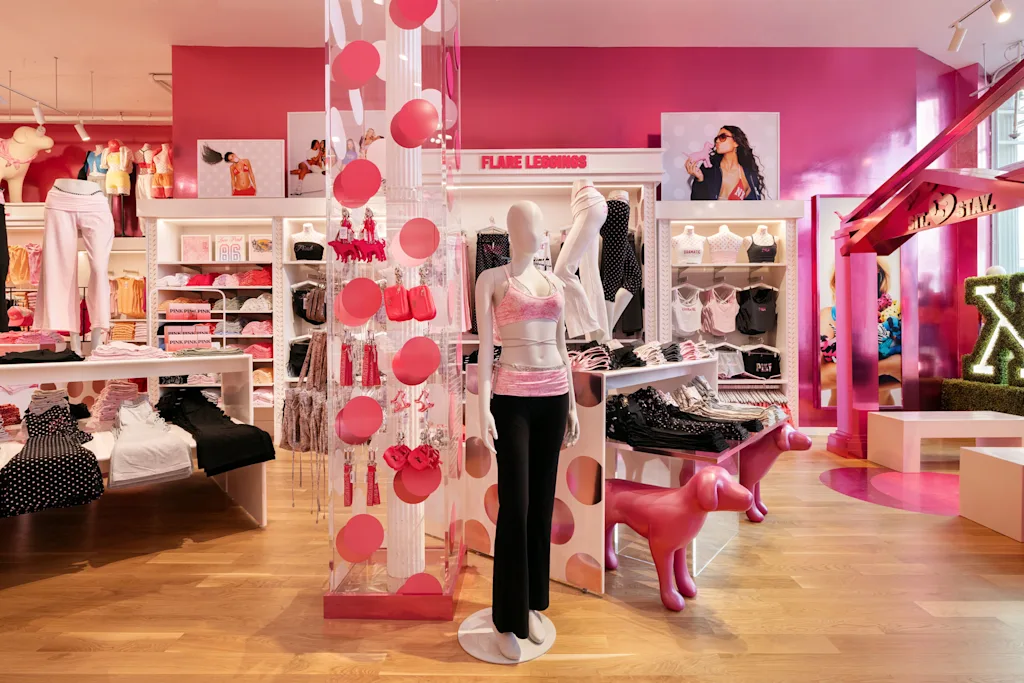
The first way Selman differentiates the retail space is through its displays, which convey look and feel as well as spatial scale. “If VS is the mansion, then Pink is the cottage,” Selman says, pointing out the glossy hot pink house structure that greets shoppers when they first enter the store. It brings down the scale of the store and creates a door frame to go through.
“It does go back to that idea of play,” Selman says, noting the age demo is 18-24 year olds. “Pink is loose, and it’s for fun, and it’s meant to be a little irreverent, and not too fancy, right? It’s carefree, and it’s more about girlhood.”
It sets up all sorts of design callbacks through the space that create a sense of casual coziness, that you wouldn’t see in a Victoria’s Secret but would, say, in a college house or summer home. All of the drawer fixtures look like trunk handles, walls have built-in cabinets backed with ivy and decked with little dog plushes from Victoria’s Secret fashion shows of yesteryear, like keepsakes.
“If you think about a cottage, there’s usually a lot of pictures around, there’s a lot of things, and there’s sayings on the walls, and things are sort of comfy and cozy and lived in,” says Selman. “So, and that really does sort of encapsulate the Pink brand.”
Rows and rows of pink pennant flags hang from the ceiling in the room immediately in front of the register. “It really feels tied to college, but you can imagine that in a space, but it feels like a modern cottage, too. It’s not old and dusty, but it’s a fun, bold expression.”
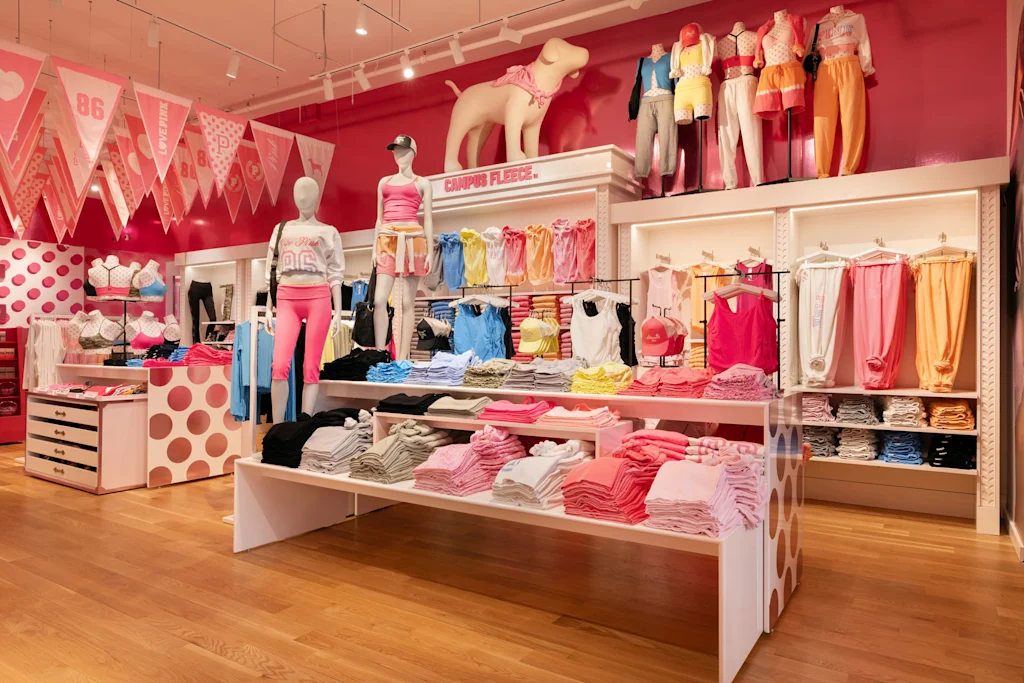
It’s definitely bold, with all sorts of witty design winks and a blitz of brand codes: layers macro pink, drop shadow polka dot wall paper, polka dot cabinet and floor decals, reflective hot pink wall paper in place of muted petal pink; oversize, all caps collegiate lettering, and yes, the Pink dog as a recurring motif. It’s girls’ best friend immortalized in photos, logo marks, and bag charms.
Selman also nods to this with a section just to the right of entry with a few benches. “Then we also made a quote, unquote, doghouse, where we’re calling it ‘sit and stay,’” he says. “For, you know, friends or boyfriends or family members to be able to, like, sit at this door while people shop. We thought it would be a really fun play, and it’s also in our brand codes.” (In maybe his greatest gift to retail, Selman has finally given TikTok’s boyfriend corner a coinage.)
And unapologetic Pink brand codes
Pink Soho is maximalist retail design. Its displays are roomy enough for product storytelling and collegiate signage that displays big product names—to directly guide shoppers to items they already found on TikTok—but neatly filled with brightly colored product (at least before its opening). There are also exclusive New York themed products at this location, a small example of its bigger strategy to grab the attention of Gen Z and Gen Alpha.
There are four prongs to what Selman says those demographics are looking for in retail right now: community building, trust, fomo-inducing activities, and brand collaborations. The store is designed with more open space than its operationally-optimized mall counterparts for community activations and engagement that build relationships with the brand, like a planned frozen yogurt stand in the summertime.
Getting a shopper into the store also signals trust, says Selman. Retail allows digital-first customers to experience a brand in its purest form with the social media interlocutor, according to Selman.
“If you show up in person, that’s trust with the customer, right?” he says.
It’s not just engagement. You build the trust and the relationship with the customers. “We’ve been in a decade of earnestness,” says Selman. “I think people just sort of want to feel something; they want to play again. We’re all missing it, no matter what age you are. That’s, again, something that Pink is really good at and is uniquely Pink.”
That’s not to say he’s not interested in IRL activations that turn into online content. “Everyone’s hungry for real life, real interaction, and it also creates a sense of, ‘I wish I was there,’ or ‘I want to experience that. Oh, she was there too. Wow, I really missed out,’” says Selman. “That’s a lot of what internet culture is right now too, is that sort of jealousy. So I think it’s an important aspect.”
The roomier concept also leaves white space for brand collaborations Pink hasn’t been able to do that digitally—but clearly has plans for. (It’s worked well for Gap’s return to relevance.)
Selman also says this Pink retail experience, through its surfaces and overall expression is “totally different” from what you might remember during your aughts mall years.
“It was loud in a very different way. Now, we’re more honed in and targeted on the customer that we’re going after, where she’s at and where she’s playing.” This summer will test whether the tweens of Tween Row will play along.