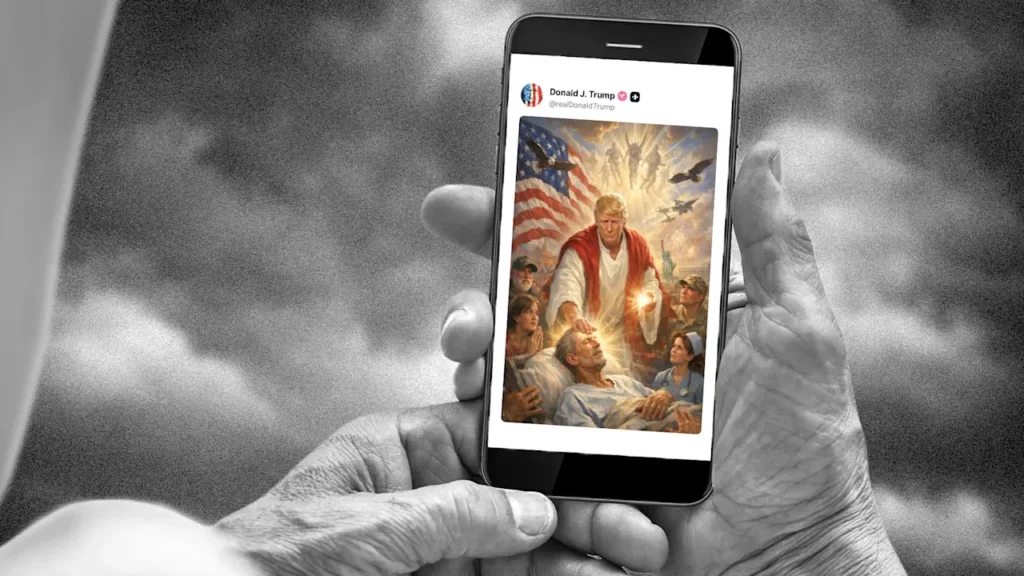
On April 12, President Trump took to Truth Social with a captionless piece of art. The now-deleted image, which appears to be AI-generated, shows Trump in a flowing white and red robe, holding his hand over the head of a dying man in an apparently healing gesture, in front of a backdrop of almost comically patriotic imagery. The implication of divine healing, paired with Trump’s tunic-like garb, makes a clear connection between the President and Jesus.
The post came after Pope Leo XIV, a vocal critic of the U.S.-Israel war in Iran, spoke out against Trump’s threats to wipe out Iranian civilization if Tehran did not agree to open the Strait of Hormuz. Leo’s dissent against the war spurred a series of insults from Trump—as well as seemingly inspiring the aforementioned Jesus-like image, which Trump posted just minutes after disparaging Leo on his official social media accounts.
In just a few hours, Trump’s post conflating himself with Jesus has caused the term “trump as jesus” to shoot to the top of Google’s most-searched list in the U.S., inspired hundreds of reactions on social media, and sparked a rare wave of dissent from some of his most ardent supporters, many of whom view the image as sacrilege.
Certainly, the image demonstrates a major overstep from a president who has repeatedly pushed on the limits of democratic power. But this is far from the first time that his administration’s social media accounts have featured problematic messaging: For months, the White House, Department of Labor, and Department of Homeland Security have been posting thinly-veiled white supremacist rhetoric, often to little public outcry. Now that Trump’s posts have offended his own Christian supporters, though, the backlash is taking off—and it feels like far too little, far too late.
Why did Trump post a picture of himself as Jesus?
The public back-and-forth between Trump and Leo started on April 7, when Leo told reporters that Trump’s threats against Iranian civilization were “truly unacceptable.”
He went on to call the President’s plan to destroy Iranian bridges and powerplants a “sign of the hatred, the division, the destruction human beings are capable of, and we all want to work for peace.” Then, over the weekend, Leo added that the U.S. and Israel’s attack on Iran has been fueled by a “delusion of omnipotence.”
Following that commentary, Trump issued a lengthy social media post on April 12 calling Leo “WEAK on crime and terrible for foreign policy” and adding that he should “stop catering to the Radical Left” (Leo has since told reporters that he’s “not afraid of the Trump administration or of speaking out loudly about the message of the Gospel”).
Less than an hour after Trump’s post calling out the Pope, he shared the AI image of himself as a Jesus-like figure, which was then deleted on the morning of April 13. Predictably, the post has inspired an influx of negative reactions from Trump’s dissenters. More notably, though, it has also sparked some vocal outcries from his most ardent supporters, many of whom have historically been reticent to criticize the president at all.
Riley Gaines, a former collegiate swimmer who has built a political platform bolstered with anti-trans rhetoric, wrote on X, “1) a little humility would serve him well 2) God shall not be mocked.”
Megan Basham, a conservative Protestant Christian writer and commentator, added, “I don’t know if the President thought he was being funny or if he is under the influence of some substance or what possible explanation he could have for this OUTRAGEOUS blasphemy.”
And Isabel Brown, a Catholic podcaster and conservative influencer, wrote, “This post is, frankly, disgusting and unacceptable, but also a profound misreading of the American people experiencing a true and beautiful revival of faith in Christ in the midst of our broken culture.”
Trump attempted to deflect the criticism on Monday morning, telling reporters that the image “wasn’t a depiction. I did post it and I thought it was me as a doctor.”
Trump’s long history of offensive artwork
The response to Trump’s AI Jesus image has been swift, broad, and almost universally negative. But this is far from the first time that Trump has posted inflammatory artwork to his official social media channels: in fact, it’s been a consistent tool for his administration throughout his entire second term.
Last summer, the Trump administration began posting pro-America artwork to its official Department of Homeland Security (DHS) accounts in between dozens of other posts celebrating mass deportations, using dehumanizing language like “criminal illegal aliens,” and defending Immigration and Customs Enforcement (ICE) raids. The artwork included a painting titled American Progress, created by John Gast in 1873, with the caption “A Heritage to be proud of, a Homeland worth defending.”
American Progress has long been used as an embodiment of the concept of “Manifest Destiny,” a belief held by many during the 19th century (and beyond) that the United States was destined by divine right to control the entire territory from the Atlantic Ocean to the Pacific. For decades, this dogma was used to explain and legitimize the forced displacement and ethnic cleansing of Native Americans.
And, since then, Trump’s administration has published multiple posts containing what experts warn are white supremacist dogwhistles.
In August 2025, an investigation from from the Southern Poverty Law Center (SPLC) found that the “DHS and other agencies have used imagery associated with the white nationalist movement and other parts of the extreme right to promote and recruit for ICE,” describing the posts as “ranging from overt nationalist and antisemitic imagery to coded racist dog whistles about the supposed loss of white American culture.”
On New Year’s Eve, the White House’s X account posted a photo of Trump alongside the word “remigration.” According to Wendy Via, co-founder of the Global Project Against Hate and Extremism, in an interview with The New York Times, that’s a decades-old European concept centered on the expulsion of nonwhite people and immigrants deemed “unassimilated.”
Later in January, the White House and the Department of Homeland Security jointly posted a recruitment ad for ICE captioned with the words “WE’LL HAVE OUR HOME AGAIN,” which is also the name of a song written by members of a group called the Pine Tree Riots, a self-described “pro-White fraternal order.”
Multiple Trump administration posts have echoed the title of the 1978 book Which Way Western Man?, which is a common source used by white supremacist groups to justify violence against Jewish people. As this piece from The Times explains, several others have been linked to neo-Nazi literature and QAnon conspiracies.
Offensive and dangerous artwork has been issuing from the Trump administration’s official social media accounts since almost the moment he took office in 2025. The only difference this time is who is offended.
