In June 2026, the Trump administration told states that they couldn’t use billions of dollars in Inflation Reduction Act federal rebates to help homeowners switch from fossil fuel appliances to climate-friendly heat pumps.
But that move didn’t affect a heat pump rebate available in Tacoma, Washington, run by the city and its local power utility.
It’s one example of how, even as the federal government takes a serious step back from climate action under the Trump administration, local leaders on the city and state level are still able to make climate progress with their own policies.
A new database, from the University of Maryland’s Center for Global Sustainability, details such city-level actions. It covers more than 1,400 policies and programs from 157 cities across the country—from building efficiency upgrades to financial incentive programs to climate mitigation actions like increasing shade in cities affected by extreme heat.
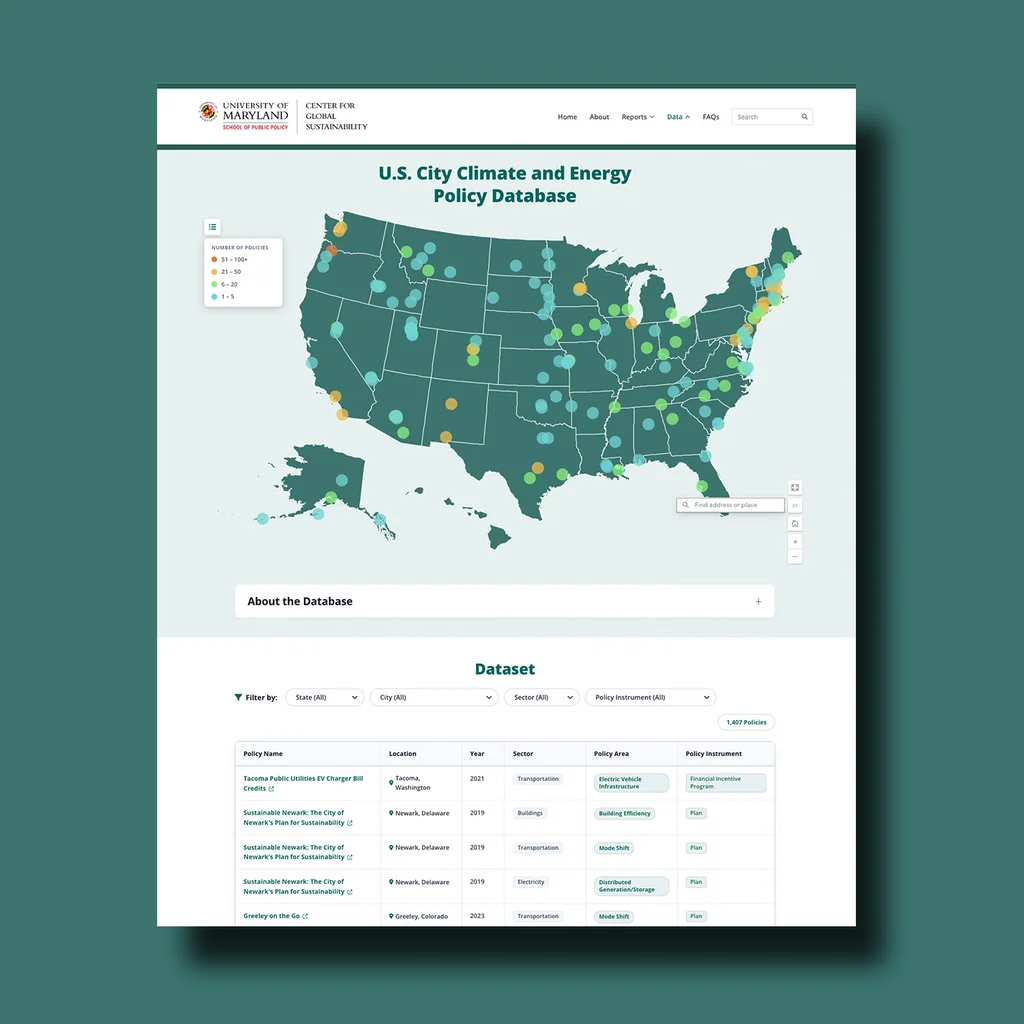
Called the U.S. City Climate & Energy Policy Database, the tool features both a map, which shows which cities have the most climate policies, and a dataset that links out to city plans and categorizes each action by location, sector, and policy area (such as transportation, electricity, or waste, for example).
“This database gives us the clearest picture yet of how cities across the country are responding to the current moment with policy,” Nate Hultman, director of the Center for Global Sustainability at the University of Maryland, said in a statement.
“What stands out is both the breadth of action and the opportunity it reveals: cities and states are pursuing clean energy and energy efficiency, and understanding that landscape is the first step toward accelerating action where it is needed most,” he added.
Other examples of local climate action highlighted in the data set include Cleveland’s plan to overhaul city facilities with renewable energy and efficiency upgrades. The city has a climate plan, introduced in 2025, to cut emissions 63.3% by 2030, which would save residents $2.3 million in energy costs and create more than 1,200 jobs per year.
In Phoenix—which saw its second-hottest summer on record this year—city officials are already in the process of adding shade to combat that heat. In 2024, the city launched a Shade Phoenix initiative to add 27,000 new trees and 550 new shade structures in the next five years.
Not every policy in the database is recent; some date back a decade. But because they’re on the local level, they’re protected from the Trump administration’s efforts to tear down federal climate programs.
We need city, state, and federal action on climate change. What this database shows, though, is that even when the federal government fails on this front, local governments can still take impactful actions.
“The data show that local leadership is real, it is widespread, and it is providing the groundwork for a better pathway,” Hultman said.