It was on maybe my third day of parenting that I realized we would need to find a thrift store. My baby was already too big for about half her brand new outfits. A significant percentage of the rest were stained with various liquids which emerged from said baby on the regular. The tiny dry-clean-only sweater someone had gifted us seemed like a sick joke. So the sweet consignment shop we found a few neighborhoods away from our own seemed like a godsend.
We had no idea.
Much is made of the merits of preowned clothing as environmentally friendly, an end run around fast fashion, a path towards more mindful consumption. What’s talked about less is the boon this fashion approach is to parenting.
Just before she started first grade, my no-longer-a-baby disabused her father and me of an erroneous assumption we’d been making her whole life: She wasn’t really a boy. Instead she was a girl. Who needed girl clothes. A whole new wardrobe of them. I tried to argue that her clothes were gender-neutral, that girls and boys both wore t-shirts and shorts and sneakers to school, especially when they were six. But I was missing the point. Gender transition requires, first and foremost, transition. As any budding fashionista knows, you can’t be a new person in the same old clothes.
It was our consignment shop that saved us. They raised not a hair of an eyebrow when we switched from the boys’ section to the girls’. This, after all, is the whole idea behind preworn clothing stores. They provide the opportunity to try something different, become partly new, release what doesn’t work anymore not because it’s bad or wrong but simply because it no longer fits. My daughter was over-the-moon, not just to have girls clothes, but to have clothes that had actually belonged to actual girls. The store liked the term “rehoming,” which had always seemed sappy to me, but that’s because I had misunderstood. We weren’t giving the clothes a new home — clothes don’t need homes — the clothes were giving us one.
Older now, my daughter no longer needs an entire wardrobe in one go, but buying used continues to provide us with more than cute outfits. Shopping for preowned clothes allows one to pass on to one’s teenager important values to which teenagers are otherwise resistant: making financially responsible choices, differentiating between needs and impulses, accepting individual responsibility in the face of global catastrophe and political negligence.
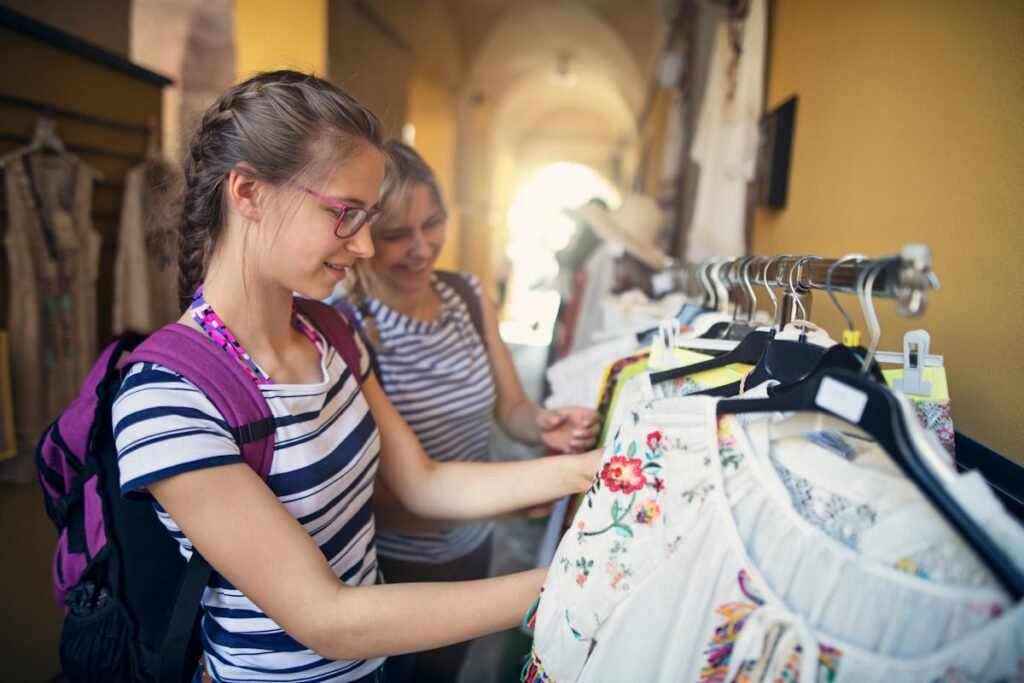
Once, refueling between thrift stores in Manhattan, my daughter and I were listing our favorite-ever finds over pizza. “Velvet bomber jacket,” I said. “Brand new Kate Spade,” she returned. “Striped palazzo pants,” I came up with. “Those platforms with all the buckles,” she said. I was about to volley back another item when she said, “What about me? You thrifted me.”
My daughter is adopted, proud to be adopted. As thrifting is her favorite activity, this joke was a not especially humble brag. But it allowed me the opportunity to reassure her, without getting mushy or being accused of — sin of sins — cheesiness, that I love her beyond words. “You were the thrifting find of a lifetime,” I said and knew she knew I meant that what I feel towards her is the besotted love and unutterable luck she felt when she found that Kate Spade bag with the tags still on. It also meant we got to have a conversation about how she was never unwanted or given away, how adoptive families are matched far more carefully than are thrifters with designer bags, how birth mothers who place their children for adoption don’t do so like placing an outgrown sweater in the donate pile but as the most difficult, complicated act of love I know.
Joyfully wearing used has even allowed us to talk about maybe the hardest topics of all: aging, illness, and death. My mother, just the other side of a health scare and nearing eighty, has instituted a “no new things” rule. She tells me, every chance she gets, she must get rid of everything she owns so that I won’t have to deal with it. When she dies, she means. But I don’t want to prepare for that before we have to. I don’t even want to think about it. I understand you can’t deal with anything after you’re gone, that preparation, by definition, occurs before it’s time. But understanding, of course, has nothing to do with it.
In contrast, my mother’s granddaughter, after all these years of practice, is much more amendable. It’s not that she wants to think of her grandparents gone any more than I do. But to her, the cycle of acquiring then adoring then shedding is natural, admirable even. Moving items along, getting rid of what’s no longer needed or beloved, is only making room for something new, freeing space for what comes next. So she helps her grandmother sort and organize: piles to donate, piles to trade for credit, piles to sell online.
And piles to go to a new home: ours. My daughter will say, “Can I have this?” and her grandmother won’t even look up to see the “this” in question before answering yes. My mother is thrilled to have someone to love what she doesn’t anymore, someone to whom to pass on items but also the stories that go with them. My daughter takes a beaded clutch along with the story of my grandmother stashing a transistor radio inside so she could listen to the World Series during High Holiday services. My mother hands over a gold signet ring with a tiny, secret door, and we laugh until we’re all in tears speculating what my great-grandmother might have hidden inside.
All of which makes a difficult task — sorting, letting go, getting ready for something none of us wants ever to happen and all of us know eventually will — lighter. There is lots of stuff to deal with, yes, but it’s brimming with gifts: stories, laughter, family history, a sense of ourselves in the world, a way to talk about hard things, an impulse to share, and the elusive, invaluable opportunity to declare undying love without — mea culpa — being cheesy before our teenagers.

Laurie Frankel is the New York Times bestselling, award-winning author of the novels Family Family, One Two Three, Goodbye for Now, The Atlas of Love, and the Reese’s Book Club Pick This Is How It Always Is. Frankel lives in Seattle with her husband, daughter, and border collie.