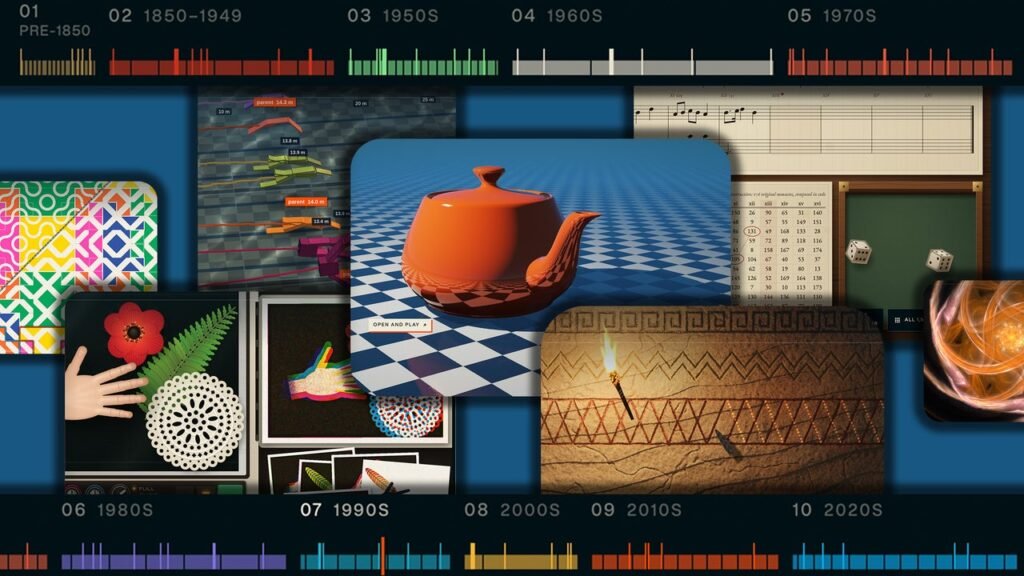
Around 71,000 BCE, someone in a place now called Blombos Cave, on the southern coast of what is now South Africa, scratched crosshatched lines into a piece of ocher. No computer. No code. No prompt. But according to The Living Timeline, launched by digital art institution Le Random, the drawing is a work of generative art, just like your latest AI-styled photo on Instagram.
The Living Timeline is an interactive history of generative art, with 1,147 moments running from 71,000 BCE to 2026 that cover artworks, ideas, and exhibitions connected to the human-made algorithms and machines that made them possible. It includes examples as disparate as those primitive etchings, the 1804 invention of the jacquard loom, and a video processor from 1974.
According to Peter Bauman, editor-in-chief at Le Random, the timeline “helps explain to people outside of the space why certain works are important.” He believes you can’t judge 1960s plotter art by its appearance alone, for example, because “you also have to consider the context, and how difficult every single thing they were doing at the time was.”
Bauman wrote The Living Timeline with contributions from Sasha Stiles—a Kalmyk American poet and AI researcher—and Vuk Ćosić, a Slovenian pioneer of the 1990s net.art movement known for his ASCII-based work.

Take those 73,000-year-old crosshatched lines in the Blombos Cave, the first known drawing by humans and the first entry in the timeline. According to art theorist Philip Galanter, professor emeritus at the Texas A&M University College of Performance, Visualization & Fine Arts, “They qualify as generative because the placement of individual marks has not been decided by the artisan, but dictated by a manually executed symmetry‐based algorithm.”
Galanter’s definition of generative art—published in a research paper in 2003—strongly influenced Bauman’s own definition, which in turn influenced the timeline. Generative art is an art practice in which an artist uses a system (natural-language rules, a computer program, a machine, or another procedural method) that contributes to or completes the work.
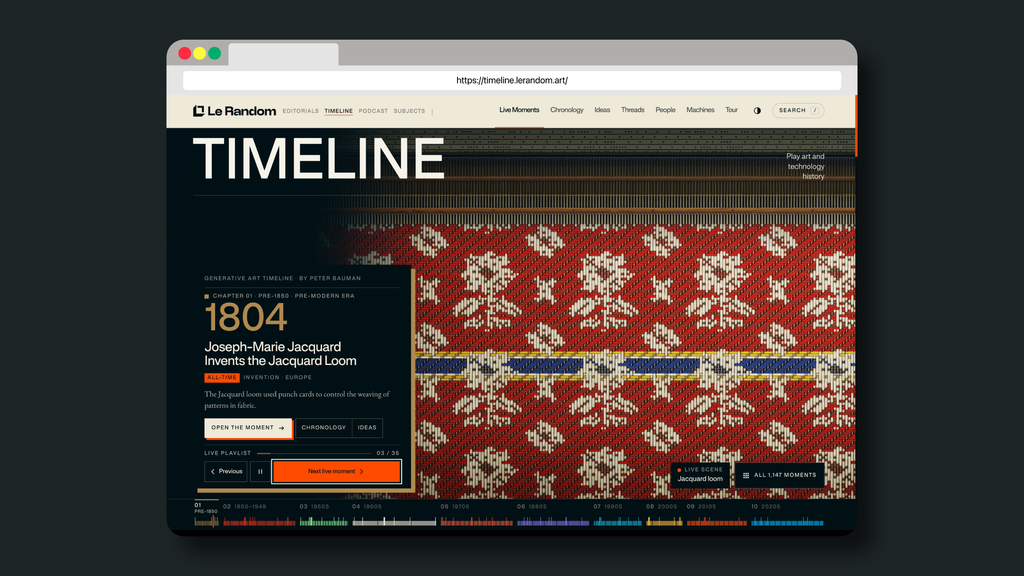
Galanter’s thesis that generative art “is as old as art itself” is a provocative, but solid, idea. Still, it doesn’t mean that all art is generative.
To know what’s generative you have to ask a simple question: Did the artist give a rule, process, material, or machine some room to make decisions? The timeline does that, connecting generative art to looms, music composed with dice, code-controlled plotters, and neural networks. The artist creates a system, and if the system helps or makes something, that’s generative art.
By that general rule, however, I can see many different rules or algorithms used to create art through the ages, from the realism provided by the perspective grids and optical mirrors that dictated the appearance of a masterwork like Diego Velázquez’s Las Meninas to the strict geometric and chromatic limits rules set by Piet Mondrian for his de Stijl-style paintings.
AI has joined the chat
Perhaps that’s why the timeline is so useful at this moment in history, as a tool to understand art under a different set of lenses. It doesn’t treat AI art as an alien object that crash-landed on culture the day somebody typed “astronaut riding a horse” into a text box. It puts AI in a long history of artists ceding part of the creative process to algorithms.
That’s what Bauman himself said in 2023: “In a way it’s that classic Philip Galanter ‘artist ceding control to an autonomous system.’” Bauman believes AI art is generative, and that AI is an autonomous system with different degrees of autonomy.
The “code” invented by the Blombos cavemen, for instance, “directed” the movement of their hands, ceding some autonomy to the algorithm but retaining final creative control. When we give an AI video generator like Seedream 2.5 a few assets with a prompt, we cede most of the autonomy and creative control to the algorithm.
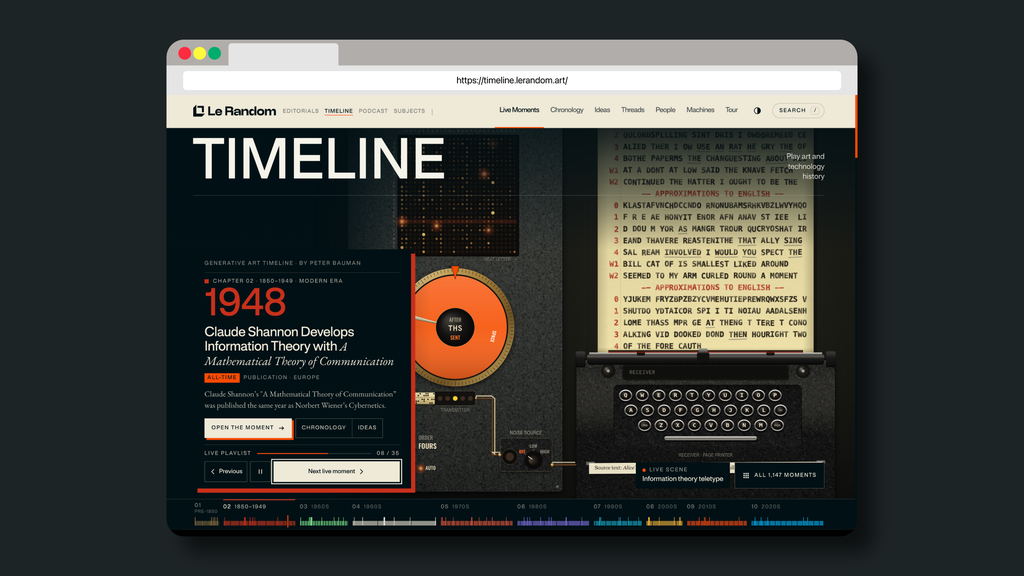
The timeline’s AI guide treats today’s image generators as the latest step in the history of AI systems, which kicks off in 1955 with the Dartmouth proposal, a paper in which John McCarthy and his peers formally coined the term artificial intelligence.
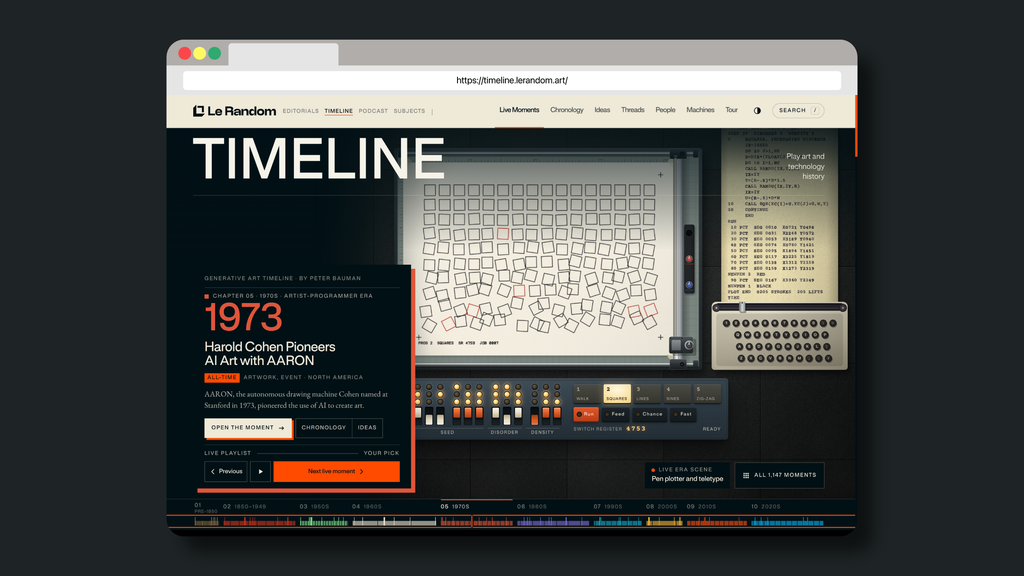
McCarthy’s ideas set in motion the events that led computer science to conceive the earliest artificial neural networks or algorithm-driven machines like Harold Cohen’s AARON, a computer program that autonomously controlled a plotter in 1973.
The archive also charts the transition to emergent machine learning. It starts with the work of digital media artist and VFX software developer Karl Sims, who used genetic algorithms to evolve digital creatures in 1994.
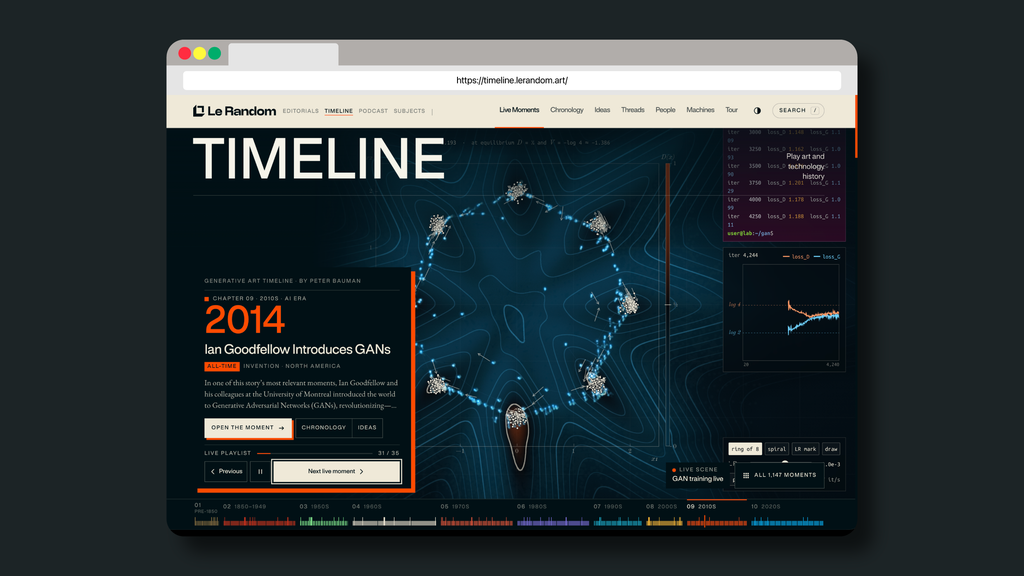
Two decades later, we arrive at the generative AI boom of the mid-2010s, with the first generative adversarial networks (GANs). Today, the latest diffusion models are so perfect that they have destroyed our reality as we know it, creating an endless stream of slop, lies, and art.
The tools have dramatically changed since that very first line drawing, but the foundational impulse—relinquishing creative control to an autonomous system—has arguably remained constant.
One timeline, many angles
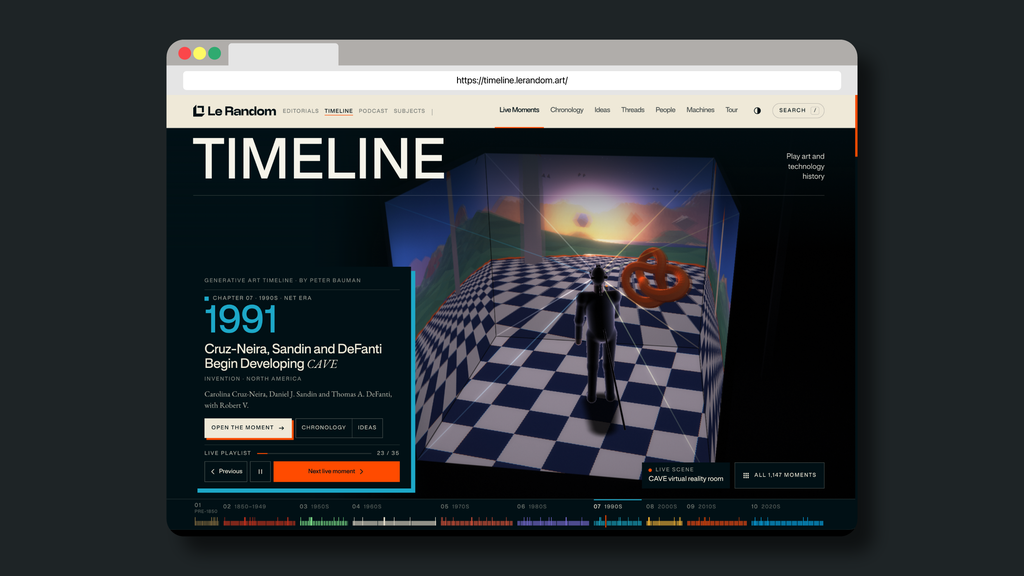
The relaunched timeline’s UX offers many different exploration paths. You can move through the history chronologically or play an automated, animated tour. You can also travel by ideas (which shows an interactive ideas cloud), threads (the interweaving strands of all the movements in generative art history you can explore through time) or people (the same, but with people grouped by different arts and organized in time on a concentric rings map, like the age of a tree).
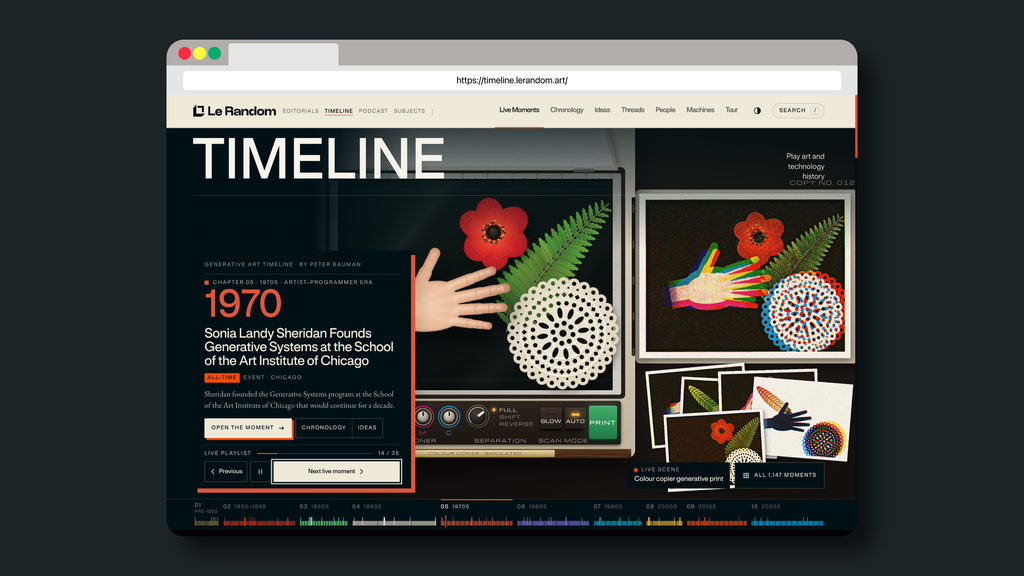
The timeline also allows you to play with the real “algorithms” used at different points in history with a collection of 36 interactive and playable machines of generative art. Instead of merely reading about all those tools, you get to play with them.
Or perhaps you can go full meta and explore the timeline using one of the simplest algorithms ever used to create art: Roll the dice. Go to the main page and scroll down until you see the button that says “roll a moment” under the head “Leave it to chance.”
Clicking there will send you to a random moment in history, a play on Johann Philipp Kirnberger’s Musikalisches Würfelspiel, an algorithm the composer invented to create music back in 1757, rolling dice to select precomposed measures to assemble his piece.