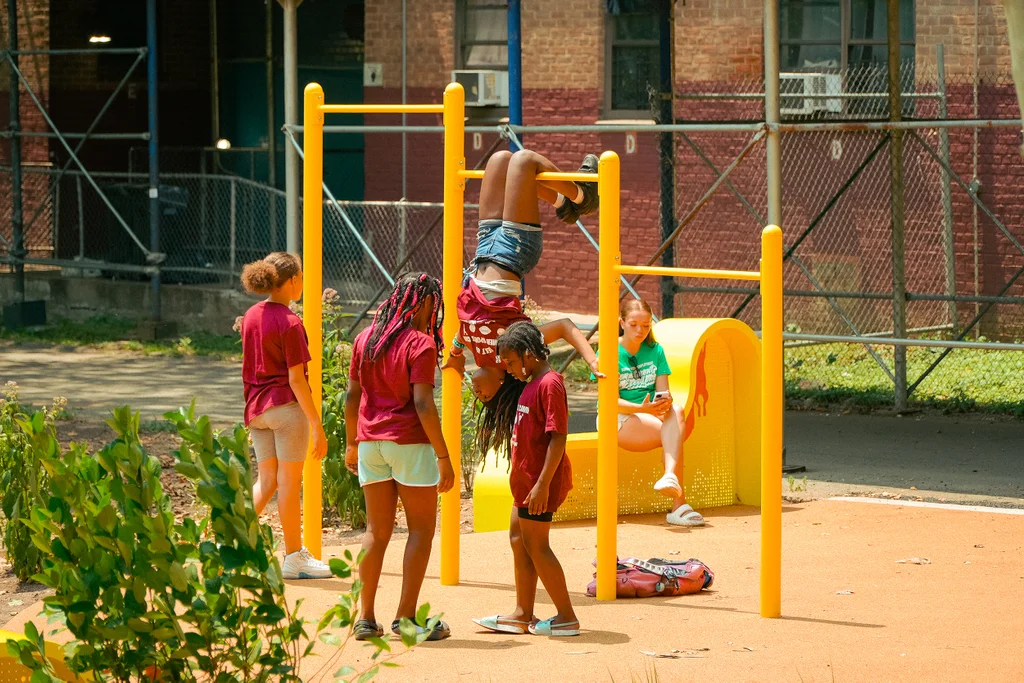
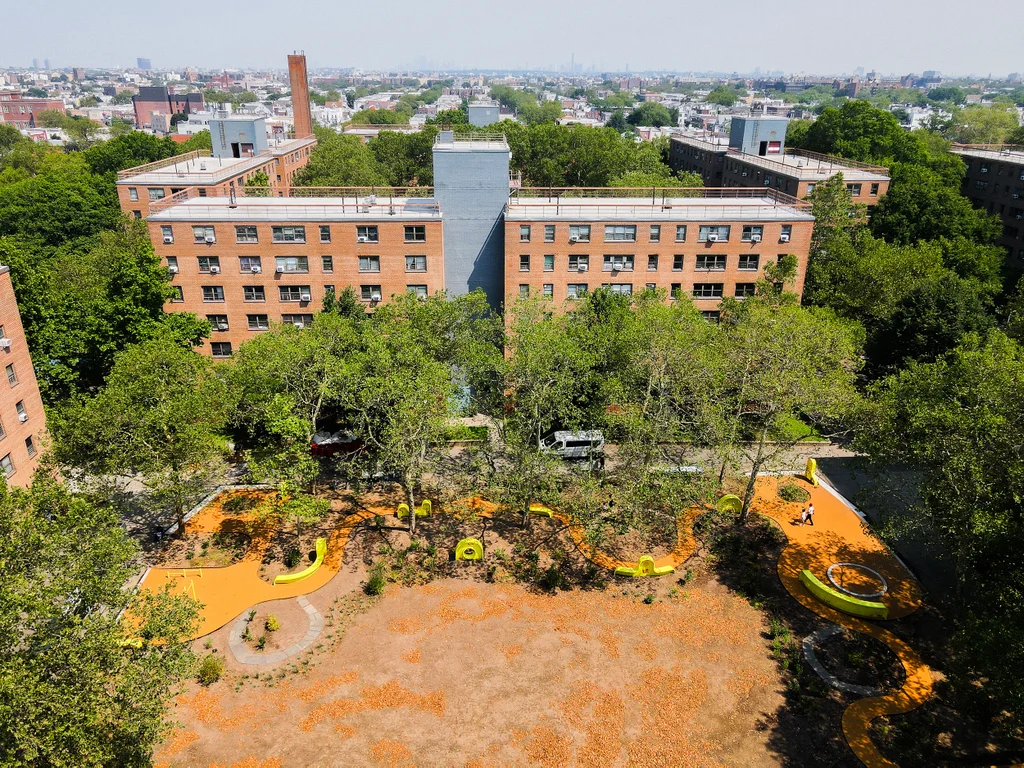
There’s really no wrong or right way to use the new playscape at Marlboro Houses, a New York City Housing Authority (NYCHA) campus in the Gravesend neighborhood of Brooklyn. The abstract, bright-yellow play structures are composed of undulating forms that can serve as benches, slides, hills to climb atop, nooks to hide inside, and portals to gaze through. Each of the forms is open to interpretation, inviting curiosity.
In addition to its abstract form, the playscape is unusual for another reason: It’s designed to be multigenerational and encourage social interaction within Marlboro’s diverse community of some 5,800 residents across 28 buildings. The open-endedness of each element means that each person who encounters the space can use it as they wish.
“We talk about this idea of a ‘playable city,’” says Maeghann Coleman, cofounder, with Ryan Swanson, of the Urban Conga, the design firm that conceived of the installation alongside the community’s residents. “How can play be layered into our infrastructure and really be these simple moments that we can engage with every day?”
The 7,250-square-foot playscape, which is divided between two separate areas on the campus, resulted from Green Space Connections. The initiative, led by the Public Housing Community Fund in partnership with NYCHA and the Design Trust for Public Space, seeks to transform underused open space within public housing into more environmentally sustainable and culturally responsive uses through participatory design.
In workshops organized by the Center for Justice Innovation, a resident stakeholder group selected the Urban Conga to help enliven their outdoor space. The residents wanted stronger connections to nature and more recreation opportunities.
For reasons that have to do with design and policing, most of the outdoor areas at Marlboro aren’t hospitable. There are large grass-filled courtyards, like the ones where the playscape is located, and mature trees, but the design tends to nudge people to keep walking. Benches face walkways, not green space. There aren’t places for groups to linger and enjoy being outside.
To determine exactly how a project could address those issues, the Urban Conga held numerous design workshops with the residents. Elders in the community described how law enforcement clamped down on public gatherings on the campus in the 1990s and how they wanted to reconnect with nature and give children the opportunity to do so too.
The Urban Conga also set up a phone line for residents to call and share their hopes and ideas for the project. Feeling safe, joyful, and excited to be outside were recurring themes, as was developing something that could better support the campus’s neurodiverse and ethnically diverse population.
The result of those collaborative workshops is a linear playscape beneath a grove of mature sycamore trees. It’s designed to provide opportunities for physical play, constructive play, fantasy play, social play, and gameplay—five common types of play that psychologists and sociologists have identified.
“I think often people think play needs to happen in this bells and whistles type of way,” Swanson says. “But it could simply just mean creating a flowing pathway with the open space where performances can start to happen.”
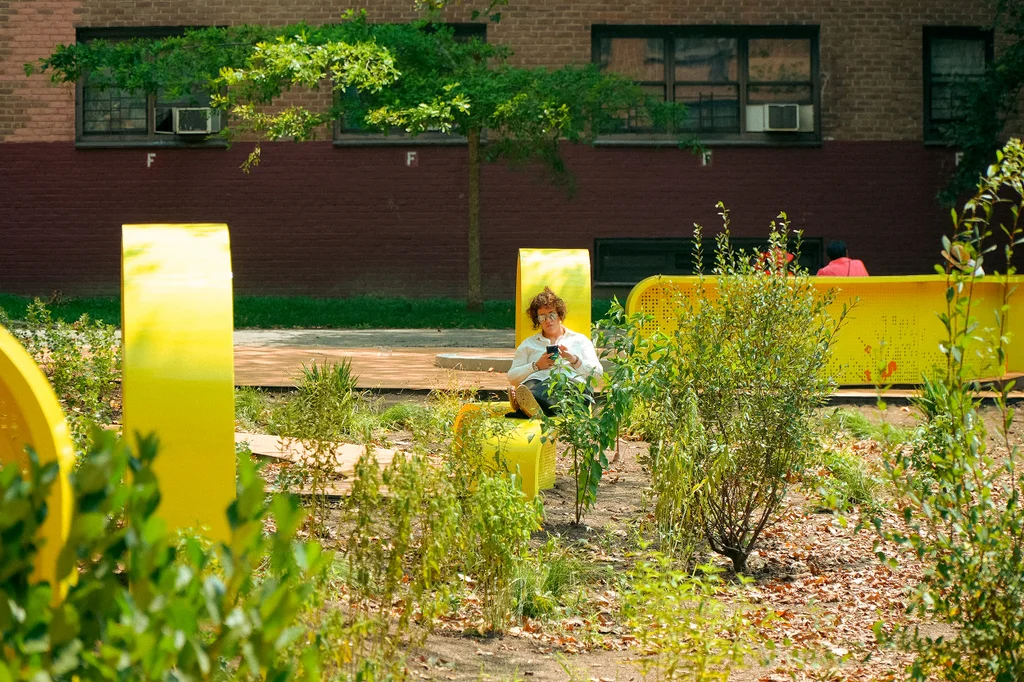
An amphitheater-like area sits on one end and is often used for group activities like outdoor movie screenings or just to sit down in the shade. Pull-up and push-up bars stand on the other end (calisthenics is popular with adults, and kids just like to swing on bars). A curved walkway made up of recycled corks provided by Cork Collective snakes between the equipment. The cushiony, slightly bouncy surface also allows rainwater to permeate.
Stormwater management was a critical part of the design. The playground is located in what NYCHA documents from 1954 describe as “sunken gardens,” but Coleman and Swanson weren’t able to find more specific information about the intended function. The area frequently floods, especially around the edges, because there are no drains.
Residents wanted a solution, so the Urban Conga, with help from landscape studio Field Form, conceived of the playground as a rain garden, too. Field Form’s specialty is working with natural hydrology, and they identified a creek flowing a few feet underground—a nod to the site’s past as a coastal meadow. They planted an array of native shrubs and flowers in the playscape that could handle inundation as well as drought. Additionally, they sloped the playscape slightly to direct water to the center of the courtyard.
“Together, these interventions reinterpret the existing ‘sunken gardens’ as an integrated, on-site, nature-based stormwater management system that captures, slows, and infiltrates runoff while also improving the landscape for the community,” Swanson says.
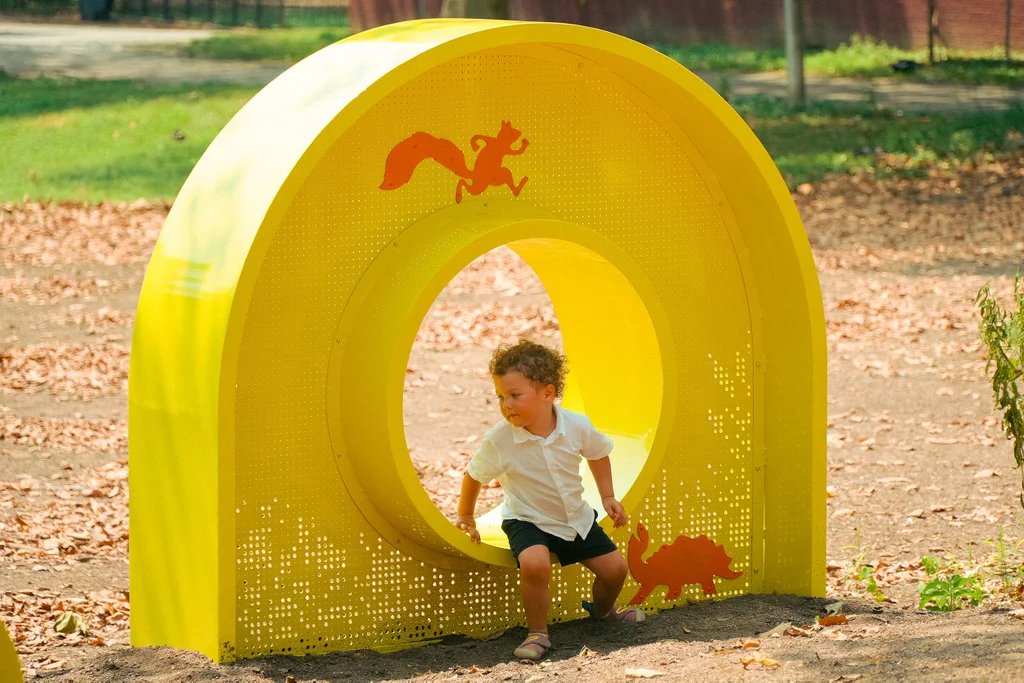
The Urban Conga integrated sensory elements to appeal to children with autism. They added a sandpapery texture on the vertical elements of the play structures and iridescent dichroic film (which changes color as it catches the light) to a rotating acrylic element. They also designed the space for comfort by building the horizontal elements of the play structures to 18 inches, the standard bench height for adults.
“If you create things based off of code, that feels recognizable, and adults are more likely to engage with it,” Swanson says. “That’s how you can get over the hurdle of making the older community or adults engage with the work and linger. Then they start to engage more with the work in the more abstract ways. Kids, obviously, will play or engage with anything.”
While the playscape opened just over a month ago, it has already functioned as intended. Adult fitness groups have spread out from the pull-up bars and use the play structures to do step-ups and bench dips. Since day one, children have been scrambling all over the place.
“We were trying to think about how to create as many opportunities for people to make it theirs as possible,” Swanson says. Coleman adds: “With all of our projects, we don’t want it to be one-note. We want it to forever evolve and be dynamic enough to evolve with the community that’s there over time.”