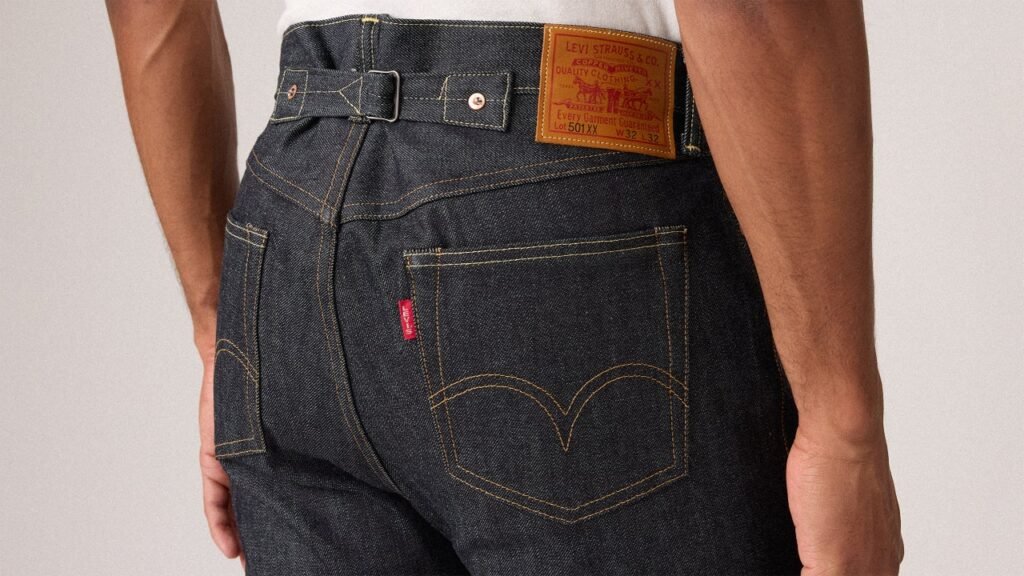
Levi’s just recreated one of the rarest models of its most iconic jeans, and they’re a relic of a crucial moment in garment design history.
The jeans, Levi’s 1942 501s, document a short-lived period of the brand’s history around America’s entry into WWII, when rationing would fundamentally change the construction of its jeans. Levi’s recreation was spearheaded by Levi’s Vintage Clothing (LVC), the brand’s heritage-focused arm, and encompasses an exact replica of the jeans—from the weight of the denim down to the stitching and rivets. Just 800 pairs of the $295 limited-edition pants were made, and they’ve already sold out online after debuting on August 13.
To reproduce the 1942 501s, the LVC team consulted Levi’s archives, sourced a genuine pair of the jeans from Tokyo, and analyzed every detail of the design to capture a snapshot of apparel history in jean form.
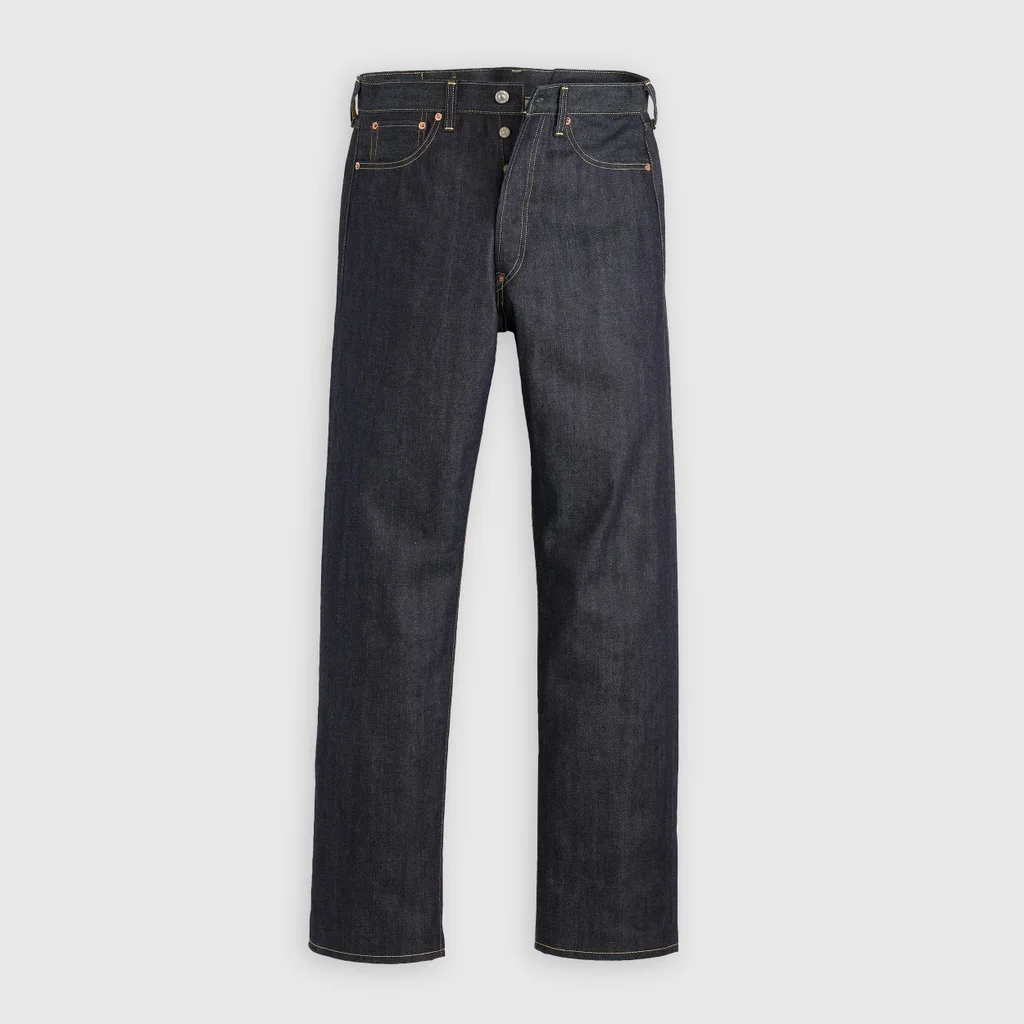
Wearing a piece of history
LVC started as a concept in 1996, when Levi’s decided to reproduce and reissue several pieces from its archives. In 1999, LVC became a collection, and today, it’s an entire team dedicated to converting the brand’s history into wearable artifacts.
Paul O’Neill, the design director, says that every LVC piece—from its 1922 “Japan” 501s to its 1970s 517 Bootcut Jeans—starts with a visit to Levi’s physical archives. The archives, located at Levi’s San Francisco headquarters, houses thousands of original garments and pieces of ephemera dating back to 1873, when Levi Strauss & Co. patented the original riveted blue jean.
“We study the original garment in detail and work to recreate every element, stitch for stitch,” O’Neill says. “That can mean analyzing everything from the slub pattern, yarn count, and depth of shade of the denim to the quality and tanning process of the leather patch, the copper rivets, and everything in between.”
In the case of the 1942 501s, the team studied several garments from that year, including a number from the archives and one sourced from the vintage store BerBer Jin in Tokyo, a longtime friend of the brand. O’Neill says that, given that each garment was nearly 100 years old and they varied in condition, it was crucial to examine several pairs in order to confirm that the fit, construction, and details of the reproduction were as accurate as possible.
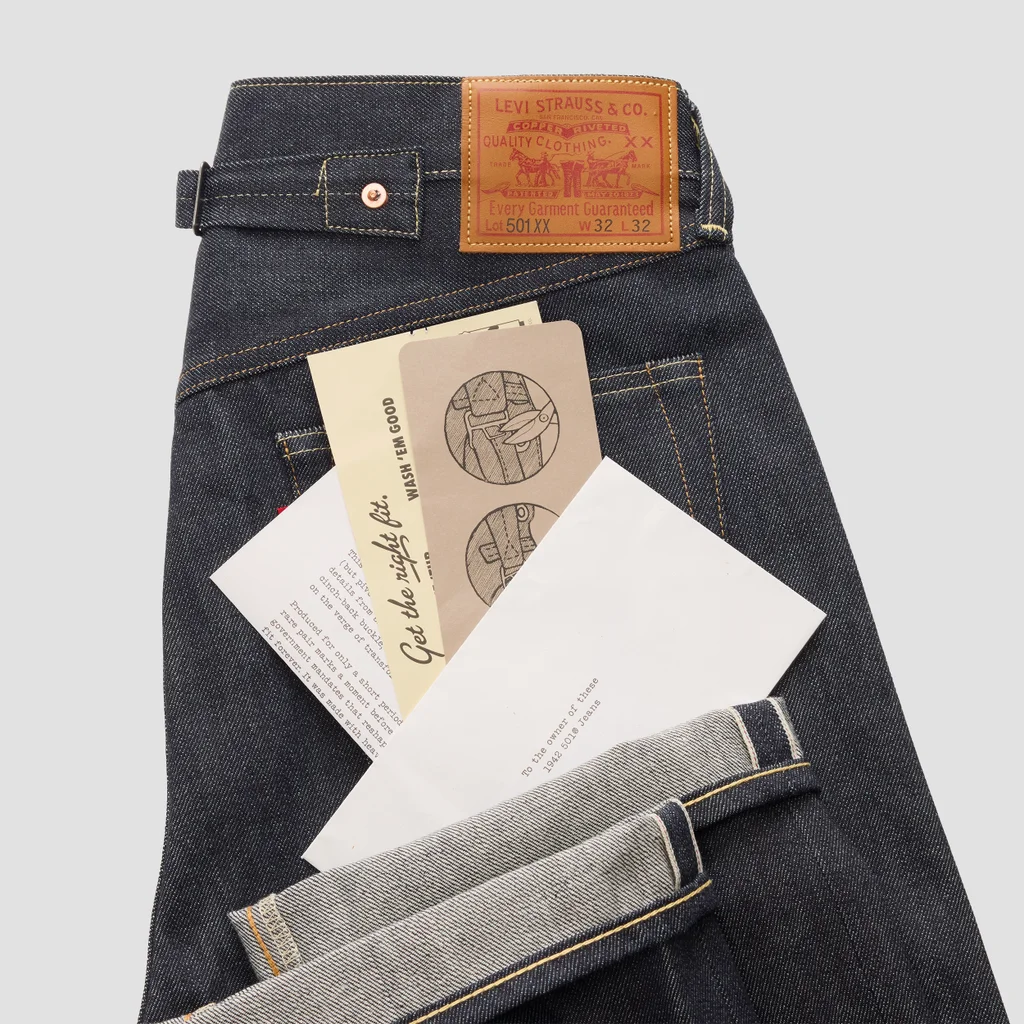
“The 1942 501 is a transitional model that was produced for a relatively short period of time,” O’Neill explains. “It retained details from the 1930s models, including the cinch-back and crotch rivet, while introducing the heavier-weight denim that would become standard in the 1940s and beyond. Shortly after this model was produced, World War II rationing would dramatically change the 501, making this particular version especially rare and historically significant.”
The reproduction is faithful to that duality. Like earlier ’30s models, it has a cinch back, complete with its distinctive buckle, a single-sided Big E Red Tab, and a Two Horse leather patch; while the denim is a 12 oz. shrink-to-fit selvedge denim, which represents the new, heavier denim coming into vogue in the ’40s.
Each pair of the reconstructed 1942 501s also comes with the paper ephemera that accompanied the original jeans, carefully modeled after the archival versions. These include a guarantee ticket, also known as the “dollar bill,” that assured customers they were buying an authentic pair of Levi’s, as well as a pocket flasher, which emerged as a way to communicate the rivets were still present when the back-pocket rivets changed from exposed to hidden, and later evolved into a way to communicate information about the product.
For LVC collectors, owning these reproductions isn’t just about buying a new pair of jeans, but rather experiencing a design moment that, until now, has been tucked away in the archives.
“Our aim is to recreate each piece so that when you buy it, you feel like you are getting a piece of history,” O’Neill says.