As artificial intelligence use skyrockets, tech companies are racing to build data centers, the infrastructure needed to run and teach their models. There are roughly 4,000 data centers around the U.S., with reports suggesting 3,000 more are coming online soon.
Just one problem: No one seems to want a data center in their backyard. Communities oppose them because they consume massive amounts of energy and water and pollute the environment. Another concern? Data centers are major eyesores.
These complexes can span hundreds of acres and usually feature uninspiring, windowless concrete facades. Built quickly, efficiently, and as inexpensively as possible, their design is determined by practicality, not aesthetics.
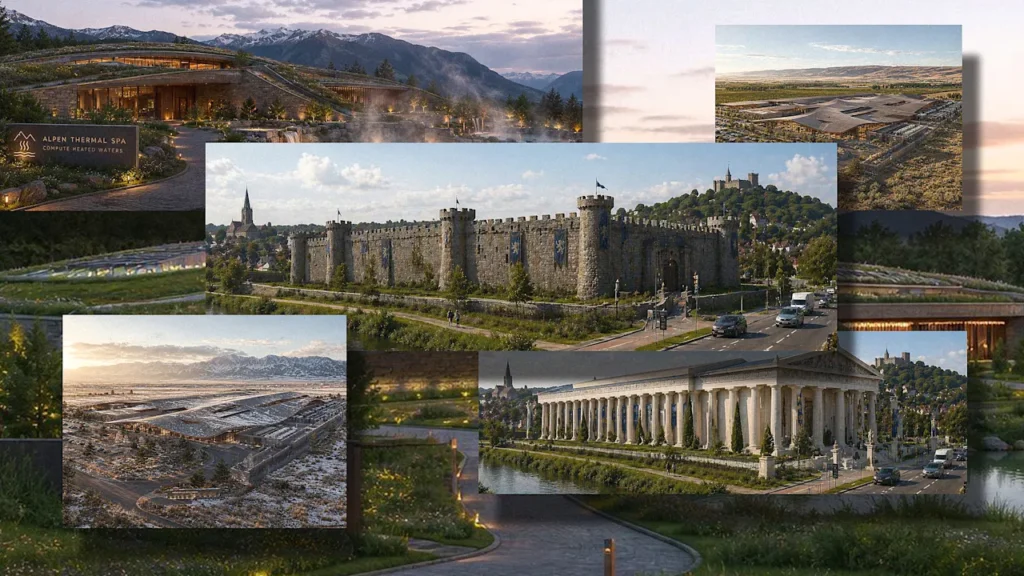
As more and more continue to pop up, fed-up observers of the trend are turning to social media to propose fantastical AI-generated renders of what these structures could look like.
Could and should a data center resemble the Shire? An Alpine spa? A castle? These are just a few of the ideas circulating.
Venture capitalist Joshua Kushner sparked the conversation with a post saying, “make data centers aesthetically beautiful,” though he didn’t offer any specific visual suggestions.
One X user who created an AI rendering of a data center tucked into a hillside, just like the hobbit houses in J.R.R. Tolkien’s Middle-earth, posted: “Genuinely if datacenters looked like this, the nimby angst around them would drop by half.”
The ideas are far out. One armchair designer (who also happens to be an editor at The Economist) shared a data center dressed to look like a medieval stone castle, writing, “Many people do not seem to want data centres built near them, despite the fact that they don’t cause that much traffic and often generate a lot of local tax revenue. I suspect it’s partly because they’re ugly!”
He also posted a render that imagines a data center done up to look like the Parthenon, captioning the image: “This is not beyond our abilities.”
While those proposals might be more joke than reality, others are finding a lesson in the discussion about data center aesthetics.
“To me, the opportunity here is not greco-or-techno-futurism,” designer Joshua Puckett said on X. “It’s to create a regionally inspired form that settles into the land rather than stand in defiance of it.” He also shared renders of a hypothetical data center in three different cities: Sydney; Denver; and Columbia Basin, Washington. The design features an undulating, serpentine roof that blends into its surroundings.
Sure, these are social media gimmicks. But for those in the architecture field, the AI renderings also illuminate tensions about what is actually buildable and why.
Architect Sean McGuire didn’t mince words. “Every day I open this app to another bird-brained take: ‘Why won’t designers make it pretty, look what I cooked up in 0.0003 seconds in ai,’” he posted on X.
The issue isn’t necessarily designers’ will; it’s the policy around construction. “Begging people to spend five seconds learning why buildings look the way they do,” he wrote. “It is code. It is financing. It is policy. Aesthetics are downstream of all of it (unless mandated in zoning! which usually fails!). Your AI rendering is a screensaver. Infrastructure CAN be beautiful, we need to set our expectations at a reasonable target.”
But is beauty really the main problem?
Discourse around data centers is not only on their rather boring exteriors, but also how energy-intensive they are to run. No matter how beautiful we make data centers on the outside, these core problems remain.
But still, more data centers will be built. Regardless of whether the new structures will look like something out of a movie or more grounded in reality, the rapid expansion does present a blank canvas to build beyond just practicality.
“The warehouse design approach of most data centers is the architectural equivalent of burying one’s head in the sand,” Fast Company’s Nate Berg argued in December last year. “The boring design of data centers is a missed opportunity to counter their negative externalities with at least a little upside.”