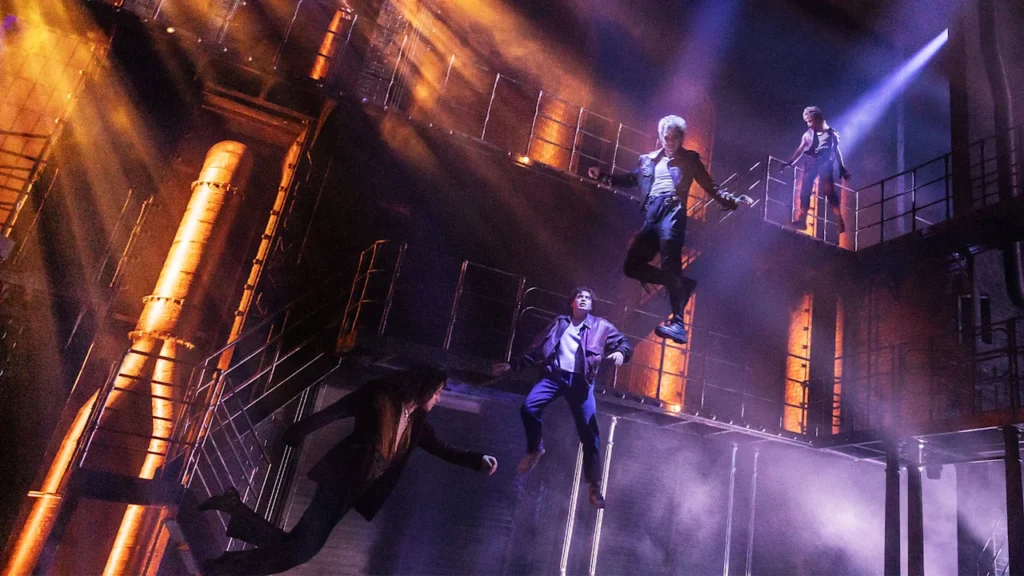
When you’re building sets for a musical that’s populated by flying vampires, you have to challenge yourself to think three-dimensionally.
But Dane Laffrey is used to challenging himself.
Over the course of his decades-long career in theater, the Tony-winning scenic designer has been tasked with bringing to life some of the most memorable sets in recent Broadway history—from a sandy, 360-degree Caribbean archipelago for the 2017 revival of Once on This Island to the futuristic South Korea setting of 2024’s Maybe Happy Ending.
Now Laffrey’s set designs are literally soaring to new heights—while also sinking to new depths—in The Lost Boys, a dynamic and at times acrobatic musical that opened last month at Broadway’s Palace Theatre.
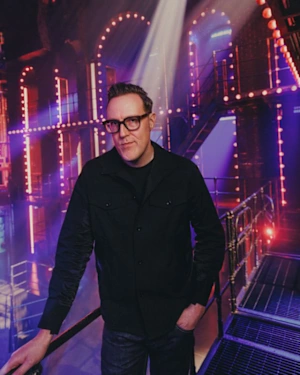
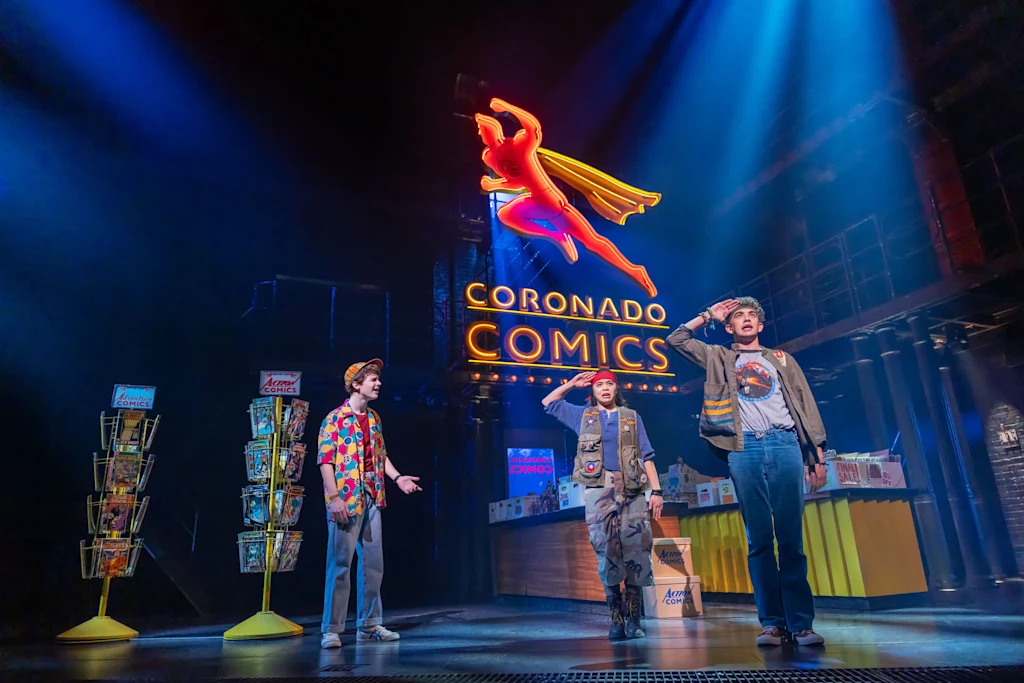
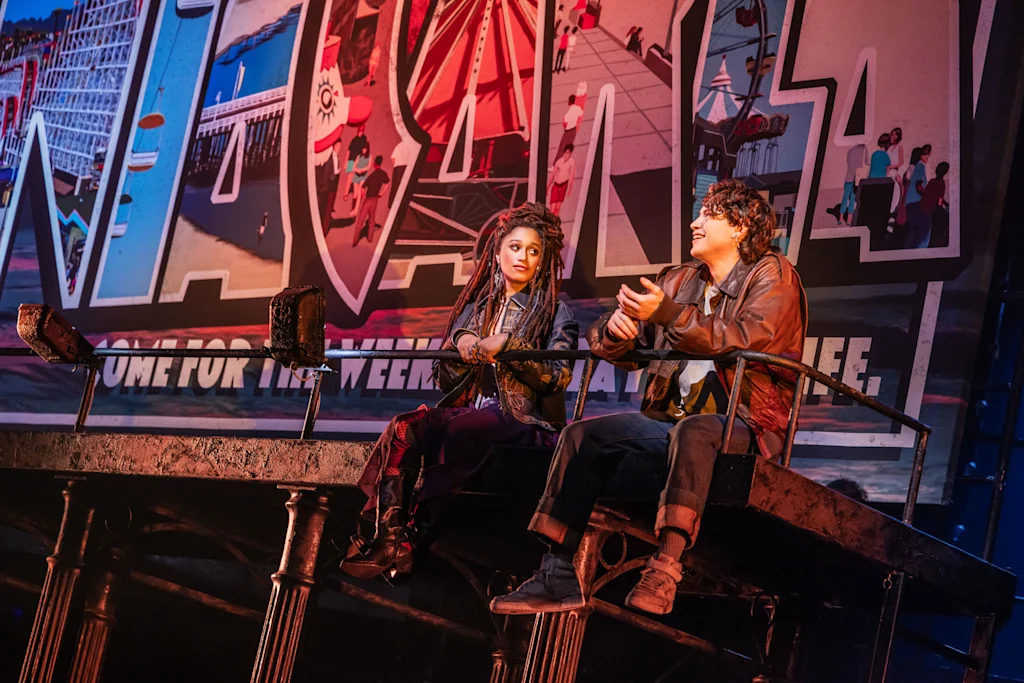
Based on the 1980s movie about undead teenagers running amok in a California beach town, the musical demanded a head-spinning array of disparate locations: for starters, a seedy arcade, a washed-up boardwalk, a sunken-in mosh pit, a towering railroad trestle, and a postindustrial underground lair where the vampires claim their victims—complete with its own working elevator.
In the vast expanse of the Palace, one of the biggest houses on Broadway, Laffrey’s work astounds as it morphs into all these locations in service of the fast-paced story, sometimes offering the actors multiple levels on which to perform their action-packed sequences, and other times moving out of the way completely so they can take flight.
You may find yourself anxiously holding your breath as you wait to see if everyone lands on cue, and fortunately, Laffrey’s Rubik’s Cube-like set pieces always slide into their proper place at just the right time.
Taken in as a whole, the experience is at once intense and hard to describe, which is the point.
“Hopefully, it feels boundless in a good way,” Laffrey tells Fast Company in an interview from his office in New York’s Hell’s Kitchen neighborhood. “One of the things we’ve tried to do is make the audience unaware of the boundaries of the space. You can’t quite tell where the theater begins and the set ends, or where anything goes, or quite how big anything is.”
Laffrey approached The Lost Boys set design by viewing the story’s central location not just as a backdrop, but as an “important character” in its own right: the rustic old house where the Emerson family, fleeing an abusive patriarch, first arrive in the opening scene.
“It’s a metaphor for the thing that everybody in the story is yearning for,” he says. “They’re yearning to belong. They’re yearning for a home.”
As the musical faithfully follows the main beats of the movie, the house had to be ready to accommodate key scenes, including quieter moments between the family and a major showdown that involves some effects-laden vampire hunting. That meant a house with multiple levels, rooms, and complex moving parts, Laffrey recalls thinking early on.
That same house then also had to disappear—quickly.
“We needed to be able to explode out onto the Santa Carla boardwalk, and have that feeling of scope and mystery and luridness, and find ourselves in the vampires’ lair, and do a lot of magic tricks, and the list goes on,” Laffrey says. “So the challenge of this show was figuring out how to hold all of those quite divergent visual ideas into one container.”
The Lost Boys was nominated for 12 Tony Awards this week, including best musical, with Laffrey picking up a nomination for his scenic design.
Blood, sweat, and fangs
Adapting a movie into a musical always brings with it a delicate balance: how to honor the source material while also pushing it into a direction that justifies the singing and dancing.
Pleasing the fans can be its own thing entirely, perhaps especially so with The Lost Boys. The movie is, if not quite a cult classic, certainly a Gen X touchstone with its share of pop-culture references. Kiefer Sutherland’s bleached mullet aside, there is also the famous scene of the gang hanging from a bridge—which is restaged brilliantly here.
Laffrey hadn’t seen the movie when he first joined the project, and he confesses that he waited as late in the process as possible to do so, in the interest of developing his own “visual point of view” about the story.
“Being tabula rasa is an incredibly valuable place to find yourself artistically as a designer or visual artist,” he says. “I was able to confront The Lost Boys for the longest time just as a piece of theater, as it was being written.”
The production comes about a year after Laffrey, along with George Reeve, took home the Tony Award for best musical scenic design for Maybe Happy Ending, the sleeper hit about two obsolete robots who fall in love.
Side by side, the two shows are a study in contrasts, with Laffrey remarking how he tries not to repeat himself.
Indeed, the set pieces for Maybe Happy Ending are unabashedly sleek and modern, with bright colors and size-shifting rooms that underscore the intimacy of the storyline and complement its romantic undertones.
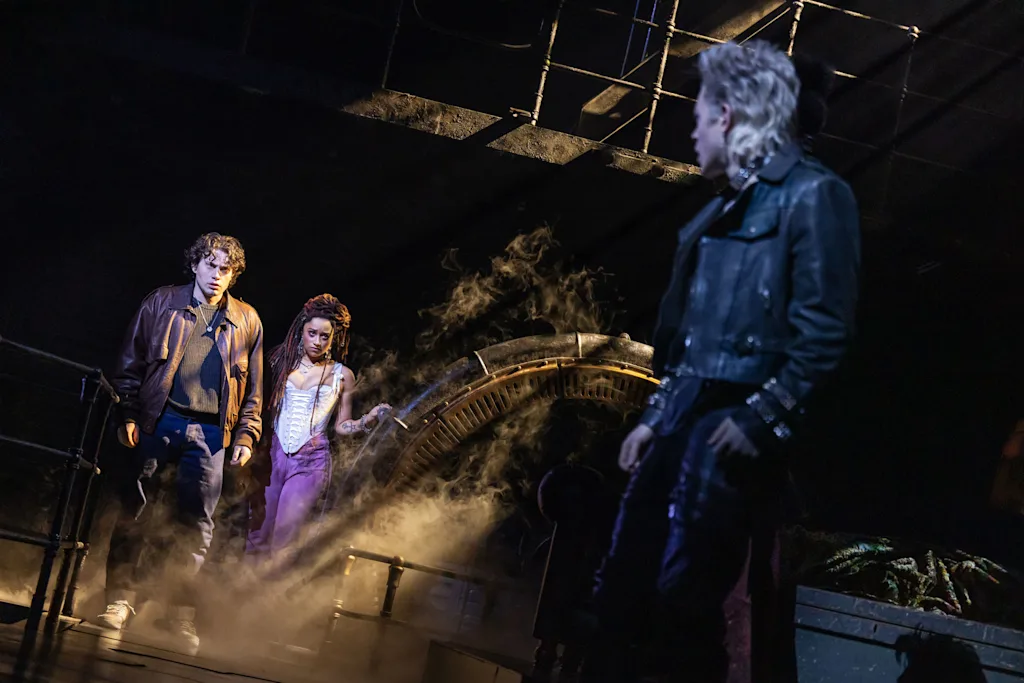
The Lost Boys, meanwhile, is awash in brown and rust, a dreary cast-iron portrait of a town that’s long past its prime. “There is a lot of detail in there that hopefully flags that this is something that has some history to it, and some weight and some time on it,” Laffrey says. “And we’re sort of layering 1987 on top of that.”
In contrast to the immersive projections that won such acclaim in Maybe Happy Ending, the only screen we ever see in The Lost Boys is a tube TV set featuring a speech by Ronald Reagan.
“The needs of those shows couldn’t be more different,” Laffrey says.
One thing they share in common is director Michael Arden, Laffrey’s longtime collaborator. The two met in high school in Michigan and have been close friends for 25 years, he says—vital in a business that thrives on relationships.
“The building blocks of a shared vocabulary are so valuable in making really dynamic art,” Laffrey says.
The Lost Boys marks Laffrey’s and Arden’s seventh show together. The pair also have a producing interest in the show through their production company, At Rise Creative. Laffrey says the company raised “several million dollars” for the project, though he declined to share a specific figure.
While creatives often serve as producers on movies, this arrangement is less common in theater, Laffrey points out. He says it’s a testament to what he and his producing partners see as the creative and commercial potential of the show.
“As people who intend to make ambitious theater—which also becomes expensive theater—we want to be conscious of making expensive theater that is also sustainable theater,” he says.
They’ll have their work cut out for them. Profits can be ruthlessly elusive on Broadway, where most shows don’t recoup their full investments and many close under the weight of crushing operating costs and light attendance.
For now, the buzz is on their side. In addition to this week’s Tony nominations, The Lost Boys earned a wave of positive reviews when it opened last month, with Laffrey’s work in particular being praised in The New York Times, Deadline, The New Yorker, Variety, and elsewhere.
The show is being cited as the one that finally broke Broadway’s notorious “vampire curse,” a reference to early-2000s musical flops such as Dance of the Vampires and Lestat.
But then maybe that’s because, in Laffrey’s mind at least, The Lost Boys is not really about vampires at all.
“The vampires are a textural element in this world, but this is a story about lost people and a family that’s breaking apart,” he says. “There’s something universal and emotionally resonant about that. Those are the things you need for a musical to really work.”