Source: AGU Advances
As human activity has increased temperatures globally, determining the costs directly incurred by climate change is challenging. The effects of climate change on extreme weather events—such as hurricanes and heat waves—can be locally specific and variable, and observations and climate modeling might not accurately capture those effects.
One way researchers attempt to estimate the costs of climate change is by comparing an actual extreme weather event to a hypothetical scenario in which climate change wasn’t a factor. Extreme event impact attribution (EEIA) uses these comparisons to estimate the damages and costs associated with climate change. But multiple versions of EEIA exist: A frequency-change approach asks how much more likely an event was made by climate change, whereas an intensity-change approach asks how much more damaging an event was made by climate change.
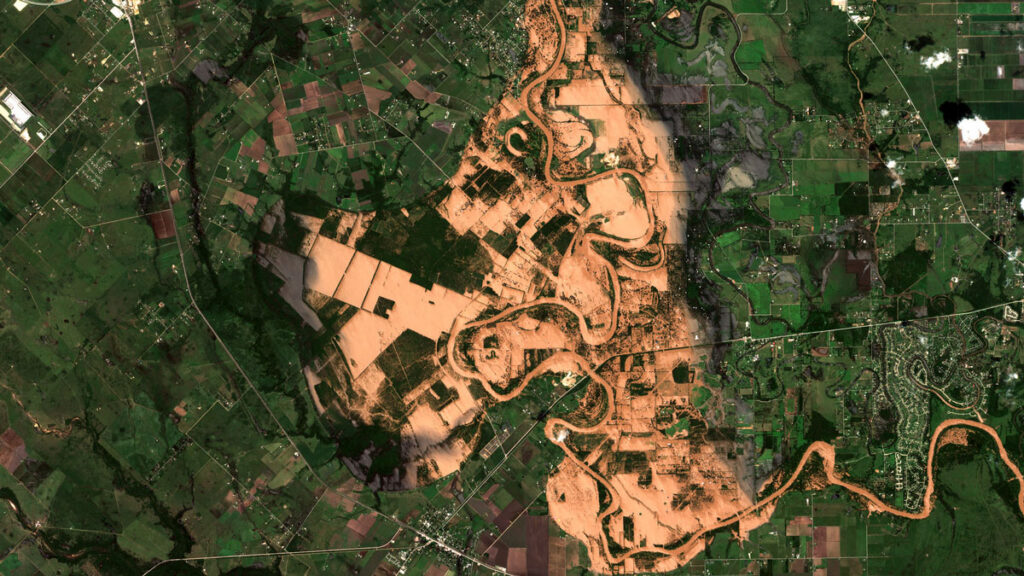
These approaches can produce vastly different estimates of the costs of climate change. For example, 2017’s Hurricane Harvey caused an estimated $90 billion in damages. A frequency-change approach estimated that 75% of these costs could be associated with climate change, but an intensity-change approach put the estimate at only 15%. If the two estimates were expected to agree, then this large discrepancy would seem to imply that at least one of the methods has technical limitations or is not theoretically valid.
To determine whether a method is theoretically valid, Match et al. introduce the framework of consistency. A method is consistent if, when applied to a group of events over time, the total costs attributed to climate change by EEIA match the actual excess costs incurred. The researchers report that both frequency- and intensity-based approaches can be consistent. The consistency framework clarifies some of the specific conditions needed to capture excess costs coherently and accurately.
Because both methods can be consistent, and therefore valid, the costs of climate change from an individual event are inherently ambiguous, the authors say. They add that no technical breakthrough—or even perfect knowledge of climate and society—can eliminate this ambiguity, which could limit the ability of EEIA to inform adaptation, recovery, or litigation. (AGU Advances, https://doi.org/10.1029/2026AV002546, 2026)
—Rebecca Owen (@beccapox.bsky.social), Science Writer

Citation: Owen, R. (2026), The ambiguous costs of climate change, Eos, 107, https://doi.org/10.1029/2026EO260328. Published on 16 October 2026.
Text © 2026. AGU. CC BY-NC-ND 3.0
Except where otherwise noted, images are subject to copyright. Any reuse without express permission from the copyright owner is prohibited.