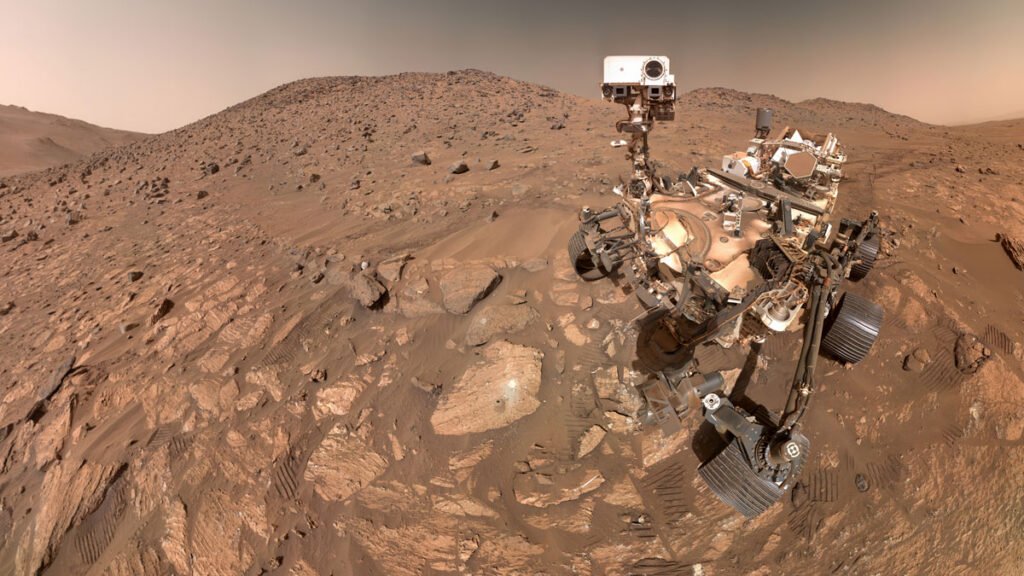
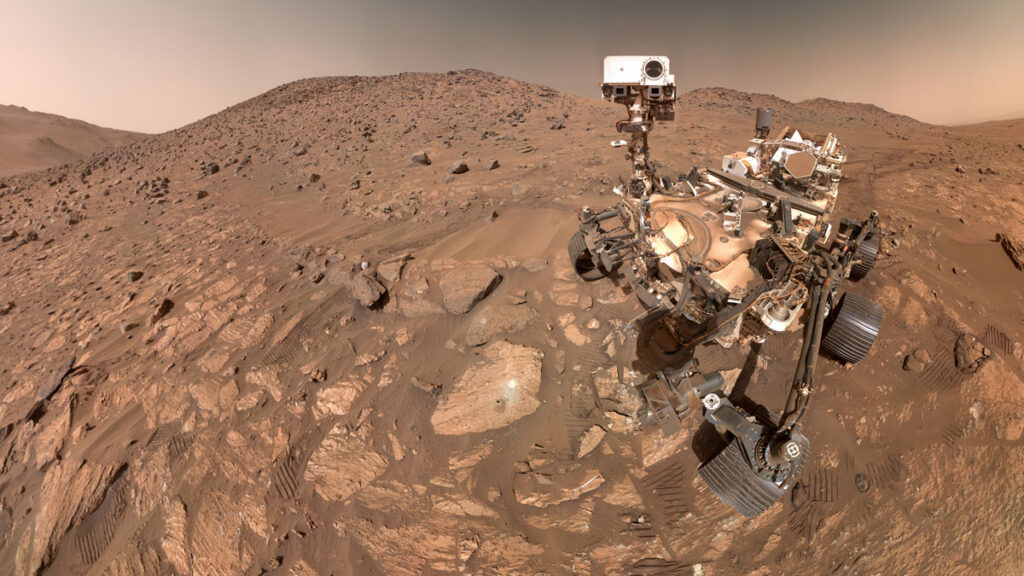
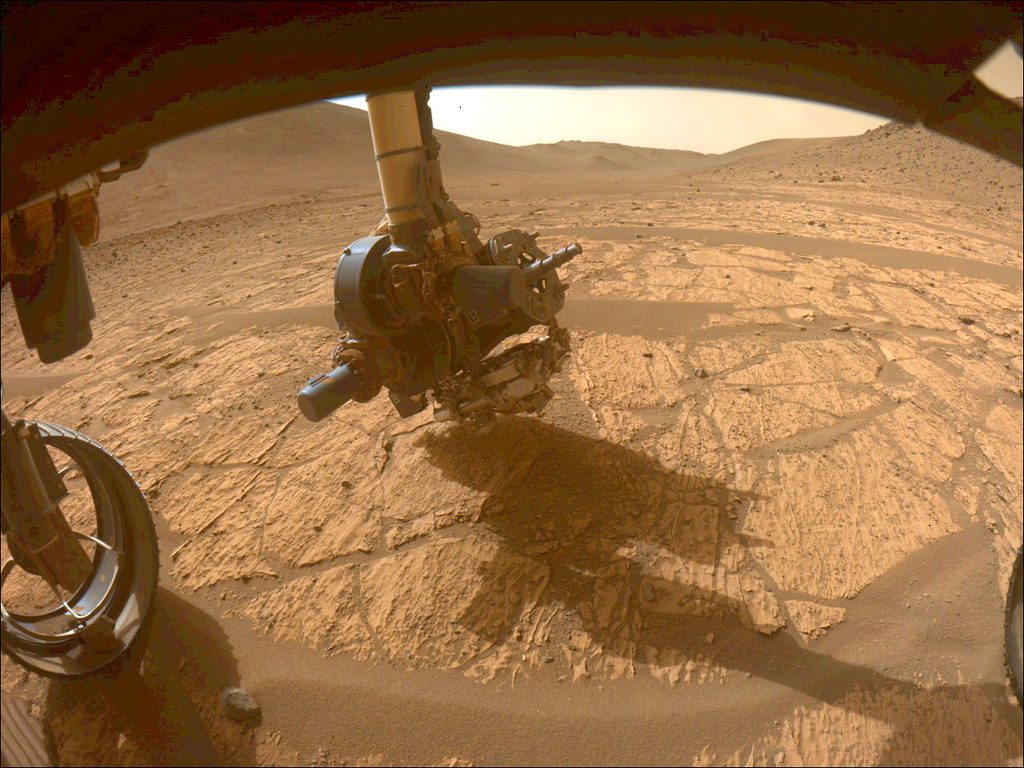
NASA launched the Mars 2020 mission in July 2020, sending the Perseverance rover to explore the Red Planet’s Jezero Crater, the site of an ancient lake and river delta selected for its potential to host signs of past life. For more than 2 years after landing in February 2021, the rover’s activities as it traversed the rocky, weatherworn terrain were controlled using conventional software programming and conducted at times predetermined by a ground operations team.
However, on 5 October 2023, the mission began using autonomous, artificial intelligence (AI) software to control Perseverance. The software, called On Board Planner (OBP), accounts for current Martian conditions and the actual durations of rover activities to make on-the-spot adjustments.
Since switching to On Board Planner (OBP)–run operations, Perseverance has reduced its idle time significantly.
Martian surface conditions and their effects on instrument performance can be unpredictable. Under the conventional, master-submaster (MSM) programming, these factors—as well as unknowns in the terrain to be explored—made it necessary to build margins (i.e., extra time and energy) into Perseverance’s predetermined schedule.
These margins minimized disruptions to subsequent scheduled events from unplanned variations in instrument preparation and data collection times, but they also frequently resulted in the rover sitting idle—losing time that could have been used for additional observations, driving, or sleeping to save energy. (Gaines et al. [2016] showed that Perseverance’s predecessor, the Curiosity rover, could increase its activity by as much as 30% by exploiting “on rover” feedback to reclaim idle time and unnecessary heating.)
Since switching to OBP-run operations, Perseverance has reduced its idle time significantly. This improvement, combined with reducing the energy used to preheat its instruments, has enabled more thorough scientific investigations at sites of interest.
AI is increasingly being used for science on Earth. The deployment of AI to control a unique space exploration asset such as Perseverance represents a major advance in space mission operations, leading the way toward the potential widespread use of AI in autonomous space missions.
From Rigid Schedules to Situational Adaptation
Successful deployment of the OBP software depended on choosing the right AI for this high-stakes application and validating it appropriately for trustworthiness.
Unlike many machine learning models, and the large language models garnering popular attention lately, OBP uses “old school” constraint-reasoning and search protocols to produce its schedules [Johnston and Miller, 1994; Chien et al., 2010], which enabled targeted analysis and testing to ensure the software worked properly prior to entering operations. Also unlike many AI approaches, the software has multiple explanation capabilities, allowing operations staff to see the reasoning behind its decisions. These qualities increase both trust in the software and understanding of how it will behave in different situations.
The OBP can access information about the real-time state of the rover and its environment, conditions that are hard to predict when planning the rover’s activities from Earth.
OBP improves the rover’s performance by replanning its schedule—on average, more than 15 times per Martian day (or sol)—in response to environmental and execution variations, using a set of activities it’s intended to perform as input. The key advance is that OBP understands the operational and science constraints required to execute these activities correctly.
Some activities must be executed during specific times (e.g., when lighting is correct), for example, and some depend on the completion of prior activities (e.g., unstowing the arm before making an observation with an instrument on the end of the arm). Other activities have requirements for energy and heating because instruments and mechanisms must be warmed before use in the cold Martian atmosphere.
The OBP can also access information about the real-time state of the rover (e.g., the battery state of charge) and its environment (e.g., the ambient air temperature), conditions that are hard to predict when planning the rover’s activities from Earth. With this understanding, it can adjust, delete, or add activities to best achieve the science intent of the ground operations team and operate the rover safely.
Greater Efficiency Means More Observations
In more than 2 Earth years of operations, OBP has increased the quantity and quality of Perseverance’s scientific observations in several ways.
More efficient energy management enables the rover to complete more activities (Figure 1). In the MSM paradigm, activities were scheduled by the ground team one or more days in advance of execution to occur at a prespecified, fixed time. The schedule also had to allocate margin time to avoid potential conflicts with later activities.
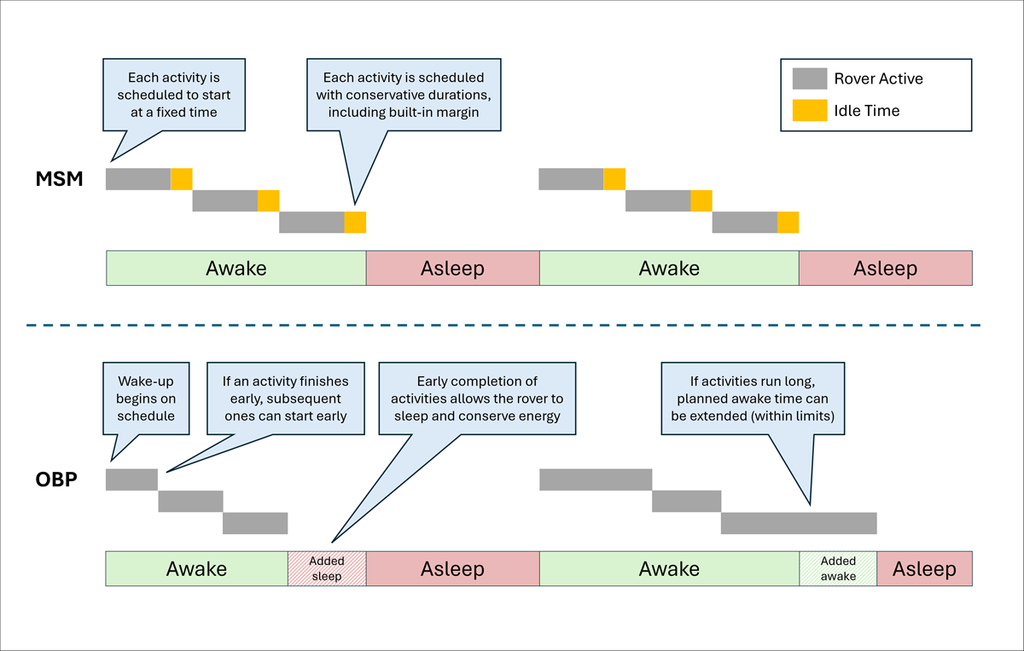
With OBP, if one activity finishes early, subsequent activities can start early, allowing the rover to complete its slate of operations sooner and either add more activities or go to sleep early to save energy. OBP can also compensate if an activity runs long, potentially canceling it to prevent disrupting more important later activities.
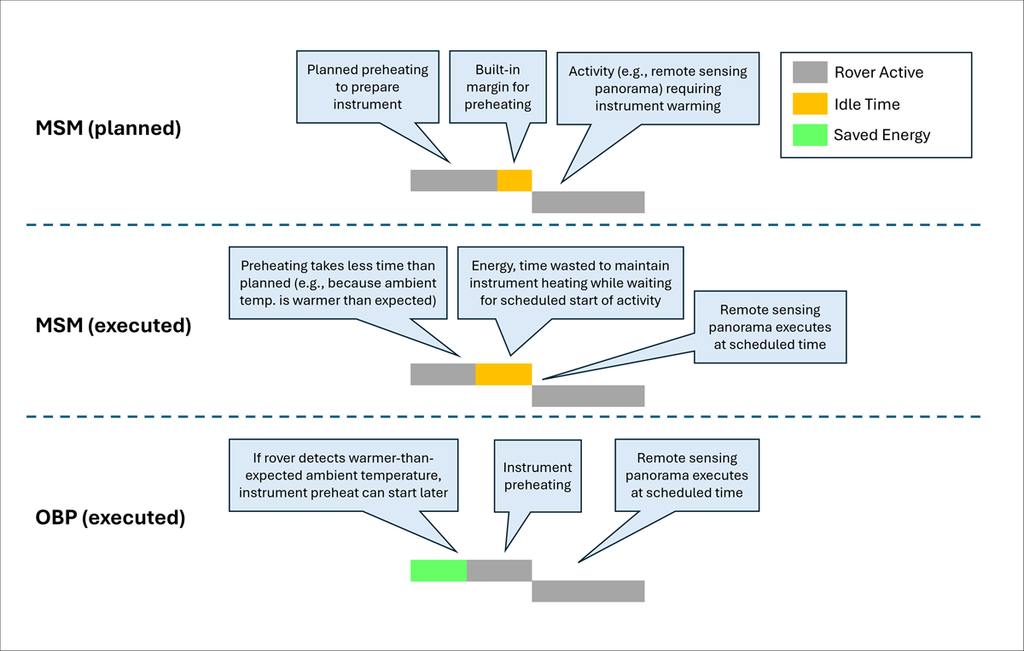
OBP also saves time and energy by exploiting the rover’s temperature readings to adjust when and how long mechanisms and instruments are preheated before use. In prior MSM operations, the ground team used predicted temperatures on Mars to schedule energy-intensive “open-loop” preheats on a preset schedule, without making adjustments based on sensor feedback. With OBP, if the rover senses that the ambient temperature is warmer than predicted, for example, it can start a preheat operation later than planned to save energy (Figure 2). Indeed, OBP has increased the rover’s available energy by more than 10% [Gaines et al., 2026].
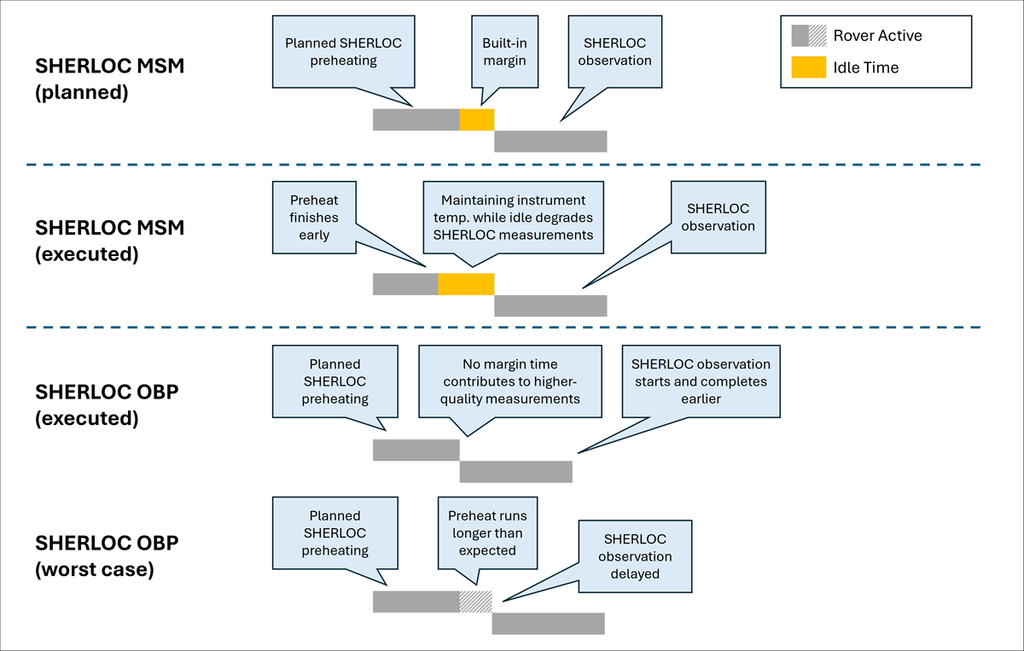
Better thermal management also improves the science performed by the rover’s laser-equipped SHERLOC (Scanning Habitable Environments with Raman and Luminescence for Organics and Chemicals) spectrometer, which detects mineral and organic signatures. SHERLOC must be preheated, but maintaining its operating temperature longer than needed causes it to absorb additional heat, which decreases the quality of its measurements by introducing noise and affecting the instrument’s calibration.
OBP can operate Perseverance using best-estimate preheat durations rather than longer, more conservative preheat times (Figure 3), resulting in less overheating of SHERLOC. If scheduled preheats need to be extended to warm rover components adequately, then following activities can be delayed, a less impactful change than totally canceling the later activities.
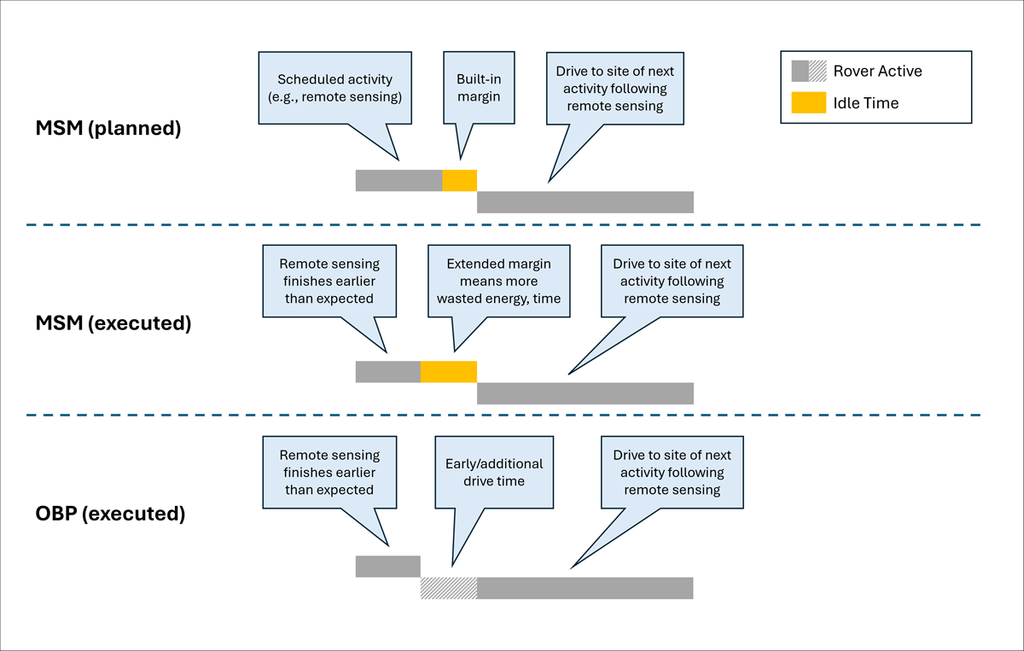
When the rover is slated to drive to another location after an activity, OBP can capitalize on that activity finishing early in the form of bonus driving time without jeopardizing later activities (Figure 4). Extra driving time enables faster progress between regions of interest, saving time especially during multiday or multiweek traverses, which, in turn, allows Perseverance to perform more science in its exploration plan.
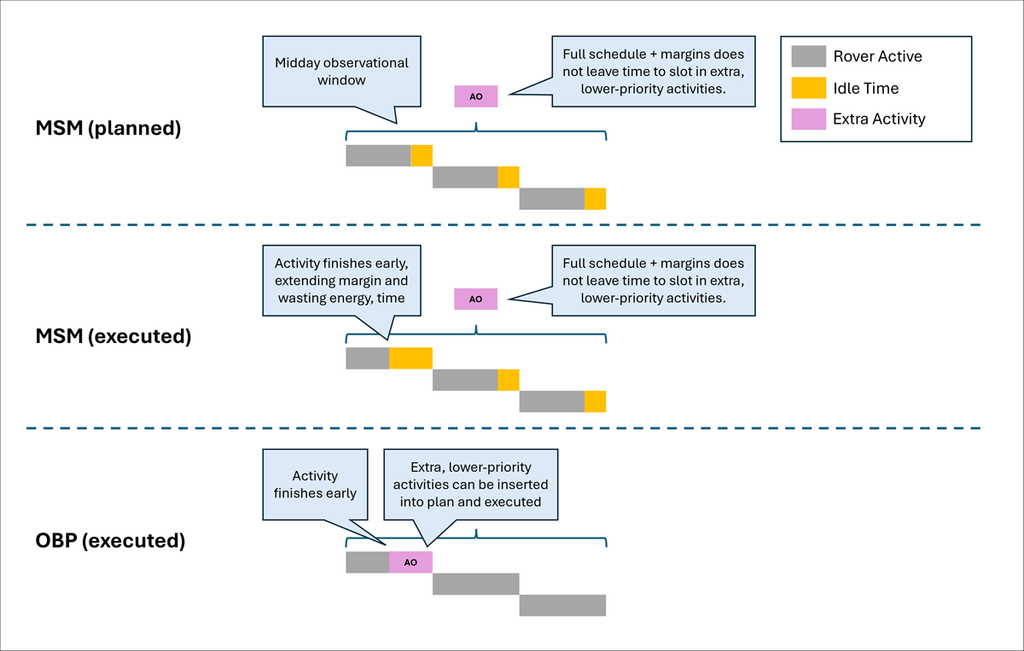
Finally, OBP can improve the efficiency of instrument use during high-demand times (Figure 5). Midday, for example, is favorable for competing high-priority activities, such as driving, geological imaging, and spectroscopy, sometimes resulting in data gaps for lower-priority atmospheric measurements. OBP can consider optional activities that may not have fit into the original schedule, and, if other activities complete early, it can direct the rover to do these lower-priority tasks.
Benefits in Bright Angel
The 42-sol campaign (sols 1,177–1,219) exploring Mars’s Bright Angel region in 2024 has been one of the most important phases of the Mars 2020 mission so far. During the campaign, Perseverance discovered the remarkable, leopard-spotted Cheyava Falls rock, from which it collected a sample named “Sapphire Canyon.”
Sapphire Canyon is one of several samples that Perseverance has stored in sealed containers for later retrieval, and it contains elemental and mineralogic features that could shed light on whether Mars had microscopic life in the distant past. In particular, the rock shows evidence of past redox reactions together with organic carbon and iron phosphate and sulfide minerals organized into millimeter and submillimeter structures, signs that have been interpreted as potential biosignatures [Hurowitz et al., 2025].

The geologic complexity of and around Cheyava Falls motivated a lot of exploration and data collection in the Bright Angel area. Energy savings and planning flexibility courtesy of OBP allowed the science team, in several cases, to collect additional science observations beyond those originally planned. Prior to the Sapphire Canyon sampling, for example, the team added more spectrometer measurements and imaging, and they chose to drive to and inspect another part of Bright Angel—all energy-intensive activities.
Under conventional programming, energy-intensive activities could not be accommodated on short notice. With OBP, the team found itself far less constrained in adding or swapping out planned activities.
Under MSM, such campaigns were highly constrained to follow the planned schedule, because new, energy-intensive activities could not be accommodated on short notice. With OBP saving substantial energy from its onboard management of scheduling, heating, and computer-awake times, the team found itself far less constrained in adding or swapping out planned activities. Decisions could also be made more quickly because fewer sacrifices and complex trade-offs were required.
Notably, after the Sapphire Canyon sample was drilled, the team decided to conduct extensive additional SHERLOC observations on Cheyava Falls. In MSM mode, these extra observations would have required 1–2 sols for recharging, meaning their potential scientific value would be weighed against the several sol delay. But because OBP conserved energy from a shorter-than-planned sample drilling duration, these observations could be taken without delay.
Ultimately, the additional SHERLOC measurements, which provided greater spatial coverage and improved statistics for the mission’s observations around Cheyava, were important in shaping—and increasing confidence in—the science team’s interpretation of potential biosignatures in the Sapphire Canyon sample.
Building Trust for a High-Stakes Mission
In addition to OBP, Perseverance uses other AI software for specific functions. This includes its enhanced navigation (Enav) software for autonomous driving, the Autonomous Exploration for Gathering Increased Science (AEGIS) system used for targeting of its SuperCam instrument [Verma et al., 2023], and an adaptive sampling algorithm used by the Planetary Instrument for X-ray Lithochemistry (PIXL) X-ray fluorescence spectrometer [Lawson et al., 2025]. But OBP is notable in that it controls the entire rover system.
Considering that Perseverance is a one-of-a-kind asset that cost billions of dollars to develop and send to Mars, OBP was designed for extreme reliability.
The software has been in near-continuous operation for Perseverance since October 2023. As of September 2026, OBP has covered more than 450 tactical planning cycles spanning more than 1,000 sols. And it is expected to remain in control through the rest of the rover’s mission.
Considering that Perseverance is a one-of-a-kind asset that cost billions of dollars to develop and send to Mars, OBP was designed for extreme reliability. Similarly, the rollout process was carefully developed to ensure that the rover operations staff could operate it for peak performance.
The staff first used a version of the onboard planner in ground operations for more than a year to familiarize themselves with OBP’s capabilities. This version also included explanation capabilities, which helped the team understand how OBP would perform on board.
Second, rover operations staff repeatedly met with science instrument staff to review operational processes for each instrument. Through these meetings, the instrument teams transitioned from the long-standing paradigm of expecting fixed execution times for their activities to specifying ranges of times during which the activities could be carried out—on the basis of safety and science requirements—and accepting that OBP would execute them within those ranges.
Third, a series of increasingly realistic and comprehensive operations walkthroughs by the mission team culminated in readiness tests of OBP on the ground and during three flight tests on the vehicle. Training also included a “flight school,” in which most of the operations team learned the fundamentals of how OBP operates and gained a feel for autonomous operations.
This testing and training process contributed to a smooth rollout of the software and, when the time came, a smooth transition from MSM to OBP during the Mars 2020 mission.
To Mars and Beyond
The successful deployment of OBP will help to move the research community forward in understanding the technology and how it can be used for future robotic explorers both on Earth and beyond.
The OBP on Perseverance is an unprecedented use of AI for a major mission, and its successful deployment will help to move the research community forward in understanding the technology and how it can be used for future robotic explorers both on Earth and beyond. Lessons learned from the experiences of advocating for OBP and of developing, verifying, validating, and rolling out such a significant AI capability can also inform the many similar efforts to follow, such as the potential Uranus Orbiter and Probe and Endurance lunar rover concepts.
For example, it is important that everyone involved in the mission—including the science, instrument, and robotics teams—understands the freedom (and limitations) that OBP has to change the timing (and sometimes the nature) of activities, and to allow these teams to specify the flexibility appropriate for each activity. It is also essential that the engineering operations team has tools to predict the range of possible outcomes of the OBP-scheduled plan and understand after the fact what OBP chose to do and why. This understanding of OBP performance enables safe and efficient operation of the rover while accomplishing the desired science.
For all its autonomy, OBP still relies on ground control for strategic science and operational decisionmaking. Future mission concepts involving travel to more distant and hostile environments—such as the Europa Lander mission concept and the Exobiology Extant Life Surveyor (EELS) mission concept to Enceladus’s surface—would have more restricted communications with Earth and shorter mission durations and would contend with even more unknown and extreme environments. Thus, they would require even greater use of AI to balance risk and reward in making major decisions without human oversight. Indeed, both Europa Lander and EELS have prototyped such systems that would balance risk and reward. Other proposed missions, such as the Enceladus Orbilander, would benefit from a similar approach.
Nonetheless, if and when these future missions happen, we will almost certainly be able to trace the success of the software systems controlling them back to the innovations of Perseverance’s OBP.
Acknowledgments
The research was performed by the Jet Propulsion Laboratory, California Institute of Technology, under a contract with NASA (80NM0018D0004).
References
Chien, S., et al. (2010), Timeline-based space operations scheduling with external constraints, Proc. Int. Conf. Autom. Plann. Scheduling, 20(1), 34–41, https://doi.org/10.1609/icaps.v20i1.13410.
Gaines, D., et al. (2016), Productivity challenges for Mars rover operations, in Proceedings of the 4th Workshop on Planning and Robotics (PlanRob), pp. 115–125, London, https://ntrs.nasa.gov/citations/20190025594.
Gaines, D., et al. (2026), The Mars 2020 OnBoard Planner—Increasing mission productivity of the Perseverance rover, Sci. Robotics, www.science.org/doi/10.1126/scirobotics.aeh2947.
Hurowitz, J. A., et al. (2025), Redox-driven mineral and organic associations in Jezero Crater, Mars, Nature, 645, 332–340, https://doi.org/10.1038/s41586-025-09413-0.
Johnston, M., and G. Miller (1994), Spike: Intelligent scheduling of Hubble Space Telescope observations, in Intelligent Scheduling, chap. 14, edited by M. Fox and M. Zweben, Morgan Kaufmann, San Mateo, Calif.
Lawson, P. R., et al. (2025), Adaptive sampling with PIXL on the Mars Perseverance rover, Icarus, 429, 116433, https://doi.org/10.1016/j.icarus.2024.116433.
Verma, V., et al. (2023), Autonomous robotics is driving Perseverance rover’s progress on Mars, Sci. Robotics, 8(80), eadi3099, https://doi.org/10.1126/scirobotics.adi3099.
Author Information
Steve Chien (steve.a.chien@jpl.nasa.gov), Raymond Francis, and Dan Gaines, Jet Propulsion Laboratory, California Institute of Technology, La Cañada Flintridge, Calif.
Citation: Chien, S., R. Francis, and D. Gaines (2026), The AI upgrade helping Perseverance work smarter on Mars, Eos, 107, https://doi.org/10.1029/2026EO260340. Published on 29 October 2026.
Text © 2026. Jet Propulsion Laboratory, California Institute of Technology. CC BY-NC-ND 3.0
Except where otherwise noted, images are subject to copyright. Any reuse without express permission from the copyright owner is prohibited.