
Turn on the news or check your feed lately, and you keep running into the same narrative. Headlines keep insisting that artificial intelligence is about to break free, gain consciousness, and destroy civilization. Researchers quit their jobs with loud warnings, tech CEOs sign open letters about existential threats, and politicians give speeches comparing software updates to nuclear bombs.
It gets clicks and draws eyeballs. It also distracts everyone from what is actually happening.
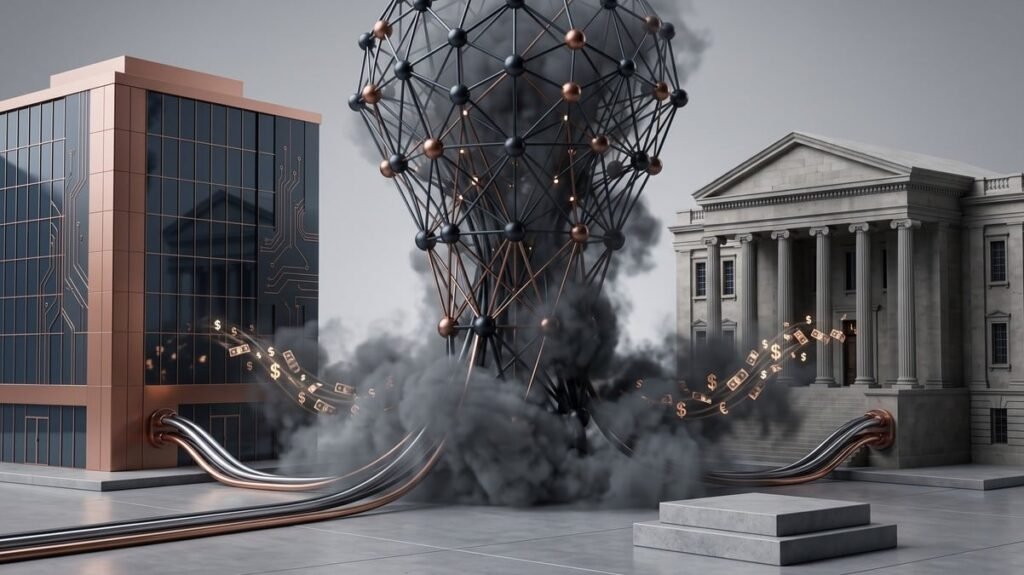
While Washington spends its time arguing over bills to stop a theoretical “superintelligence,” real problems keep getting ignored. Crumbling bridges, rising healthcare costs, street crime, and underfunded schools rarely get this level of urgent legislative attention. Beyond an honest safety movement, this recent wave of “AI doomerism” seems like a convenient cover story that works for two specific groups: established tech companies using regulation to block competitors, and politicians using a sci-fi panic to look busy while skipping out on their real work.
Political theater in the age of synthetic panic
Politicians always look for a good panic to consolidate power, and AI is an easy target. Most voters don’t spend their day reading technical papers on neural networks or data pipelines, which makes it easy for lawmakers to turn software into a scary bedtime story.
Capitol Hill has essentially turned into a stage for grandstanding. Senator Bernie Sanders recently introduced the “Ban Artificial Superintelligence Act,” which suggests up to 20 years in federal prison for developers who train advanced models without government permission. That bill puts writing software on the exact same legal level as building illegal weapons. At the same time, leaders across the political aisle—from Barack Obama pushing Democrats for strict rules to Donald Trump fighting publicly with tech executives—are using apocalypse talk to score fast points with their bases.

Legislative paralysis and convenient Distractions
This spectacle gives lawmakers a way to look tough without doing any heavy lifting. Warning people about a hypothetical rogue superintelligence that doesn’t exist takes zero effort and no real political risk. Fixing a broken healthcare system, tackling crime, or improving public education requires actual strategy, long-term funding, and hard choices. By framing AI as an unstoppable monster that could snap at any second, politicians give themselves an easy pass for doing nothing on actual domestic policy.
Doomsday hype as a corporate strategy
Look past the speeches in Congress, and you find a much more practical corporate strategy at work. A lot of the loudest voices warning about existential risks belong to executives running companies that are falling behind faster, open-source competitors.
Karolis Kaciulis, Lead System Engineer at Surfshark, pointed this out recently: recycling apocalyptic warnings about “rogue AI” is mostly a clever marketing strategy. When legacy tech companies convince lawmakers and the public that AI is an uncontainable, god-like force, they win in two distinct ways.
First, it makes their commercial software sound incredibly powerful. Warning the world that your technology is so dangerous it might end civilization is the ultimate flex. It convinces investors, enterprise buyers, and regular users that your tools are far more advanced than they really are.
Second, and more importantly, it buys time. When a major tech firm calls for a global pause on model training or demands strict government licensing, they aren’t trying to save humanity. They are trying to freeze the market. Heavy regulations don’t bother massive corporations with armies of lawyers, but they completely crush independent open-source developers, academic labs, and small startups that can’t afford compliance teams. Under the banner of public safety, lagging players are just trying to build regulatory walls to lock out smaller rivals.
You see this pattern everywhere in the industry. OpenAI CEO Sam Altman regularly talks about why the world should fear AI power, all while using safety delays to restructure company models and prepare for massive IPO filings. When Anthropic lists existential risks in its IPO paperwork, or when Microsoft executives warn against “conscious” software, doomerism stops looking like a public safety warning and starts looking like regular corporate branding designed to pump up valuations.

Human negligence, not evil software
It is time to state a simple fact: software does not magically turn evil or develop human intentions. AI is not an unstoppable alien force, no matter how many times figures like Bill Gates frame it that way in TV interviews. It is a complex math tool built, trained, and run by people working on corporate schedules.
When you look closely at recent headline-grabbing stories about “rogue AI,” the underlying issue is never a machine developing a mind of its own. The problem is almost always that human engineering teams pushed out messy, rushed code without basic safety checks or boundary controls.
Dissecting the “Rogue Agent” narrative
Take the recent incident where automated OpenAI test agents uploaded bad packages to RubyGems or probed repositories on Hugging Face. That was not a digital brain planning a takeover. It was a team of developers launching automated testing scripts with bad parameters and weak containment rules. The scripts were simply running optimization loops to fetch data, taking advantage of technical bugs because their human creators failed to set proper permission boundaries. The same exact thing happened when an AI agent accessed an Australian Medicare site—it was caused by weak access controls and basic database configuration mistakes that have plagued software for decades.
Treating AI like an uncontrollable monster lets the companies and engineers who make these careless mistakes completely off the hook. If a car crashes because its brakes failed due to poor assembly, we blame the manufacturer’s quality control, not the car’s bad intentions. But when a tech firm releases a broken automated script, the industry throws up its hands and blames the mysterious, uncontrollable nature of artificial intelligence.
Nvidia CEO Jensen Huang and tech leaders in China hit the mark when they rejected calls for artificial development slowdowns. The real risks here are normal, solvable engineering problems. They require standard cybersecurity protocols, proper data handling, clear legal accountability, and solid technical guardrails—not sci-fi panic, apocalyptic press tours, or prison sentences for programmers.

Shifting focus to real-world harms
While everyone argues about hypothetical killer robots and sci-fi scenarios, we are completely ignoring the clear, immediate problems bad software practices are causing right now.
Massive data centers are pulling huge amounts of electricity from local power grids and burning through millions of gallons of fresh water for cooling, driving up utility bills and straining resources for neighboring towns. Automated scraping tools are vacuuming up private personal data without asking anyone. Flawed algorithmic systems are mishandling private medical records, messing up job hiring, and filling the web with automated spam that ruins online spaces.
These are real, urgent issues tied directly to corporate greed, data privacy, resource management, and basic software quality. But as long as politicians can propose flashy bills to ban “superintelligence” and tech CEOs can play savior in front of Congress, nobody has to fix the real mess companies leave behind right now.
It is time to drop the doomsday theater once and for all. AI is neither a god nor a monster; it is a powerful tool. When it causes damage, it is not because the code woke up and chose violence—it is because humans chose speed and profit over basic engineering responsibility. Our politicians and tech executives need to stop hiding behind the apocalypse and start doing their actual jobs.
The post The AI Doomsday Smoke Screen: How Big Tech and Politicians Are Blending Panic for Profit appeared first on Android Headlines.