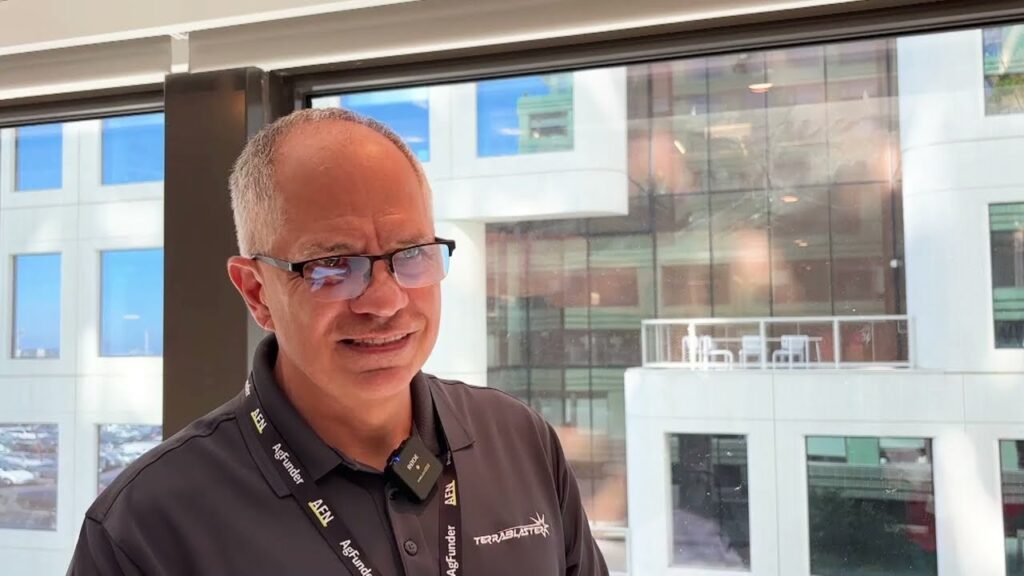
TerraBlaster—a startup using tech first deployed on the Mars rover to determine levels of key nutrients in the soil—has raised a $12.5 million seed round as it gears up for commercial operations in 2027.
The round, which takes the firm’s cumulative funding to $16.5 million, was led by Ulu Ventures with participation from Khosla Ventures, Trailhead Capital, Builders Vision, Bidra, Ag Startup Engine, Reservoir, Sunna, Plug and Play, GrainInnovate and the Hort Innovation Venture Fund managed by Artesian
“With our technology, there’s no reason to suffer suboptimal yields by applying nutrients to a field based on low-resolution or old measurements,” says cofounder and CEO Jorge Heraud. “We are quickly moving to a future where real-time measurements enable precise soil fertilization, all in one pass.”
Precision ag
TerraBlaster uses laser-induced breakdown spectroscopy (LIBS) in rugged sensors that can be dragged by a tractor or ATV through the soil at a depth of around six inches to provide detailed maps outlining pH, plus levels of nitrogen, phosphorus, potassium, and other nutrients in real time.
This can then be used to guide the more precise application of fertilizer, delivering ROI in the form of reduced input costs and increased yield, says Heraud.
Following extensive testing in Iowa last year, California-based TerraBlaster is running demos with growers and retailers across the Midwest this fall. Learnings will then feed into the systems delivered in spring 2027, says Heraud, who cofounded ag robotics firm Blue River Technology—which was later acquired by John Deere for $305 million.
Commitments for the company’s first systems are already in place ahead of a pre-sale that opens this fall, says Heraud, who was approached by Impossible Sensing to build a new company deploying its LIBS technology in agriculture last year.
The initial go-to-market strategy is to sell the system to row-crop growers and the retailers and agronomists who support them.
Right now, the tech works at 5mph, a speed Heraud reckons he can soon double to 10mph and could ultimately get to 20mph with a narrower probe that can move more easily through soil.
The limits of traditional soil sampling
The company is still finalizing the price of hardware, with costs expected to come down as the device gets smaller, says Heraud. But the basic proposition to farmers is that it won’t cost more than what they currently pay for soil sampling, a slow, and labor-intensive process that lacks the granularity and convenience of TerraBlaster’s approach.
First, says Heraud, existing methods involve going into the field, taking multiple samples, mixing them, bagging them, and sending them to a lab, which returns results several days later, limiting the ability to make timely adjustments.
Second, he claims, most farmers sample at around 2.5-acre grids, which masks significant variability within a field. For example, an area that looks uniformly high in nutrients at that resolution may contain a mix of high and low zones when measured more precisely, such that farmers either over- or under-apply fertilizer, leaving yield on the table. While they could increase sampling density, he says, this quickly becomes prohibitively expensive.
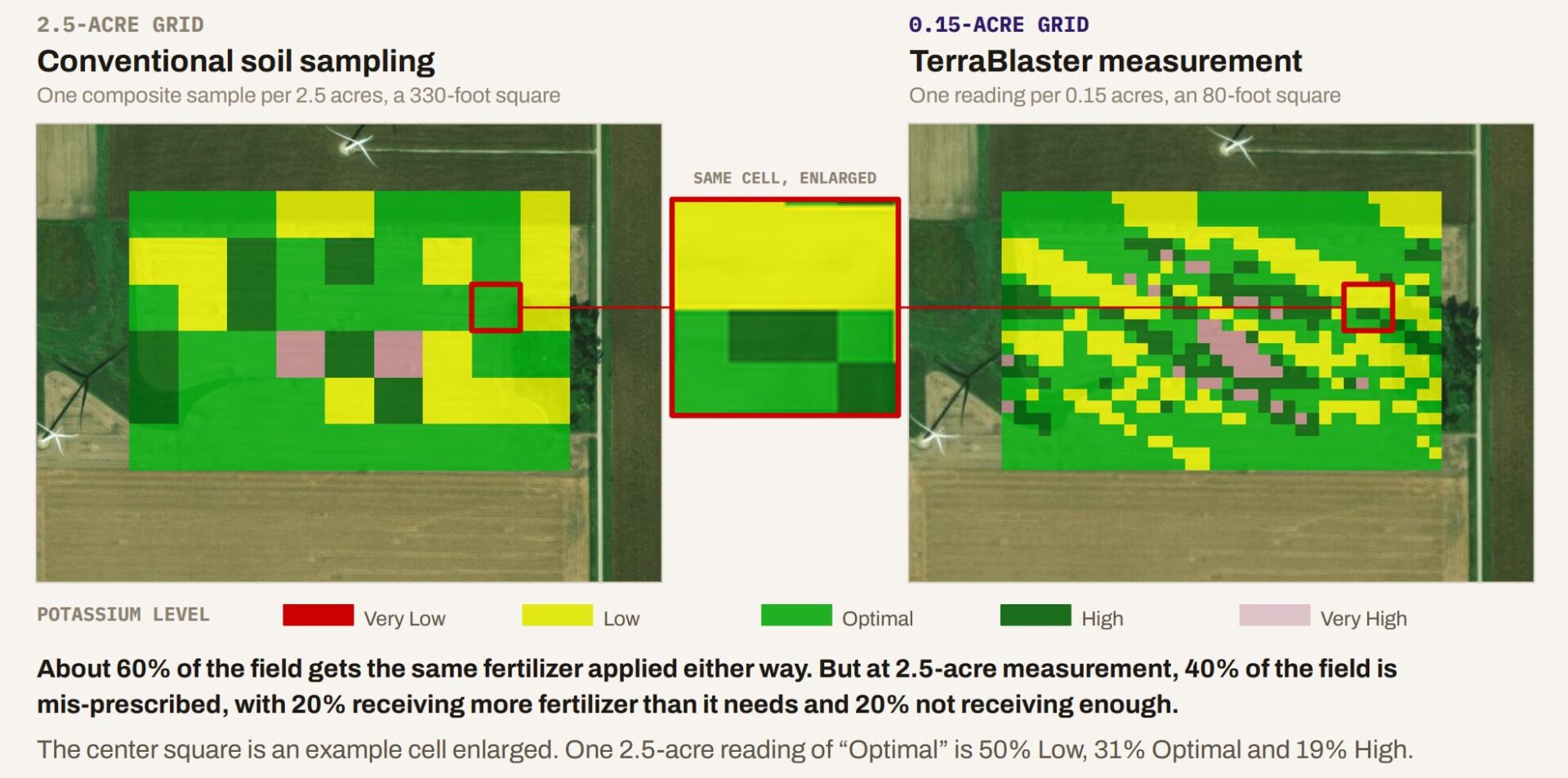
More granular measurement = more granular application of inputs
In the image above, for example, the low-res version on the left suggests the 2.5-acre plot highlighted in red has optimum levels of potassium. The more granular map provided by TerraBlaster using 0.15-acre grids on the right shows that the plot actually contains some areas that are low in potassium and some that are too high.
This level of detail allows farmers to apply the correct amount needed to the low spots, leading to potential increases in yield and cost savings from reduced application in areas that don’t need the inputs in question.
Importantly, says Heraud, TerraBlaster’s more granular data is still actionable for farmers, as standard fertilizer spreading machinery enables variable rate application.
TerraBlaster’s first model, the Blaster 1,000, is a towed unit that opens a shallow trench and measures soil fertility as it moves, roughly twenty times per second, producing nutrient concentration maps at a resolution of 0.15 acres, he explains. “That’s an area of about 80 by 80 feet, which matches the working width of application equipment already in the field.”
The economics depend on many variables including field type and crop, but using TerraBlaster’s tech could save $10/acre on lab testing and labor costs and boost yields by $35/acre for corn and soy, claims Heraud.
“Within the most deficient areas, yield gains can reach 20%.”
The holy grail: measure and apply in real time
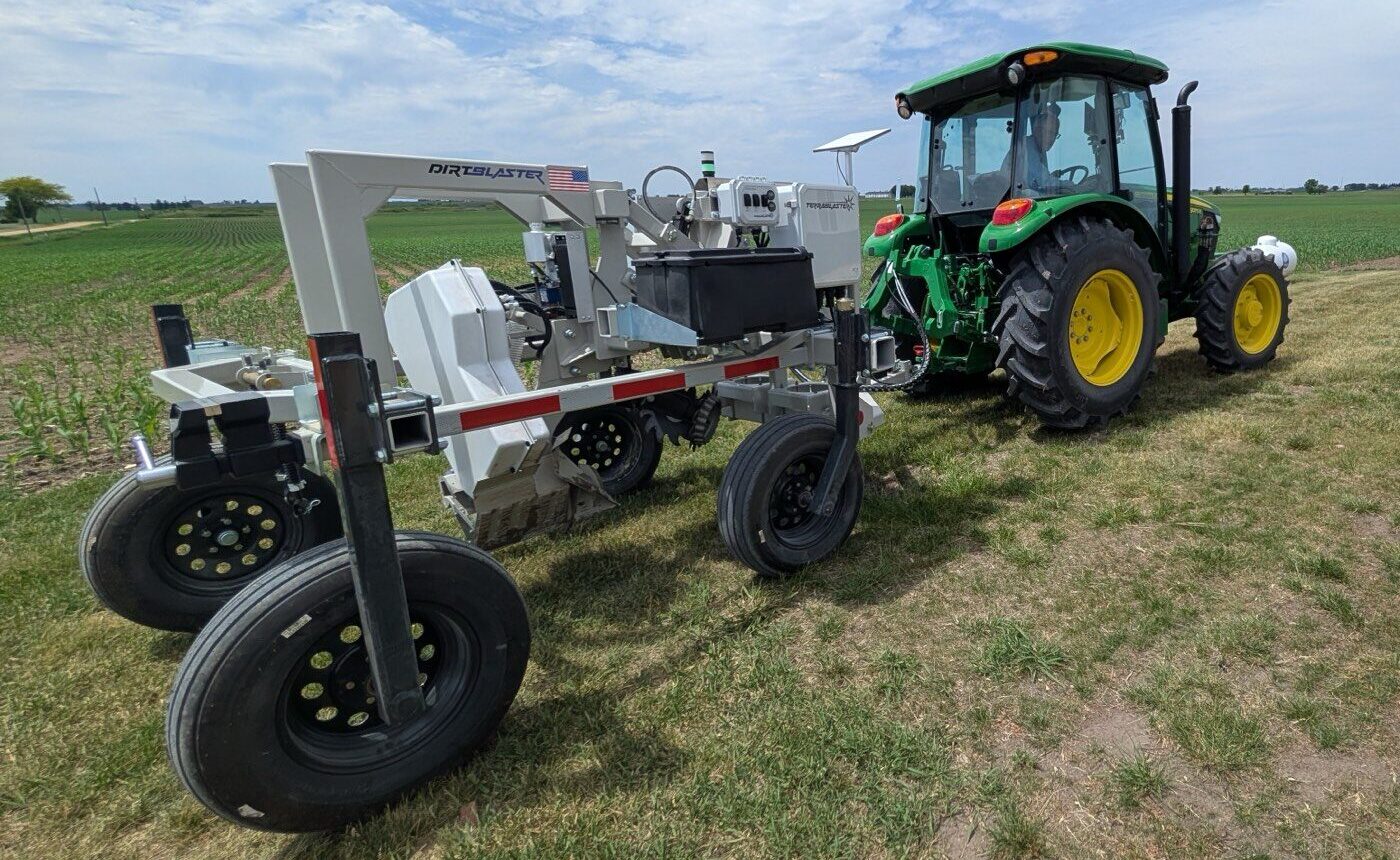
There are two ways to use TerraBlaster devices, says Heraud. “The first is something that you put behind a tractor or ATV and you drive it through the field. The second is to integrate it into an operation that farmers are already doing like planting or tilling, so that you don’t even need to go and drive the field for measuring. You can be measuring as you’re planting.”
The holy grail would be a system whereby farmers could measure nutrient levels using TerraBlaster’s tech and then apply the optimum level of fertilizer/nutrients at the same time, which would be especially valuable for “mobile” nutrients such as nitrogen and sulfur, where levels can shift rapidly after rainfall, says Heraud.
The agtech funding landscape
Asked about the funding environment, Heraud said: “With all the focus going to AI, some other areas, including ag tech, are not necessarily being sought as much as by investors, so I would characterize this as a challenging environment. But I can tell you that at Blue River we started funding just one year after the Great Recession.
“So I am of the thinking that a down cycle is sometimes where the biggest and best opportunities end up being funded. I think that investors that invested during those times where valuations were more reasonable [will find that] returns will be higher.”
What is laser-induced breakdown spectroscopy (LIBS)?
LIBS is a sensing technique that uses a high-energy laser pulse to briefly vaporize a tiny amount of material—such as soil—creating a plasma.
As the plasma cools, it emits light at wavelengths that reveal the sample’s elemental composition.
By analyzing this spectral fingerprint, LIBS can rapidly measure nutrients such as nitrogen, phosphorus, potassium, and other nutrients and soil properties like pH, BpH and CEC in real time without the need for traditional lab testing, says Heraud.
“There is a little bit of AI that is used as part of that as we need to figure out if the elements are in forms that are going to be uptaken by the plant. But we’ve shown that our measurements are as accurate as a traditional soil lab.”
The post TerraBlaster raises $12.5m for real time NPK soil mapping at tractor speed appeared first on AgFunderNews.