Artist Tammy Nguyen will present the foreword to her debut opera Timaeus and The Teacher at the 61st Venice Biennale’s closing program on November 13 and 14, capping off an eventful edition of the international contemporary art festival.
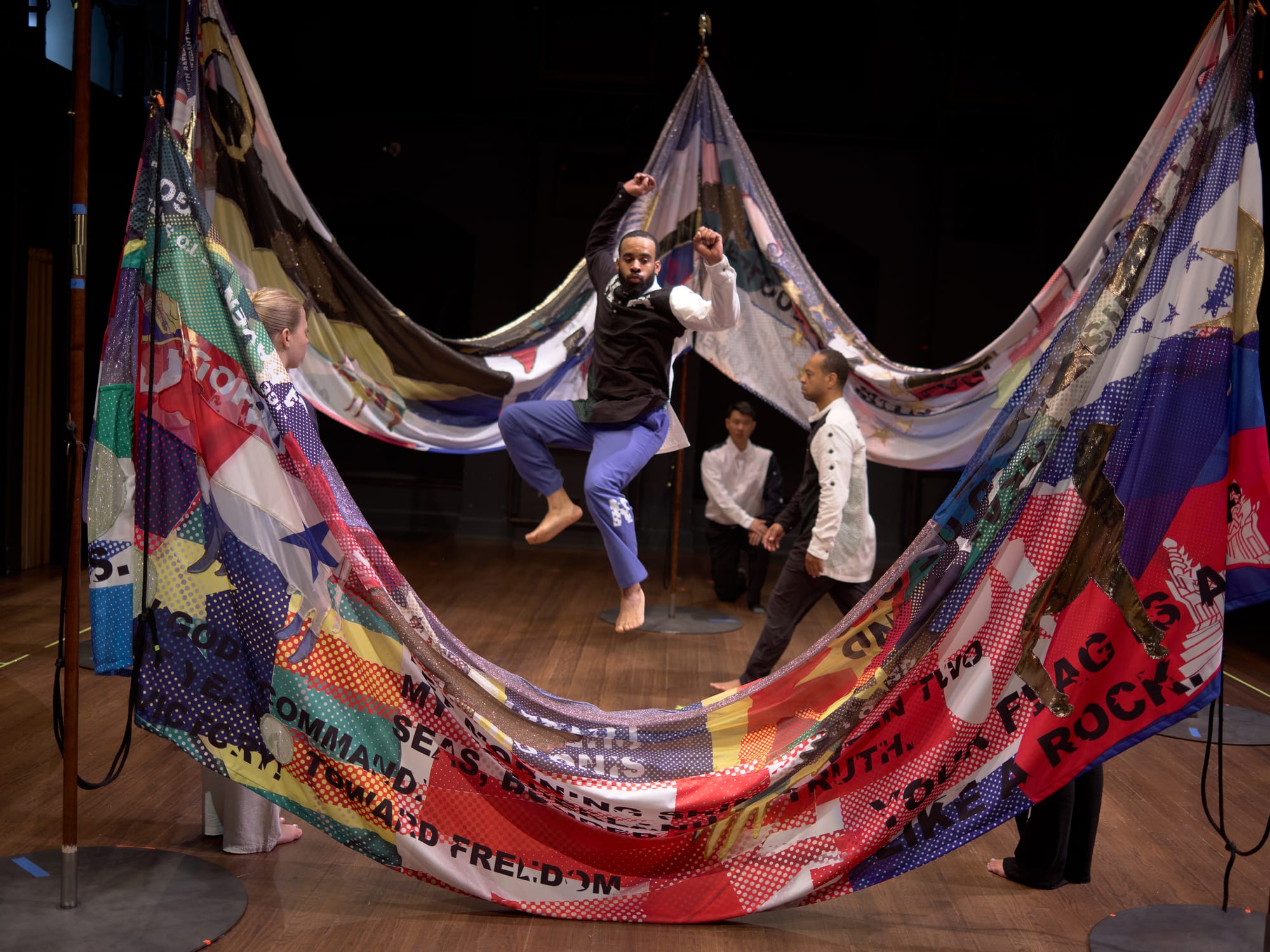
The aria is the entry point to Nguyen’s still-unfinished opera, which traces the national and ideological impacts of the Vietnam War and fuses Plato’s theories of the cosmos with enduring questions of identity. Inspired by her father’s experiences as a refugee aboard a vessel in the South China Sea, Nguyen centers the performance around a Vietnamese English teacher who attempts to flee Saigon (since renamed to Ho Chi Minh City) by boat, two years after North Vietnamese forces captured the capital in 1975. Grammy-nominated tenor Brian Vu will sing the libretto as the titular teacher, while a group of dancers will maneuver around him with a tapestry composed of flags.
“I was really fascinated by what happened at sea, as are many children of refugees from war-torn countries,” Nguyen told Hyperallergic in a phone interview. “The South China Sea is such a heavily trafficked area, and it created little stories where humans and the global economy collided.”
Commissioned and produced by Wesleyan University, where Nguyen teaches as an associate professor, the opera echoes themes prevalent in the artist’s other works, including a series of paintings on view at the biennale’s Central Pavilion through November 22.
The tapestry of flags at the heart of the performance extends upon Nguyen’s 2024 exhibition Timaeus and the Nations at the Sarasota Art Museum, where the artist rearranged 46 “flags of convenience,” alluding to the practice in which ship operators change their flags for tax and regulation benefits.
Choreographed by Jamal Jackson, the opera’s dancers will configure the tapestry into mountain ranges, a ship, the sea, and the cosmological diagram championed by the Pythagorean philosopher of Plato’s dialogue, Timaeus.
“Opera has a gestalt of sorts, just this massive tapestry of coming together and telling a story,” said Nguyen, adding that she’s had the goal of directing an opera since learning to play and write music in San Francisco. “I took the anthems of all the countries in the flags of convenience, extracted various lyrics, and hybridized them arbitrarily for the libretto.”
As Vu’s character journeys across the sea, musical accompaniments mirror his literal and ideological movements. Nguyen assembled the libretto by breaking down traditional English language structures through a fractal sequence, while composer Neely Bruce remixed national anthems into the musical score.
Other performances slated for the final days of the biennale include a gathering around a Ouija board led by Hagar Ophir, stories of cultivation and global exchange with Lebanese artists Ziad Antar, Hatem Imam and Nayla Mabsout, and a meditation on salt as an essential mineral from Nathalie Vairac. While it’s unclear when the full production of the opera will be presented to audiences, Nguyen aims to have it completed by Bruce’s 85th birthday, in fall of 2029.
“The idea of nationhood is so flexible,” Nguyen stated. “But people die over it and fight over it, questioning whether they belong. We grapple with these questions all the time, as people who are looking to feel at home or develop a sense of agency for ourselves.”