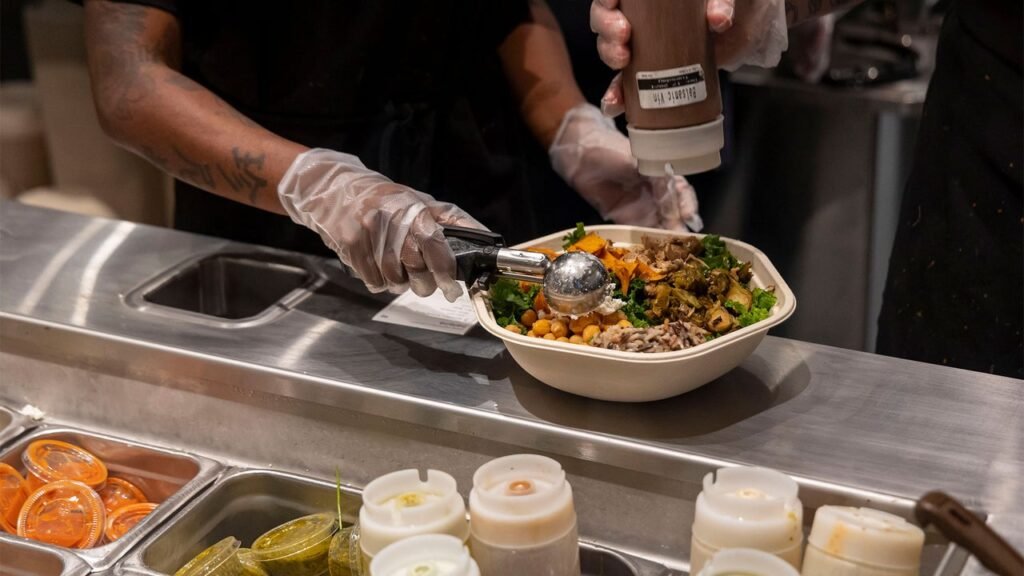
As the cyclosporiasis outbreak continues to rage across the United States, salad chains like Sweetgreen are preparing for a significant decline in sales.
The company’s second quarter earnings report, released on Thursday, included a new outlook for 2026 that “reflects reduced consumer demand for fresh prepared foods due to the multistate outbreak of cyclosporiasis since mid-July.”
Sweetgreen now predicts same-store sales for the year will drop between 7% and 8%, worse than its previous outlook, which projected a 2% to 4% decline.
The company has also lowered its restaurant-level profit margin from a range of 14.2% and 14.7% to 10.5% to 11%.
Its adjusted EBITDA (earnings before interest, taxes, depreciation, and amortization) has taken the biggest hit.
In its first quarter report, Sweetgreen predicted an adjusted EBITDA of $1 million to $6 million. Now, it’s looking at a loss of $23 million to $27 million.
“The pace and timing of recovery remain uncertain,” Sweetgreen stated in the report.
Separately, the company removed jalapenos from two of its dressings this week after the Centers for Disease Control and Prevention (CDC) issued a recall of the pepper due to salmonella infections.
Shares of Sweetgreen Inc. (NYSE: SG) fell more than 15% in premarket trading on Friday. The stock is already down more than 24% over the last month.
Fewer restaurant openings than in years past
The only figure that remained steady between the quarters is Sweetgreen’s plan to open approximately 13 net new restaurants.
However, this was already a big drop from 2025’s 35 net and 2024’s 25 net restaurant openings.
Sweetgreen currently has 287 restaurants across the U.S., 35 of which are its automated locations, known as Infinite Kitchen.
In a post-earnings call, Sweetgreen cofounder and CEO Jonathan Neman commented on the decline in new locations.
“We will continue to open stores at, I’d say, a pretty conservative pace, similar or slower to what we’ve done this year, really focused on the real estate profiles where we know Sweetgreen works and resonates.”
Neman added that the company is working on “building the core business back, spending a lot of time really perfecting the prototype, the cost of it, the overall experience.”
He indicated that store openings would accelerate again once the overall business picture improves. “Call it a slow down to speed up phase,” he said.