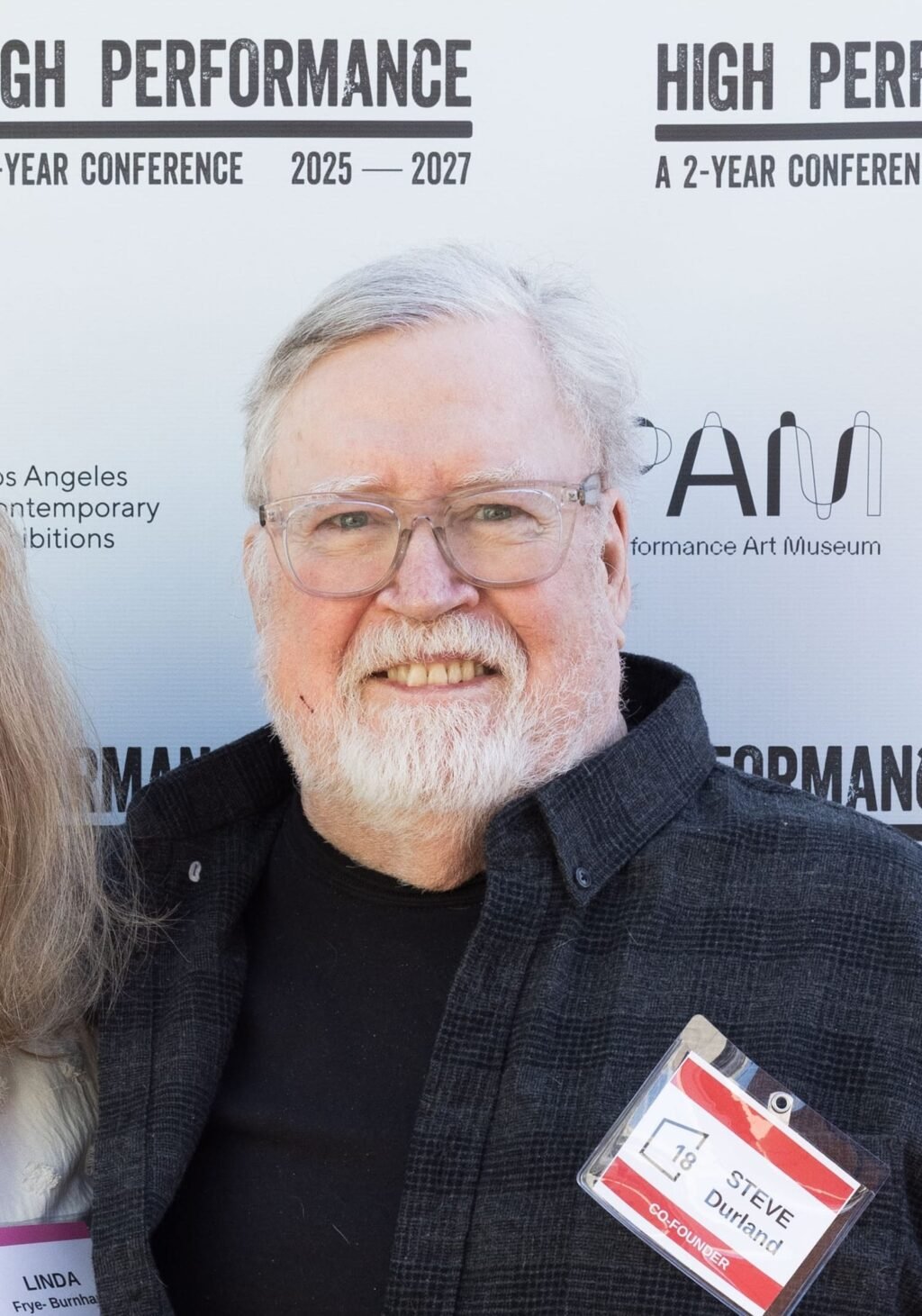
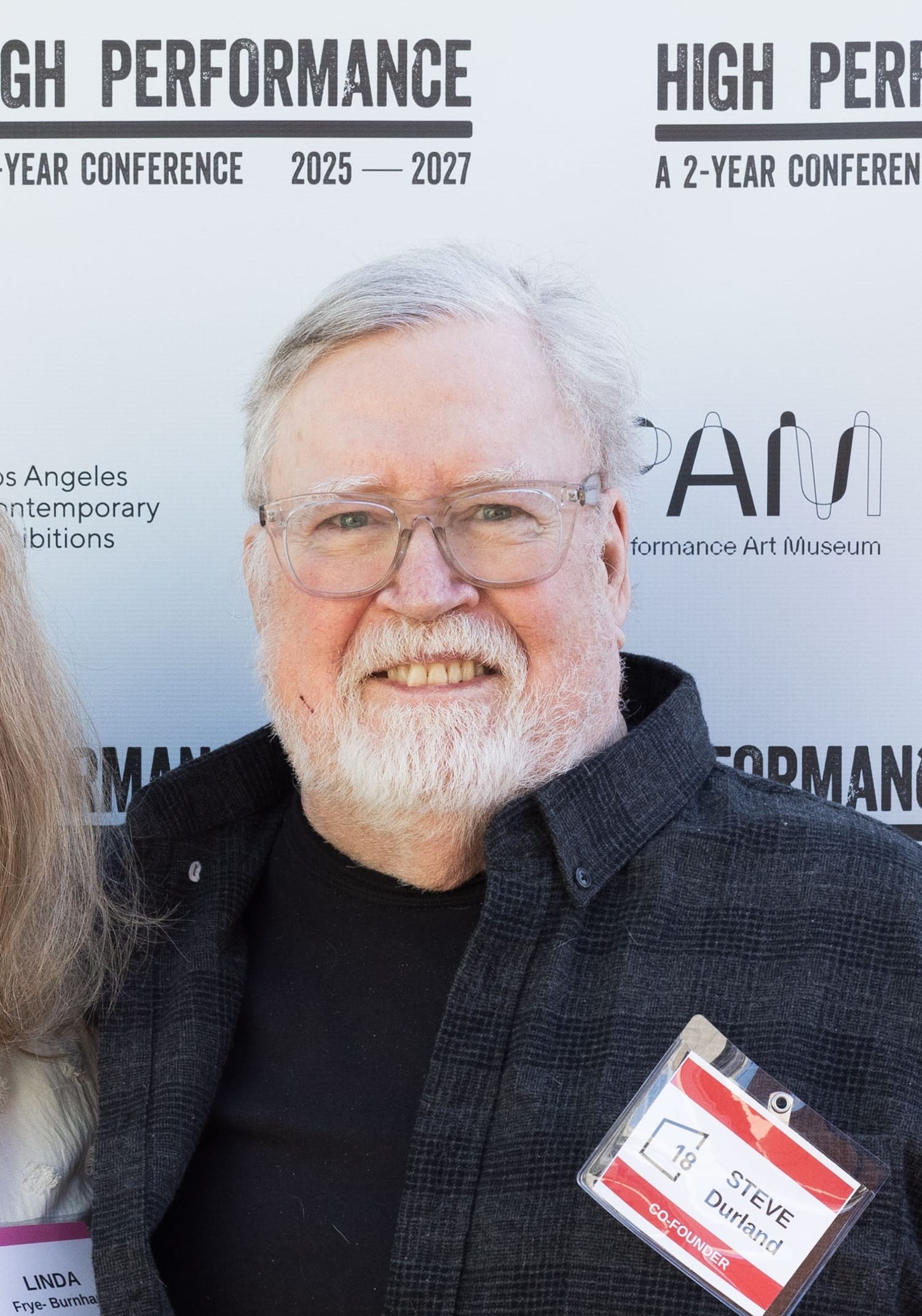
Artist, writer, editor, and cultural organizer Steven Durland died on March 11 at the age of 75 after a brief illness. His longtime collaborator and life partner, Linda Frye Burnham, confirmed his death in Saxapahaw, North Carolina, his home base of three decades.
Durland was born in 1951 in Long Beach, California, and raised in South Dakota. Over the course of his early life, he lived in Massachusetts and New York before returning to the West Coast in the early 1980s. In 1993, together with Burnham, he relocated to Frog Pond Farm in Saxapahaw, where they lived alongside dogs, cats, chickens, and geese.
Durland is best known for his work as editor of High Performance magazine, founded by Burnham in 1978, from 1986 to ’94. During its nearly 20-year run, the publication featured thousands of artists including Nancy Buchanan, Carolee Schneemann, Paul McCarthy, Suzanne Lacy, and the recently deceased Ulysses Jenkins.
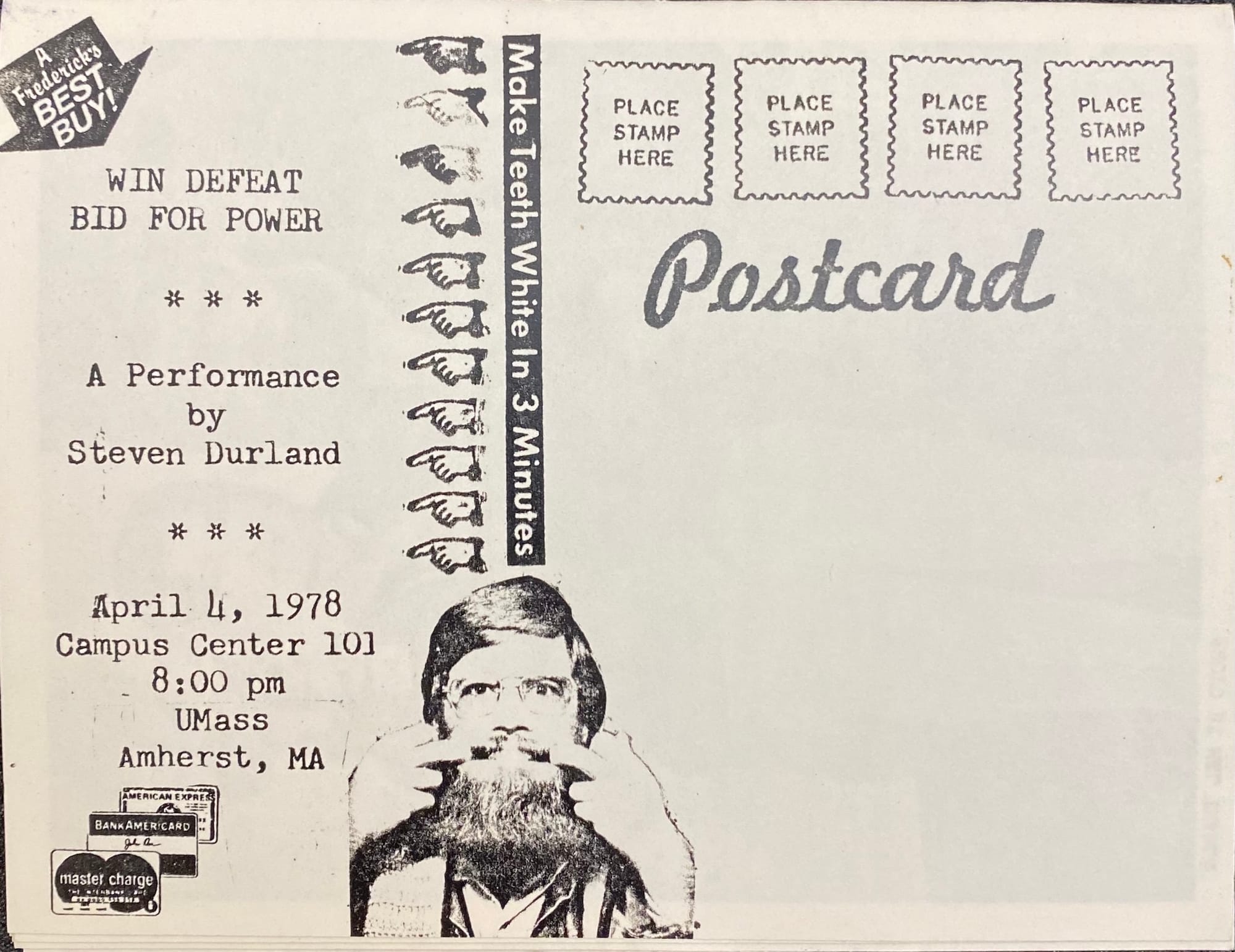
Before his career as an editor, Durland trained as a ceramic artist, earning his BFA at the University of South Dakota and completing an MFA at the University of Massachusetts Amherst. During this period, he became increasingly engaged with performance and mail art practices. A letter he sent from Amherst appeared in the fourth issue of Burnham’s High Performance magazine in December 1978, where he praised the quarterly as a service to artists, adding wryly: “especially to people like myself who exist in areas where performance is about as common as an articulate abstract expressionist.” That same issue featured his 1978 performance “Win Defeat/BID FOR POWER,” an absurdist competition spurred by dice rolls and art-historical trivia. His 1982 performance “Death and Taxis,” which both he and Burnham documented, appeared in the summer 1982 issue.
Alongside performance, Durland was deeply involved in mail art and independent publishing, conducting correspondence through international postal networks and producing small printed works. In April 1980, he began developing Tacit, a micro-newspaper formatted as a single-sided postcard. Burnham later invited Durland to make Tacit a recurring column in High Performance, beginning with issue 16 in 1981–’82. In its introduction, Burnham remarked on his distinctive combination of humor and social and art‑world satire.
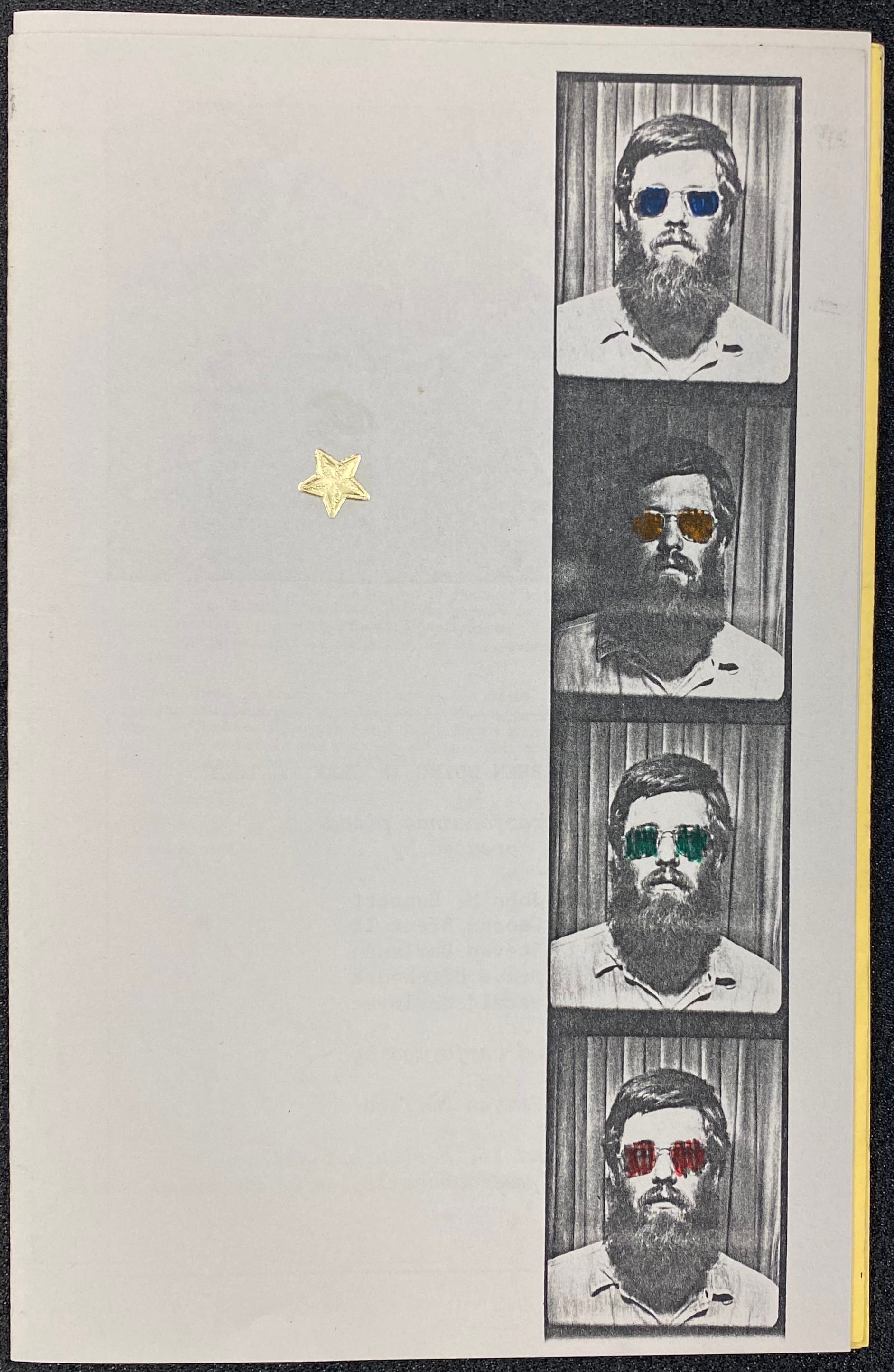
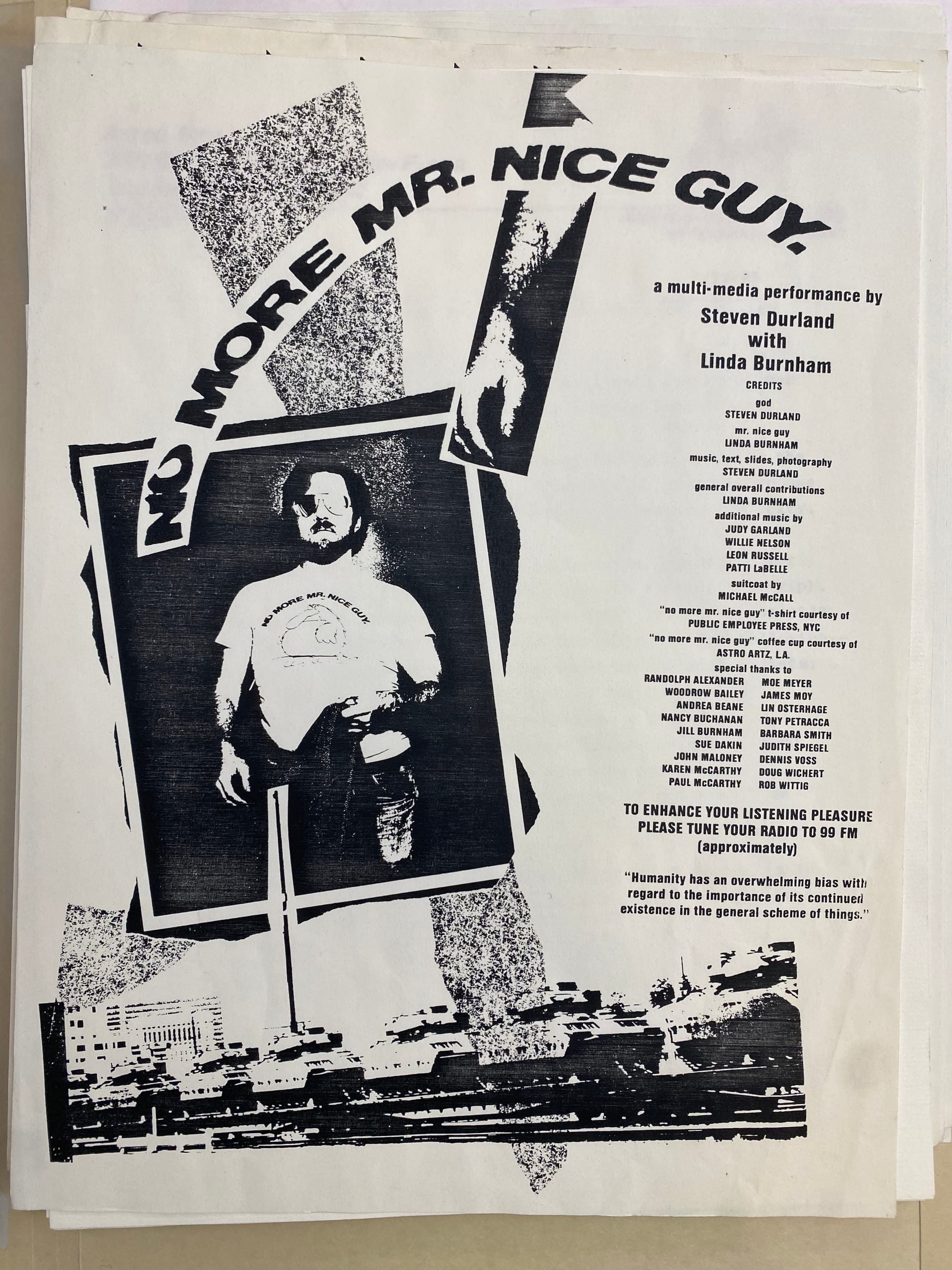
Durland first met Burnham in 1981 while she was visiting New York. At the time, he was working as a computer typesetter, having learned compugraphics — an early form of digital phototypesetting — while still in Massachusetts. After freelancing in New York’s commercial print sector, he later applied this technical expertise to editorial publishing. As Burnham recalled in a 2007 interview with curator and historian Jenni Sorkin, “So here I met this handsome young man, incredibly bright and friendly, a performance artist who knew how to set type. [laughs] Take it away!”
In 1983, Durland moved to Los Angeles and soon began working with Burnham on High Performance, becoming managing editor and, in 1986, editor. His first issue as editor articulated a vision of performance art as a “generalist” practice — one rooted in interdisciplinarity, cross-referenced research, and an expansion beyond specialization.
During his tenure, Durland steered the magazine through the era’s culture wars while consistently resisting an isolationist view of artistic practice. High Performance expanded to a broader engagement with community-based and socially engaged art, while maintaining its commitment to documentation and experimentation. He described the magazine as “a journalistic home for new, unrecognized and innovative work in the arts,” defending the importance of multiple contexts in which art might thrive. He also initiated a series of thematic issues, including ¡Nuevo Latino!, which featured Chicana artist Diane Gamboa’s paper fashions photographed by Daniel Joseph Martinez on the cover, and foregrounded Latino arts communities in Los Angeles and internationally. By the time High Performance ceased publication after its 76th issue in 1997, it had become an indispensable record of ephemeral practices that might otherwise have disappeared from history.
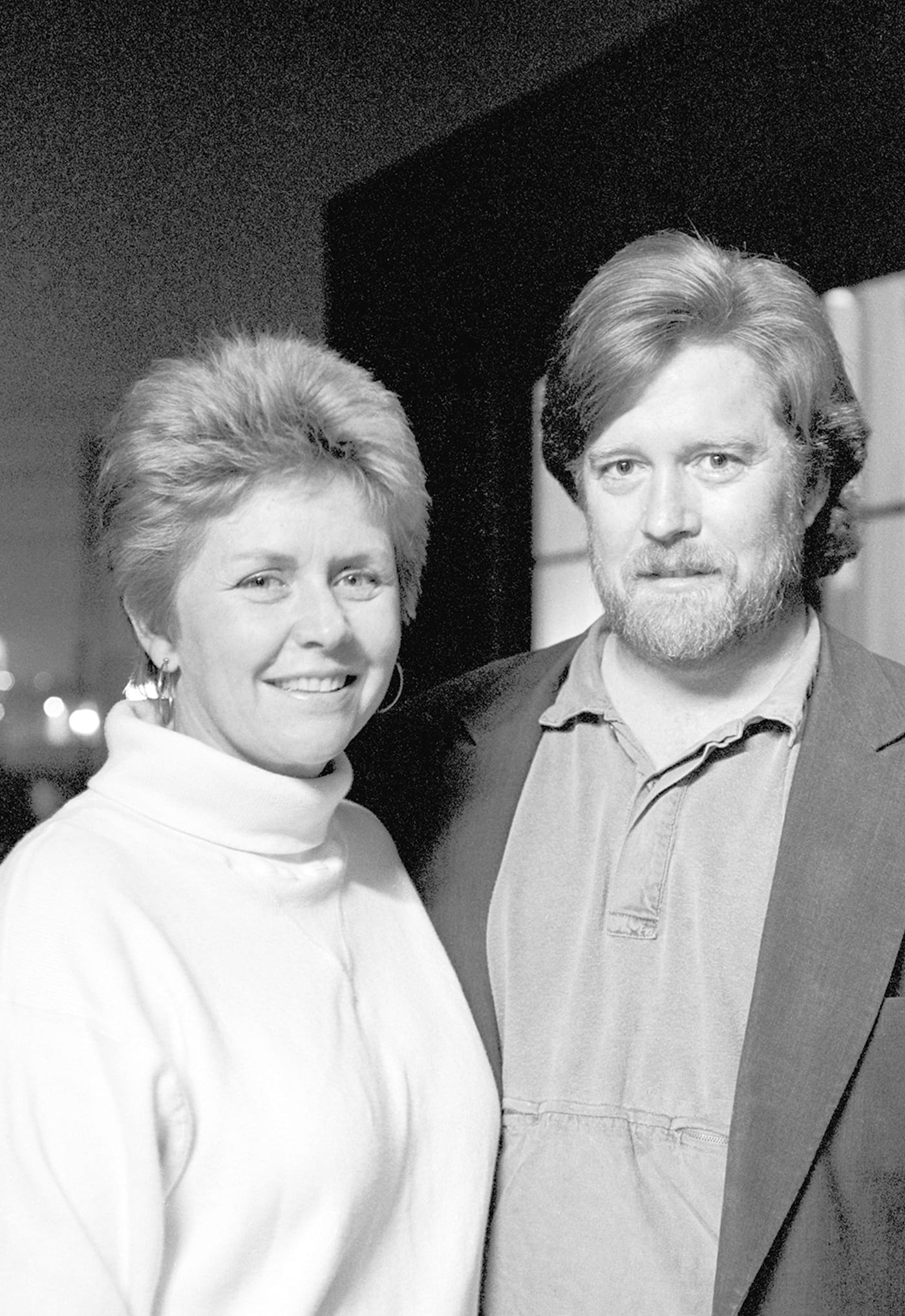
The impulse that shaped High Performance also carried its values from the printed page into lived, spatial practice. In Santa Monica, feminist art studios became the 18th Street Arts Center through the efforts of Burnham, Durland, and Susanna Bixby Dakin. Shortly after, Burnham and performance artist Tim Miller co-founded Highways Performance Space in Santa Monica, a hub for collaboration amid the HIV/AIDS epidemic. In 1995, Durland and Burnham co-founded the community-based art nonprofit Art in the Public Interest, which took its name from a 1993 book by art historian Arlene Raven. The duo also edited The Citizen Artist: 20 Years of Art in the Public Arena (1998), in which they thanked the artists without whom “our work would not be what it is.”
Throughout his life, Durland was committed to art as civic practice. He served as a community artist in Madison, South Dakota, for one year in the mid-’70s through the South Dakota Arts Council’s Artist in the Schools program and funded by the Comprehensive Employment and Training Act, calling it “the best job I ever had” in a conversation with me in 2019. Operating out of a former jewelry store on Main Street, he produced work, taught classes, and engaged the public as the town’s unofficial artist.
At Frog Pond Farm, Durland developed a body of work rooted in the local environment, gathering bark, leaves, eggs from their chickens, beeswax, and other natural materials to create assemblages that combine organic matter with digital processes, often enlarging elements to monumental scale. In 2015, he and Burnham realized “Woodland Banners Poetry Walk,” a permanent outdoor installation pairing printed banners with the latter’s poems derived from artist quotes. Durland also maintained Bourbon, Dogs & Art, a yurt studio and gallery on the property where much of this work was exhibited.
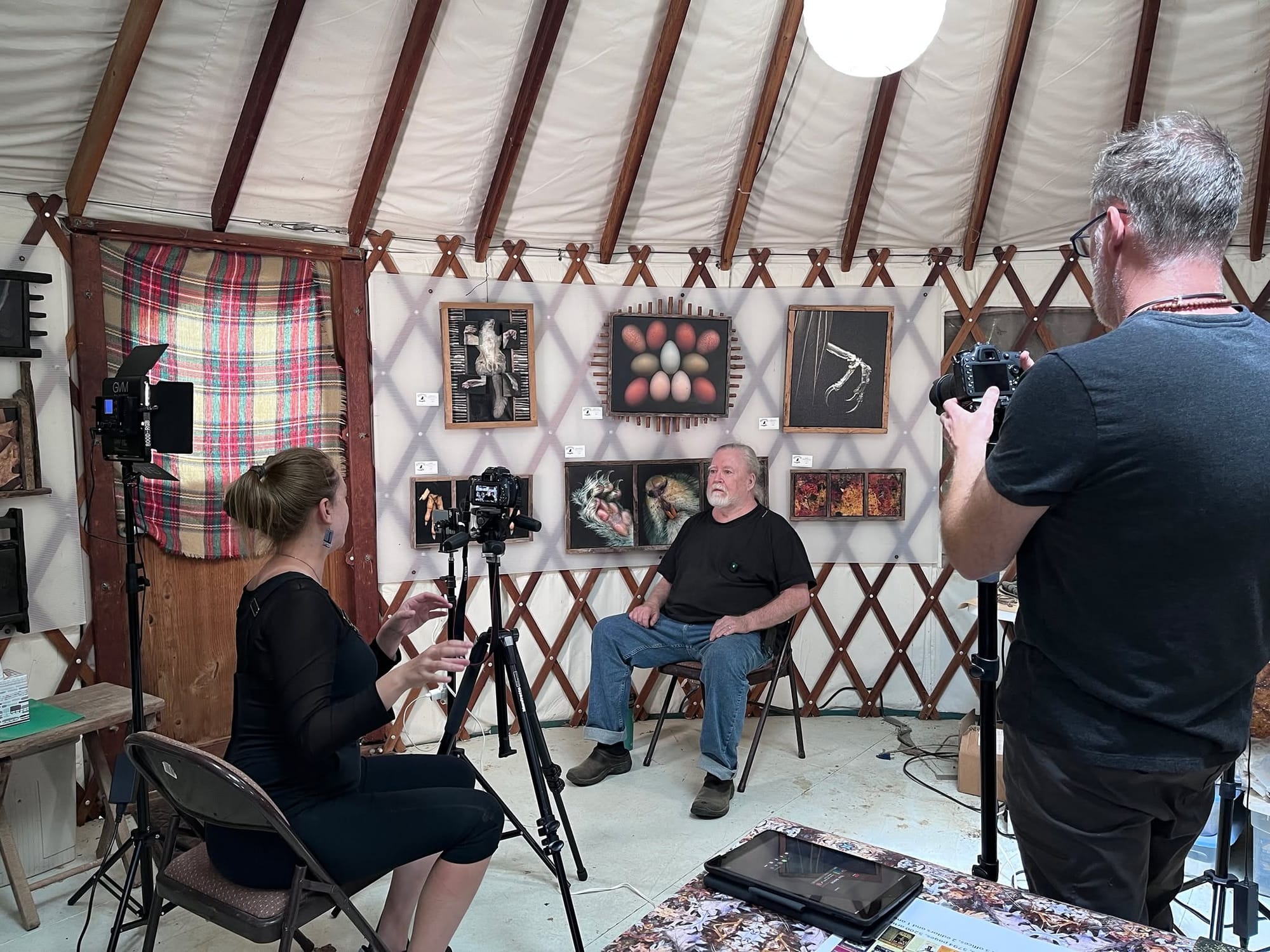
In January, Highways Performance Space mounted Inflation Gauge, a solo exhibition of Durland’s work. This coincided with the launch of High Performance: A 2-Year Conference (2025–2027), a collaboration between Highways, 18th Street Arts Center, the Performance Art Museum, Los Angeles Contemporary Exhibitions, and the Getty Research Institute. In the press text for Inflation Gauge, he recalled the words of Marina Abramović and Ulay, whom he interviewed in 1986 for High Performance. They described the artist’s life as unfolding in phases: warrior, priest, lover, and, finally, gardener. Durland saw both himself and Burnham as inhabiting this final phase, one devoted to cultivation, care, and continuity.
Asked by Sorkin whether he viewed himself as a tastemaker, Durland replied that he was more of a “facilitator.”
“There’s things we could do that nobody else could do,” he said, describing the arts as an infrastructure. “And if we did them, then the whole system benefited.” That steadfast, community-minded ethos defined his life and work. He is survived by Linda Frye Burnham; their dogs, Gracie and Oliver; his siblings, Nancy Tregaskes, Lori Manske, Patty Bassett, and Tom Durland; and his stepchildren, Jill, Tony, and Andy Burnham.