After a rocky few years, Dutch boutique auto marque Spyker has had new life breathed into it by new Ukrainian co-owner Volodymyr Nosov, and to keep its true heart beating, the company is focusing on engaging, mechanical automobiles that a person can build a relationship with, shunning hybrids and EVs. That said, the company has plans for an SUV, but after looking at what it’s done with its latest creation, the Spyker C8 Preliator XXV Coupe, I actually think a Spyker SUV might be worth getting excited about. Let’s talk about the manual hypercar making its debut on the lawns of Pebble Beach first, because it really is something special.
Spyker C8 Preliator: Good Numbers, But They’re Only Half The Story
Spyker
A 4.0-liter twin-turbocharged 90-degree V8 develops 788 horsepower and 738 lb-ft of torque, all of which is sent to the Graziano limited-slip differential through a rear-mounted Oerlikon Graziano six-speed manual. That tells you Spyker cares about fun (60:40 front:rear – great for holding a slide), while the hydraulic power-steering system tells you the company also cares about feel. Forged independent aluminum double wishbone suspension featuring coil-over-damper steel springs with stabilizer bars and countermeasures against dive and squat keeps the wheels in the right place, while 380mm front and 356mm rear Brembo brakes with four-piston calipers provide security. After all, 0-62 mph takes only 2.9 seconds, another benefit of such a front-biased weight distribution setup on a rear-drive platform, and the C8 Preliator XXV won’t stop pulling until 217 mph.
Related: Koenigsegg Built a 1,578-HP Tribute to the Race Car That Never Got Its Chance
With such impressive stats, you know this thing is light, and it is… kinda. It tips the scales at 3,417 lbs. Granted, that’s 1,000 lbs more than a Miata, the gold standard, but this Spyker is still over 400 lbs lighter than a V8 Mustang GT with 1.6 times the power. The Lamborghini Revuelto SV revealed earlier today weighs 3,906 despite using plenty of carbon fiber, but because this powertrain is far simpler and lighter, Spyker gets to play with real metal, infusing genuine craftsmanship into every car. That brings us to the styling, which will certainly get more tongues wagging than any Lambo.
Spyker Doesn’t Care About Speed As Much As Spectacle
Spyker
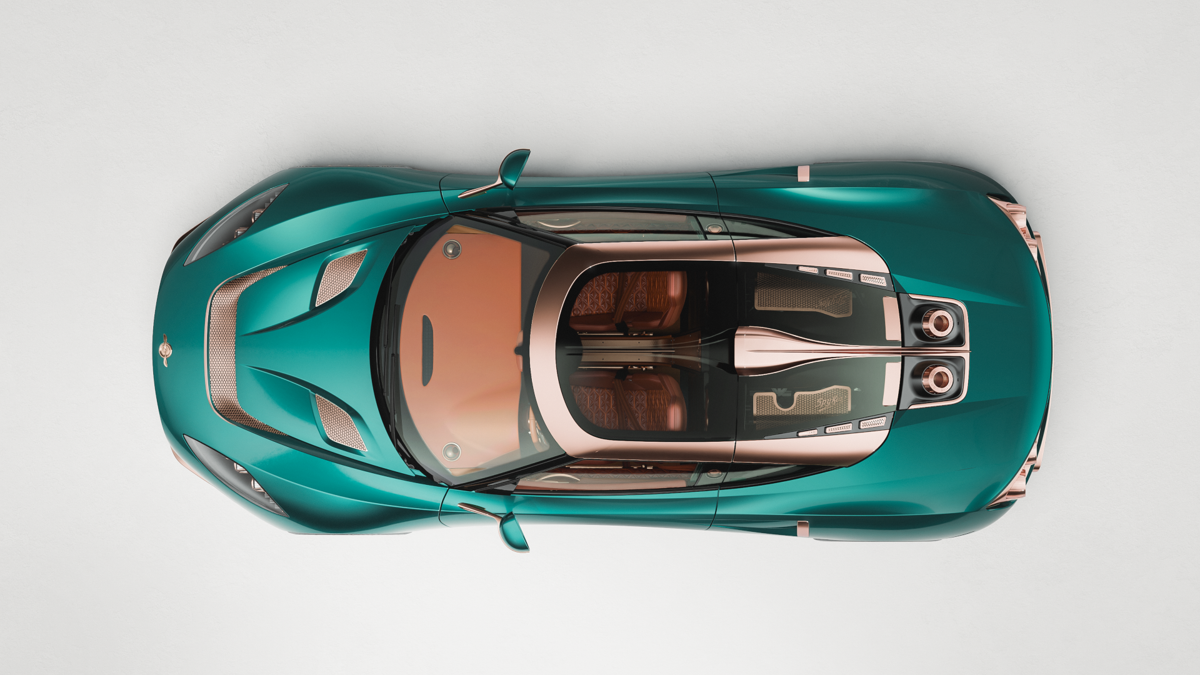
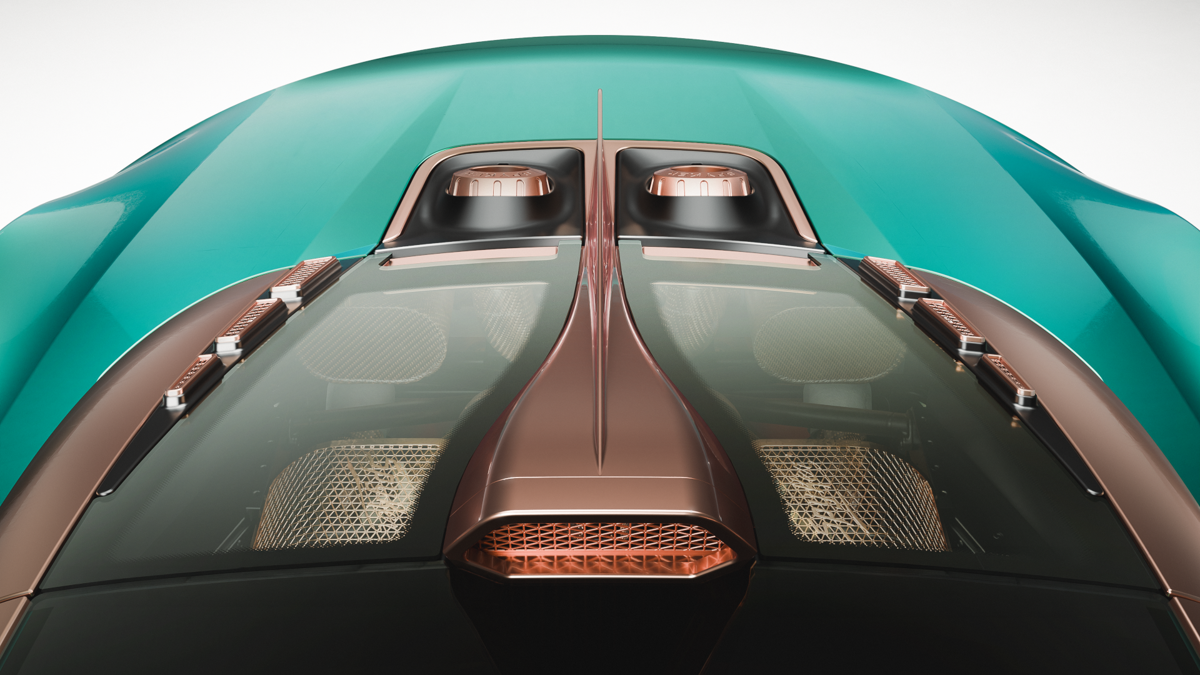
The design – inside and out – of the Spyker C8 Preliator XXV is as unconventional as the name, which is Latin for “warrior.” To begin with, it has a manually adjustable diffuser, and while other automakers choose carbon fiber for its relative ease of use and speed of production, Spyker spends roughly 2,100 hours on every car, with human craftsmanship used wherever possible. For example, the aluminum body is hand-built on a spaceframe that had to be specially redesigned for this car (chassis 270 and the last of 255 Spyker C8s built since 2000); the steering wheel is stitched by one person using two needles at once over four hours, and even the screwheads in the cabin are aligned by hand to face the same direction. The chassis number is stamped by hand; the dashboard is made of turned aluminum in a nod to pre-1925 Spykers, and there are rich metal surfaces and touchpoints everywhere. It seems that Spyker understands how to provide an ultra-luxury experience that feels truly substantial.
While carbon fiber is rightfully celebrated for its technical virtues, we have always preferred aluminum, a living metal that can be shaped by the hand of an experienced craftsman, polished to perfection, its beauty only deepening with age, like a fine Cabernet. For Spyker, this is what modern ultra-luxury should feel like: rare, personal, and made by human hands.
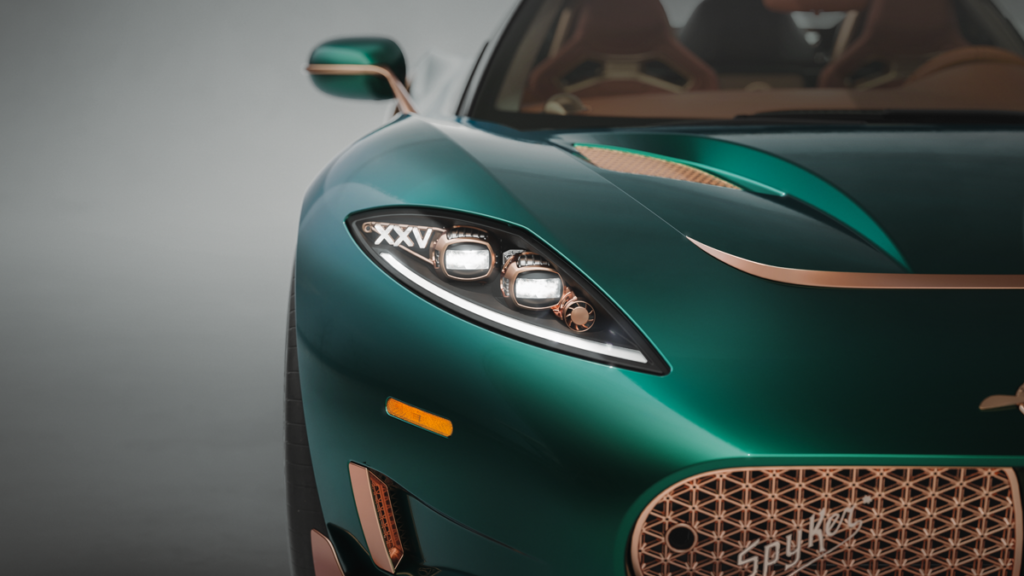
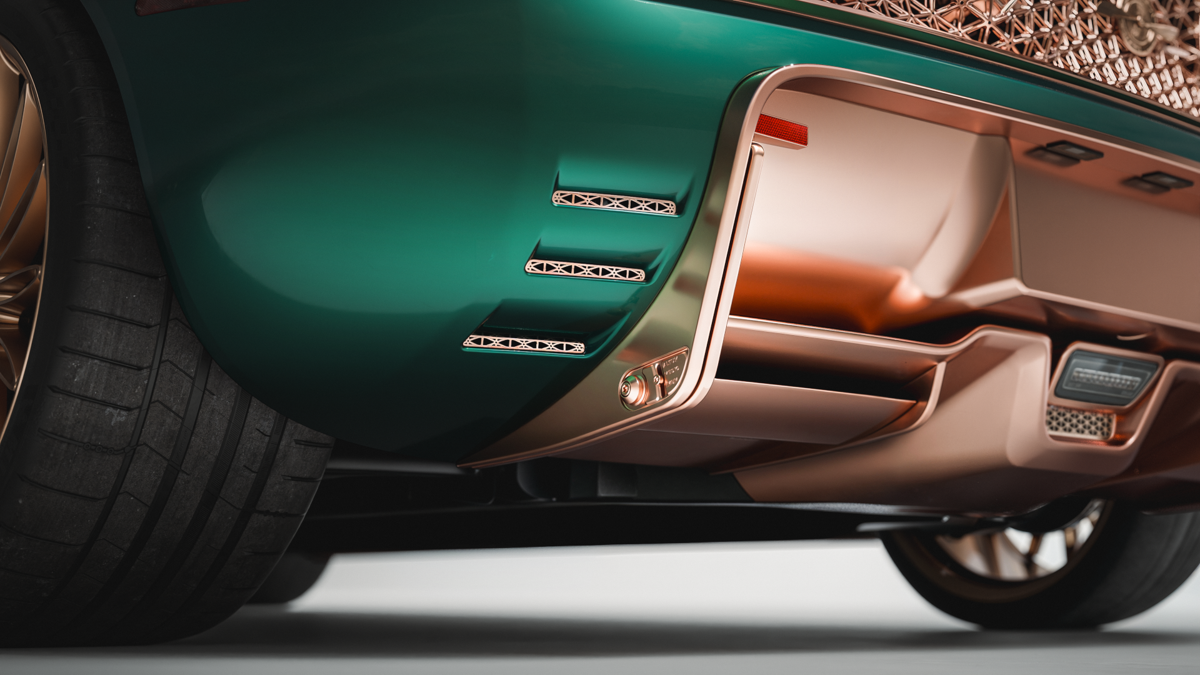
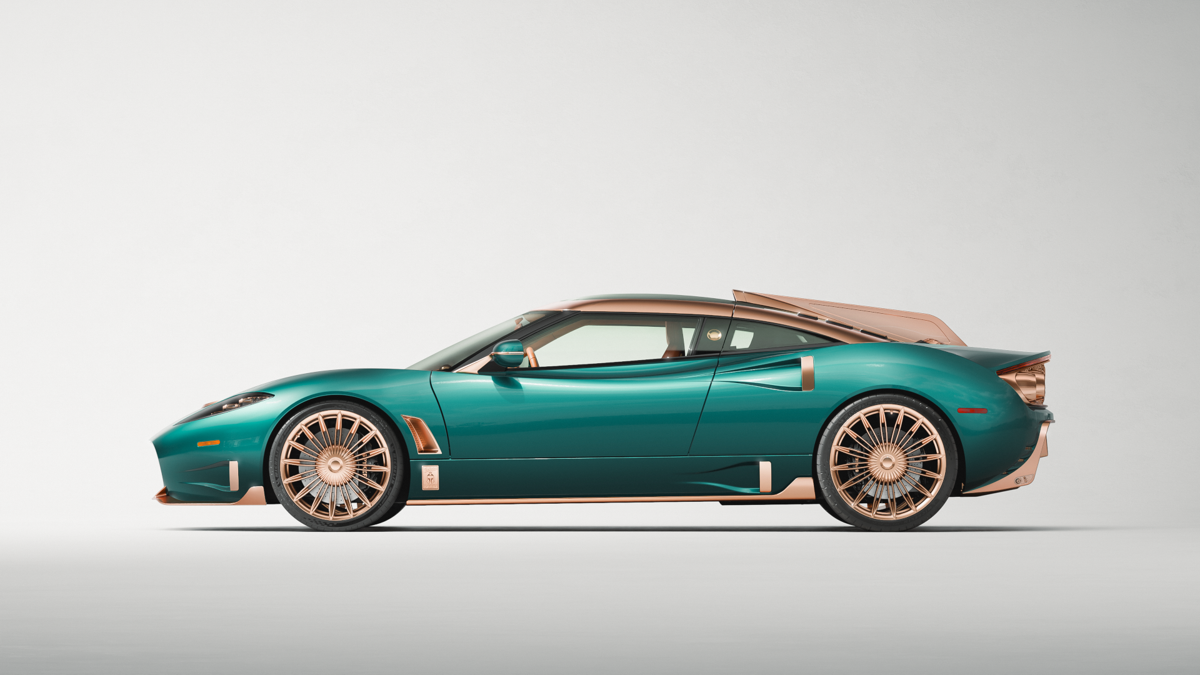
This car is finished in a metallic color called Quail Green (fitting given its debut setting), subtly uplifted with rose gold flakes, matching the bejeweling of the brightwork inside and out, while the interior gets an orange-brown leather called Tuscan Saddle. Opting for rose gold brightwork and 20-inch front/21-inch rear wheels adds €58,000/$66,900 to the doubtless sky-high price, but any other color can be had, with a price on application (i.e., also not cheap). It’s also worth mentioning the finer detail of isogrid lattice patterns of interlocking triangles, a nod to the company’s brief aerospace era, appearing in the grilles, vents, pedals, exhaust mesh, and even the seat upholstery. Rear taillights inspired by afterburners, seven NACA ducts, and front winglets continue the theme.
Spyker
The car is also somewhat practical; for the C8 Preliator XXV, Spyker moved the fuel tank between the cockpit and engine and moved the 4.2-cubic-foot trunk to the front to make the car more useful for grand touring. Like a Koenigsegg’s Ghost Mode, a push of a button activates Butterfly Mode, opening all the moving panels. And if something feels missing, the only screen in here is a head-up display, though smartphone connectivity is possible and a high-end sound system can be fitted. Just 25 examples of the C8 Preliator XXV will be made, and each will be unique, since pretty much everything can be customized.
Spyker’s Plan For An SUV Could Be Interesting
Spyker
With all of the C8 Preliator XXV’s attributes in mind, from the real exposed-linkage manual transmission (something Spyker intentionally highlights as a not-so-subtle dig at Ferrari, just as McLaren did earlier today with its McL 6GT) to the hand-formed aluminum bodywork and the intricate interior detailing, Spyker’s plans to develop the long-awaited Spyker D8 Peking-to-Paris are intriguing. This would be an expensive, low-volume, V8-powered super SUV that few people can afford, but it would feel more analog than a Ferrari Purosangue, more exclusive than a Lamborghini Urus, and more interesting than a Maybach. Because Spyker has history off-roading, racing from Peking to Paris in 1907 over thousands of miles of uncharted terrain, and because Spyker built the world’s first six-cylinder four-wheel-drive car four years before that, an AWD SUV would not feel forced into the brand’s historic narrative. It would feel natural, and with such meticulous craftsmanship combined with an abhorrence of digitalization, the D8 could feel like the Pagani of SUVs. Let’s see if it happens this time.