Source: Geophysical Research Letters
The influences on Earth’s climate and weather patterns are wide ranging, from anthropogenic greenhouse gas emissions to volcanism to variations in solar activity.
As the Sun undergoes both short- and long-term changes in activity, including the well-known 11-year sunspot cycle, it sends varying amounts of total solar energy to Earth’s atmosphere. Copious evidence has revealed correlations between long-term changes in solar activity and changes in rainfall, surface temperature, and other climate measurements. However, these atmospheric variables are highly intertwined, making it difficult to discern what physical mechanisms may be at play.
Raeder reports the first clear evidence that geomagnetic storms—brief, hours-long disturbances of Earth’s magnetosphere caused by bursts in solar activity—influence weather conditions on Earth. The findings could help scientists narrow down the possible mechanisms by which changes in solar activity influence our weather.
This analysis incorporates 67 years of hourly data capturing the intensity of geomagnetic storms over North America, as well as hourly atmospheric data during the same period. The latter dataset was only recently made possible by advancements in atmospheric modeling.
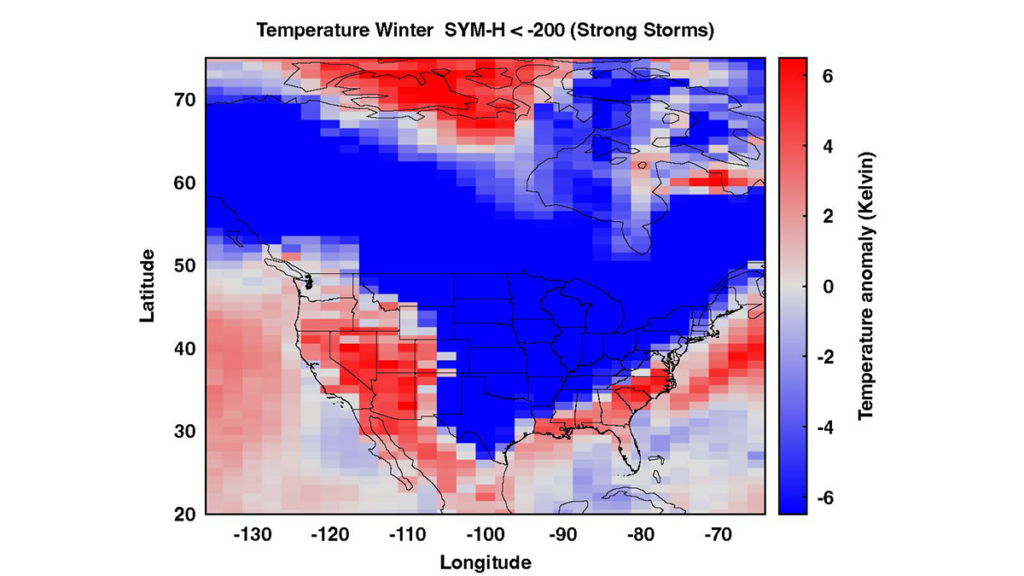
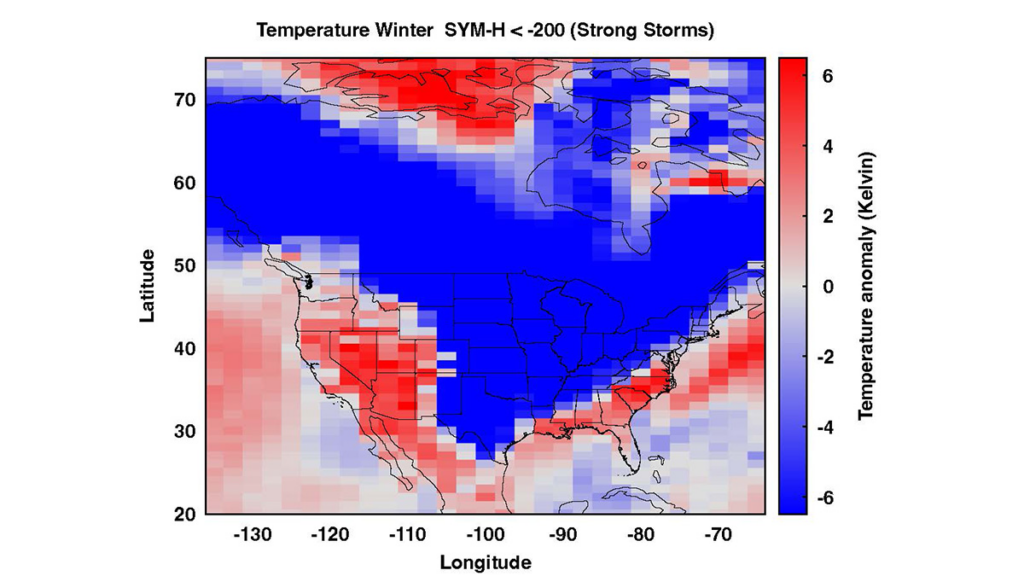
The data reveal that geomagnetic storms significantly influence atmospheric pressure, temperature, and precipitation over a matter of hours to days. The intensity of the storms appears to be closely related to the severity of their atmospheric effects. The effects also vary by regions and season. For instance, wintertime geomagnetic storms appear to boost atmospheric temperatures over the U.S. West Coast, while temperatures fall over much of the rest of the country.
The findings align well with certain previously proposed underlying mechanisms and poorly with others. They rule out the mechanism known as the cosmic ray cloudiness hypothesis but generally support top-down mechanisms that propagate from the upper atmosphere into the troposphere, where most of our weather occurs.
On the basis of this analysis, the author suggests that previously observed, long-term correlations between solar activity and Earth’s weather are likely to have resulted from short bursts of solar activity like the storms analyzed in this study, rather than slow, continuous changes.
This study could also inform updates to weather and climate models, which currently struggle to accurately capture the influence of geomagnetic storms on Earth’s atmosphere. (Geophysical Research Letters, https://doi.org/10.1029/2025GL121097, 2026)
—Sarah Stanley, Science Writer

Citation: Stanley, S. (2026), Solar storms can affect Earth’s weather. A new study examines how, Eos, 107, https://doi.org/10.1029/2026EO260200. Published on 23 June 2026.
Text © 2026. AGU. CC BY-NC-ND 3.0
Except where otherwise noted, images are subject to copyright. Any reuse without express permission from the copyright owner is prohibited.