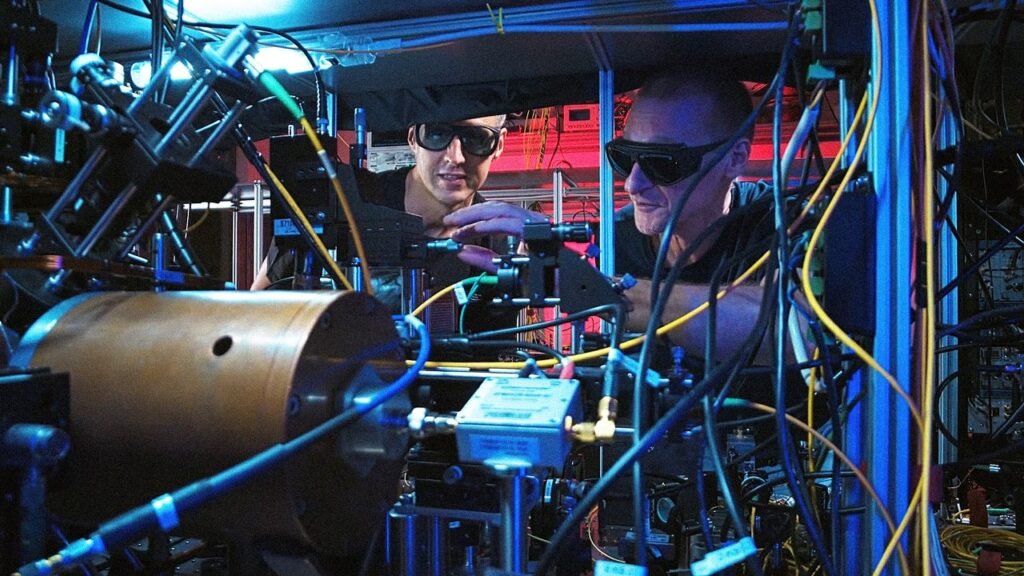
Physicists in Singapore have built an atomic clock so precise that it measures time down to the 19th decimal place.
A machine with this level of accuracy could run for hundreds of billions of years—far longer than the entire age of the universe—without gaining or losing a single second. This leaves the world’s reigning timekeeping superpowers in the dust.
Until now, the ultimate records belonged to elite laboratories in the U.S. and China, which spent years locked in an intense scientific duel using clocks powered by aluminum and deep-frozen calcium (both using ions, which are individual atoms stripped of an electron to give them an electric charge).
But Singapore’s new clock shatters anything else out there by delivering a fourfold leap in accuracy over the best American and Chinese machines, establishing a whole new league of precision, according to the research paper published in Nature.

An element with an armor
Atomic clocks quietly run modern civilization. Without their ultra-precise timing, GPS navigation would fail, cellular networks like 5G would desynchronize, and real-time financial markets would descend into chaos. Today, the world’s official time is still governed by cesium atomic clocks, a global standard established in the 1960s.
At their core, these machines work just like a grandfather clock, but instead of counting the mechanical swings of a brass pendulum, they count the natural vibrations of light waves.
An atom is surrounded by orbiting electrons that inhabit distinct energy levels. When exposed to electromagnetic radiation vibrating at an exact frequency, those electrons absorb the energy and jump between levels.
In a standard cesium clock, a microwave beam is tuned until it hits the precise frequency that makes the electrons jump—several billion oscillations every second. The clock’s electronics simply count those waves: When exactly 9,192,631,770 cycles tick by, one official second has passed.
In the early 2000s, physicists realized they could build a much sharper metronome. Instead of using microwaves, they developed optical atomic clocks that bathe atoms in visible laser light. Because laser light waves vibrate hundreds of trillions of times every second—thousands of times faster than microwaves—they divide each second into trillions of tiny slices, tracking the flow of time with vastly finer resolution.
Not all atomic clocks are created equal, however. Even though an atom’s internal jump is fixed by the fundamental laws of physics, the atom itself can be nudged off beat by temperature changes, stray electric charges, or magnetic fields.
That sensitivity sparked an intense race among global superpowers to create the most stable atomic clocks using different elements.
Now an unprecedented level of precision has arrived with a new clock sitting inside a laboratory of Singapore’s Centre for Quantum Technologies. There you will find a massive, vibration-damped steel table crowded with lenses, beam splitters, and mirrors. At its core are two sealed, stainless-steel vacuum chambers resembling miniature deep-sea submersibles, each ringed with circular glass portholes.
Peering through the glass into the pitch-black vacuum, you find four tiny, parallel metal rods pulsing with radio frequency electricity—rapidly alternating electrical currents that act like an invisible tractor beam, a device known as a linear Paul trap.
These rods generate an oscillating electric cage that holds a single, charged atom of lutetium—the key to the new clock design—hovering in midair in the dead center of the chamber, without touching a single physical surface.
Building a clock around a lone atom is usually an engineering nightmare. In an ordinary room, an atom is constantly assaulted by invisible background noise: heat radiating off laboratory walls, stray magnetic forces from electrical wiring, and wandering electric charges.
Most atoms get rattled by these disturbances, which push their internal ticks out of rhythm. Lutetium, however, has an internal structure that acts like built-in noise-canceling armor, the scientists say.
As the Nature study points out, the specific electron jump the researchers track inside lutetium is naturally blind to the ambient thermal warmth of the room, and it shrugs off stray magnetic fields far better than competing designs. Second, lutetium is an exceptionally heavy atom.
While lighter atoms dart and tremble when warmed by room temperatures—blurring their internal tempo—heavy lutetium acts like a solid anchor, sitting virtually motionless and preventing speed-induced timing errors.

Noise canceling
To clean up whatever tiny disturbances remained, the researchers engineered a clever method called “hyperfine averaging.” Think of it like a playground seesaw.
Inside lutetium, one electron energy state—the level of energy that electron has, which can go up and down in fixed steps—gets slightly nudged upward by a magnetic field, while a sibling energy state gets pushed downward by the exact same amount.
Aiming directly through the glass windows from outside the chamber are metal microwave horns and a network of laser beams. By firing rapid, timed bursts of microwaves at the hovering atom during the laser measurement, the researchers flipped the electron back and forth between these opposite states.
Because the atom spends equal time leaning up and leaning down, the unwanted magnetic and electrical pushes that could affect it mathematically cancel each other out over the course of every tick, leaving the clock running in pure, uncorrupted rhythm.
The team believed they had developed the most accurate clock in existence, but they needed to test whether that precision held up in the real world.
“There is a humorous saying that ‘a man with a watch knows what time it is, and a man with two watches is never sure,’” joint first author Kyle Arnold says. “It basically tells you that the only way to test the accuracy of a standard is to compare clocks and demonstrate reproducibility.”
To prove their clock was not fooling itself, the researchers built two completely independent lutetium clocks side by side on the same table and locked them into a 200-hour duel. They found that their two-clock test worked flawlessly. The clock’s precision was not a mirage.
Murray Barrett, a principal investigator at the Centre for Quantum Technologies and associate professor of physics at the National University of Singapore, led the study. “In the future, I just don’t see how this clock can be beat,” he says.
Barrett underscores how impervious the device is to external conditions by noting in the press release: “The good properties mean that high accuracy can be achieved even in a wide range of environments. The lutetium clock would be accurate even if you went from the hottest place recorded on Earth in Death Valley to the coldest place in the Antarctic plateau.”
Feeling the warping of space-time
Perhaps the most astonishing aspect of the experiment is how directly it interacts with Albert Einstein’s general theory of relativity. Einstein proved that gravity is not just an invisible downward pull; concentrations of mass and energy warp the fabric of space and time.
The closer you are to a massive body like Earth, the stronger gravity is, and the slower time ticks. That means a clock sitting on the floor runs slower than a clock resting on a bookshelf, even if humans cannot perceive the difference without instruments this sensitive.
These machines are so sensitive that they can feel time slowing down across a height difference of barely a fraction of an inch. During testing, the team discovered that a microscopic tilt in their laboratory table caused one clock to tick slightly faster than its twin, simply because one atom was suspended roughly 0.16 inches higher off the ground than the other.
To prove that the two clocks were fundamentally identical, the scientists had to physically measure the vertical height of both trapped ions down to fractions of a hundredth of an inch and mathematically subtract the gravitational warping caused by the Earth beneath them.
If you’re thinking, Why does measuring a fraction of a second matter? that’s fair. But this breakthrough extends far beyond the art of telling time. It gives humanity a brand-new measuring tool for observing reality.
To start, the international organizations that govern global measurement are preparing to officially rewrite the definition of the second around 2030, and this lutetium clock has suddenly leaped forward as a top contender to become the planet’s new master standard.
Beyond the laboratory, these clocks can revolutionize geology. Because their ticking tempo changes with the slightest shift in local gravity, portable versions of the machines could be loaded into trucks and driven across continents to act like subterranean radar.
Geophysicists could use them to detect dense magma chambers creeping beneath active volcanoes, spot tectonic faults warping prior to earthquakes, and measure ocean levels with sub-inch precision—a technique the Nature study terms “chronometric levelling.”
Turned toward the cosmos, interconnected arrays of these clocks could detect the faint, passing ripples of invisible dark matter drifting through our solar system, or test whether the fundamental constants of nature—the unbending baseline rules of physics, such as the speed of light or the charge of an electron—have stayed constant since the dawn of the Big Bang.
To bring that future out of the lab, joint first author Michael Lee explains, “The next step is to take the lab-scale clock and miniaturize it into a transportable system,” with the authors confident that downsizing the hardware will not degrade its performance.
This is far more than just another record-setting atomic clock. By holding a single atom of lutetium in complete stillness, physicists have fashioned an instrument that can eavesdrop on the subtle, cosmic hum of space-time itself.