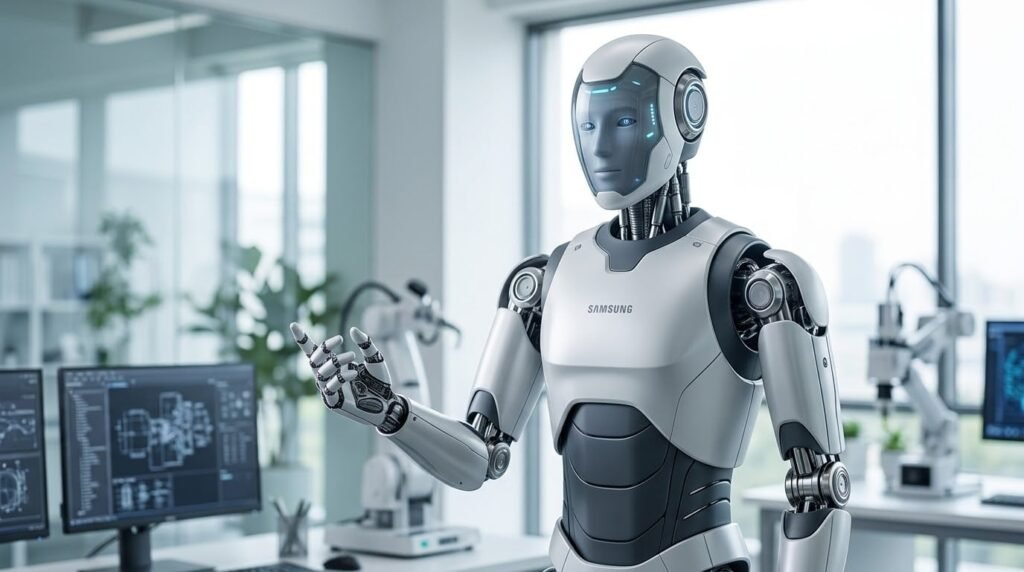

Most people know Samsung for smartphones, TVs, and home appliances, yet its next big hardware reveal is a bipedal robot. According to Korean media, the company plans to unveil its first in-house humanoid robot at CES 2027 in Las Vegas this January. The main model, named Human Reference or HR, will start working inside Samsung’s own appliance, TV, and smartphone factories for field trials in the second half of 2027, powered by NVIDIA chips.
Built by Samsung’s Robotics eXperience unit, HR stands about 5 feet 9 inches tall, weighs 165 pounds, and runs on NVIDIA’s Jetson Thor chip. That single processor handles both AI decisions and joint movement, while 3D LiDAR and wrist cameras help the robot spot obstacles and grab parts. Samsung even adapted precision hinge machining from its Galaxy foldable phones to build five-fingered hands with tactile sensors in each fingertip.
How foldable tech shapes robot hands
Building reliable hands is one of the toughest problems in robotics, because assembly lines cannot afford dropped screws or clumsy grips. Samsung robotics lab head Kris Hauser recently explained that factory owners expect a 99.99 percent success rate before putting a robot on a live production line. Alongside HR, Samsung will also bring a smaller 45-kilogram research model called Humanoid Extreme that leaves out hands to focus on agile full-body movement.
Humanoid Extreme combines an NVIDIA Orin NX chip with an Intel Core Ultra 7 processor to practice new motions through reinforcement learning, passing those skills back to HR. Samsung’s board of directors already reviewed a 90-minute private demo of the prototypes in Seoul ahead of the January CES launch. If the late 2027 factory tests succeed, Samsung plans to build a pilot production line by the end of the year as part of its goal to run autonomous plants by 2030.
Taking on Tesla and Boston Dynamics
Samsung is jumping into a fast-moving robotics race alongside Tesla, China’s Unitree, and Hyundai’s Boston Dynamics. Hyundai already plans to deploy its Atlas humanoid at a Georgia car plant in 2028, raising pressure on competitors to prove their robots can handle real factory shifts. Unlike startups that have to pitch outside buyers first, Samsung can test and improve HR directly inside its own global electronics plants.
Down the road, Samsung also wants home robots that can fold laundry, clean up, and assist older adults. Because Samsung already builds millions of phones and appliances every year, it knows how to manufacture complex parts at scale without blowing up costs. First, though, HR has to prove it can keep up with human workers on Samsung’s factory lines late next year.
The post Samsung’s First Humanoid Robot Will Debut at CES 2027 With NVIDIA’s Brain and Galaxy Foldable Hands appeared first on Android Headlines.

