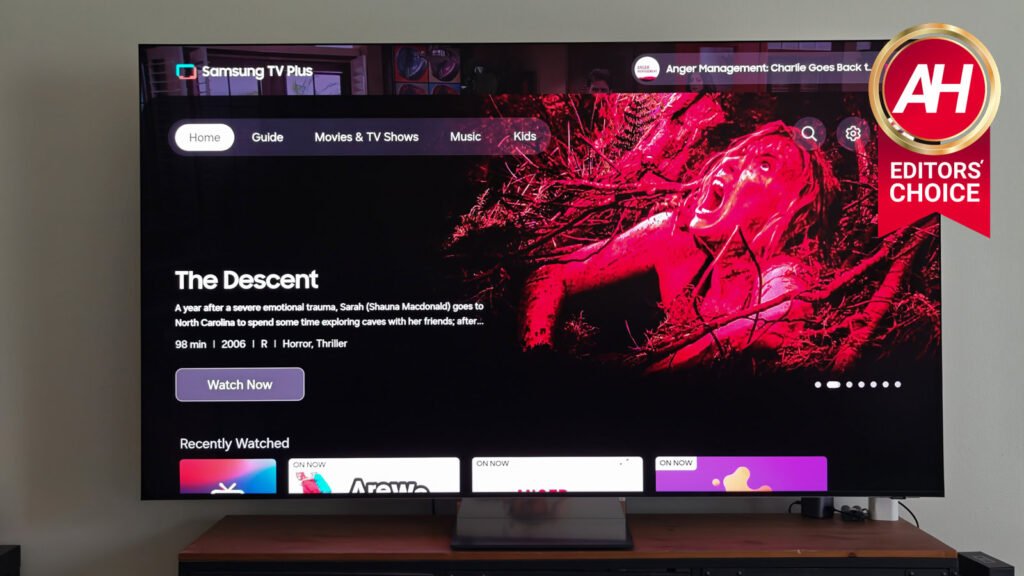

Over the years, I’ve heard a lot of marketing talk through different briefings with different companies. As someone who has been reviewing tech for the last 14 years, I’ve heard it all. When Samsung said that its new Micro RGB tech could rival other TV technologies on the market like QLED and OLED, I didn’t quite believe them. That was until this 75″ R95H model showed up on my doorstep.
I’ve been living with this TV for the past month. Watching the World Cup, watching my favorite TV shows, and even playing some CFB 26 on my PlayStation 5. It’s been an incredible experience, and now that my loan period is coming to an end, it’s time to send the R95H back, unfortunately.
So in this review, we’re going to talk about what it’s like to live with the R95H. It’s going to be a bit different than the other reviews we’ve done here at Android Headlines. So buckle up.

Samsung’s R95H didn’t just impress me. It ruined every other TV in my house.
Pros
- Micro RGB delivers unfiltered RGB backlight light directly to the eyes (no color-filtering film layer), giving noticeably more accurate, realistic colors than standard TVs, immediately visible even on the Samsung boot logo
- Covers 100% of the ultra-wide BT.2020 color space
- Gets OLED-level deep blacks while still hitting much higher brightness, without OLED’s burn-in risk
- Colors stay stunning even at max brightness, thanks to Micro RGB plus Samsung’s picture processing
- AI picture mode actually works well: it reads room lighting, content type, and preferences to auto-adjust brightness, color, and upscaling
- 165Hz native refresh rate and every HDMI port is HDMI 2.1 (full 4K120 support) — strong for gamers
- Gaming Hub includes NVIDIA GeForce Now, Amazon Luna, and other cloud platforms, so a console isn’t required
Cons
- Very expensive: $3,199 for the 65″, $4,499 for the 75″ reviewed unit — the most expensive TV the reviewer has ever tested
- Micro RGB pricing isn’t expected to come down significantly for another 5–10 years
- OLED is still considered the better picture technology overall right now, and the R95H’s cheapest size costs about the same as Samsung’s flagship OLED (S95H)
- Tizen OS, while less ad-heavy than Google TV, still isn’t as clean/straightforward as Apple TV’s app-only interface
Let’s get the price out of the way first. This is a $3,199 TV. It’s not cheap, but that is to be expected given Micro RGB is new technology. Our model here is the 75″, which means it is priced at $4,499. Making it the most expensive TV I have ever reviewed.
RGB TVs are starting to get cheaper, but they are still fairly expensive and likely will continue to be pretty pricey for another 5-10 years.
Samsung did also send over the HW-QS90H soundbar with the R95H, which is $999.
The color experience
Those of you who know about Micro RGB know that the ‘RGB’ stands for individual pixels in red, green, and blue in the TV’s backlight. Traditionally, these have been white or blue, so the color is filtered through a layer of film. However, with Micro RGB, it is direct, unfiltered light straight to your eyes. This allows Micro RGB TVs to cover 100% of the ultra-wide BT.2020 color space, as well as incredible brightness without the worry of burn-in that a lot of OLED TVs suffer from.
Basically, Micro RGB throws away the filter, so you’re getting more realistic colors, even at brighter levels. It’s immediately noticeable.

I thought, after taking the R95H out of the box, that I would not be able to tell the difference between the colors on this TV and any other Samsung TV, or even some of its competitors. But it was immediately noticeable from the Samsung logo appearing on the screen. It’s worth noting that this was not solely because of Micro RGB, but also due to the anti-glare and matte finish on this TV. Which we’ll talk about a bit later.
With Micro RGB, you aren’t just getting better and more accurate colors. You’re also getting brighter colors. While still getting the deep blacks that OLED TVs are known for. Don’t throw your OLED TV out just yet, OLED is still better, though it is typically more expensive.
Even setting this TV at its brightest setting, the colors on the R95H look stunning. This isn’t just because of Micro RGB, but also the picture settings that Samsung has included.
Typically, I would not let AI choose the picture mode to use, but Samsung has done a great job optimizing the AI layer here that it, just worked. AI is used to upscale, enhance and optimize picture quality automatically, and it works. It’s able to analyze the lighting in your room, the content type and your personal preferences to automatically adjust the brightness, color and upscaling. After the first couple of days, I found that AI was giving me the best picture possible on this massive 75″ TV.
This is a different mode compared to the AI Soccer Mode, which I already wrote about. It uses AI to brighten the colors, and I really didn’t notice a difference throughout the World Cup.
It’s safe to say this is the best color accuracy I’ve experienced on a TV, and that should not be a surprise considering it is Micro RGB.
Anti-Glare + Matte = Perfection
Over the past couple of years, a lot of TVs have added an Anti-Glare layer to their display. Which is great; I love it on the other TVs in my home. But Samsung is the only one that I know of, which does anti-glare and also has a matte layer on its panel, that doesn’t disrupt the picture quality either.
Just to give you a bit more detail about where this TV is. It sits in my living room, a few feet away from a sliding glass door, which brings in a lot of light. On the left side of the TV is a window that brings in a decent amount of light, but not as much. This makes some TVs hard to watch in the living room because of the reflections. It’s no match for the R95H.

Don’t get me wrong, we’ve seen TVs with a matte layer before, but it usually affects the viewing quality and/or the viewing angles. That’s not the case with Samsung. And that’s not surprising to me, seeing as Samsung also makes displays. So of course, they want their displays to look good on their products. I really hope that more TVs add a matte finish to their TVs, instead of saving it for the lifestyle products like Samsung’s The Frame.
Before the R95H, I would need to close the blinds and the blackout curtains to watch something that was dark. Otherwise, I wouldn’t be able to see it. With the R95H, that’s no longer a thing I need to do. That just shows you how good this matte finish is on the R95H, when paired with its anti-glare layer.
Samsung has ruined other TVs for me
This is going to sound like hyperbole, but even before packing up the R95H, Samsung ruined other TVs for me. I have a Hisense U8QG in my bedroom, which has incredible brightness and great picture quality, but it’s not Micro RGB, and it’s not Matte. The two main things that make the R95H so much better for me when watching TV. In my room, this TV is opposite a pretty big window, and you can clearly see a lot of reflections, something you see zero of on the Samsung R95H.
Of course, that Hisense TV is a lot cheaper (and almost two years old now), but it was one of my favorite TVs. Until I experienced Samsung’s R95H.
Samsung’s Tizen OS is still one of the best TV platforms
I’m someone that uses Google TV and Apple TV on the other TVs in my house. I have a Google TV Streamer in one room, and an Apple TV in the other. What I really like about Apple TV is there are no ads. It’s just apps, which is what the platform should be. And Samsung is very similar. It’s not quite as straightforward as Apple TV is, but the majority of your home screen isn’t an ad like on Google TV. And I really appreciate that.

Another tidbit that Samsung does quite well here is, the Settings. It’s a pop-up over your video, which is very useful, especially if you’re changing sound or picture settings. Going into Settings, changing it, then jumping back into the video to see how it changed, that’s too much work. Instead, seeing it in real-time really let’s you see the difference in the different settings, for both picture and sound.
Finally, there’s the Gaming Hub. Samsung TVs, since 2022, have come with the Gaming Hub, which brings NVIDIA GeForce Now, Amazon Luna, and a few other platforms onto the TV. So you don’t need a PS5 or Xbox Series X to play games on this beautiful R95H. When you mix this in with the 165Hz native refresh rate and the fact that every HDMI port on the back of this TV is HDMI 2.1 (aka capable of 4K120), it makes this TV a dream for gamers. I don’t do a lot of gaming these days, but the bit of time I did spend playing CFB26 (I know, I know, it came out last year), was incredible on this TV.
Incredible sound when paired with the HW-QS90H
Along with the Samsung R95H, Samsung also sent over one of its newer soundbars, the HW-QS90H, which is their current high-end 7.1.2-channel soundbar. It’s what Samsung calls an “all-in-one” soundbar, because the sub is built right in. This makes the QS90H a bit larger than other soundbars that I’ve used, but you can immediately tell the difference.
With this soundbar, bass is very heavy and boomy; it sounds amazing for listening to music or watching action movies. The mids and highs also sound really good. Samsung does still have Dolby Atmos support here, which is a bit of a surprise since they’ve ditched Dolby Vision on the picture quality front.

But what makes this soundbar really stand out is actually Q-Symphony. So this is a setting on the TV that allows the TV to use the speakers from the TV and the soundbar together. Really giving you that room-filling sound, without needing to have a sub or rears also in that room.
It does cost $999, which I think is a pretty fair price. Typical soundbars of this quality with a sub are also going for roughly the same price. Though, it does bring up the total value of this package to over $5k, which is a tough pill to swallow.
The Android Headlines Verdict
So, should you buy the Samsung R95H? If money is not an issue, then yes, definitely buy this TV. But unfortunately, with this verdict I do need to factor in the price of this TV. It’s not cheap, nor affordable. And as I said already, I don’t expect that to change for Micro RGB TVs for quite some time.
The cheapest size for this TV is $3,199, and that’s for a 65″. Which is about the same price as Samsung’s top-of-the-line OLED TV, the S95H. And I do believe that OLED is still a better option over Micro RGB right now; that might not last much longer though.
If you’re in the market for a new TV and want something that is the best you can buy right now, while also not planning to upgrade again for another 7 to 10 years, definitely check out the R95H. Samsung also has the R85H, which has a few downgrades, but it is also significantly cheaper, with more sizes available (55-, 65-, 75-, 85-, and 100-inch).
The post Samsung R95H Review: This TV Ruined Every Other TV In My House appeared first on Android Headlines.