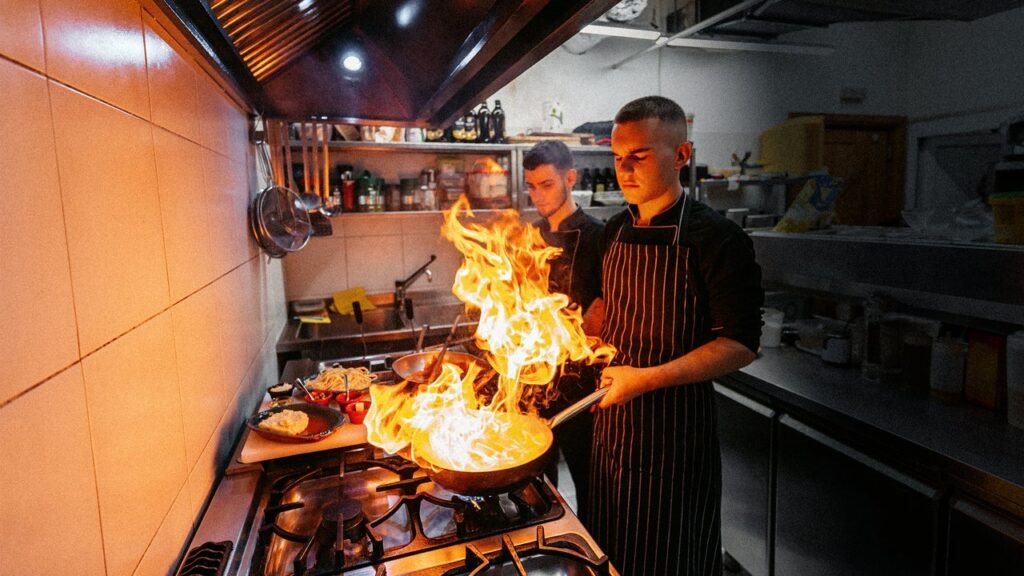
When you cook at home on a gas stove, you’re releasing hazardous pollutants into your air. So what does that mean for restaurant workers, who can spend hours in front of powerful commercial gas ranges?
Those workers are being exposed to harmful air pollution levels, as well as dangerously high temperatures, that exceed safety guidelines and regulations, a new study found.
However, the all-electric commercial kitchens the researchers studied were “strikingly cleaner and cooler,” says Drew Michanowicz, principal scientist at the nonprofit PSE Healthy Energy and one of the study authors.
The study, published this week in the journal Environmental Research Letters, is the first, the authors say, to look at air quality and heat levels in commercial kitchens, comparing ones with gas, propane, and all-electric appliances.
‘This is what workers are breathing in’
PSE Healthy Energy, a research nonprofit focused on understanding the impacts of our energy decisions, collaborated with Stanford Doerr School of Sustainability and New York University’s Grossman School of Medicine on the effort.
It also partnered with Christopher Galarza, a chef who advocates for electric kitchens, who helped them gain access to restaurant kitchens.
Researchers measured pollution levels and temperatures in 27 commercial kitchens across California, Pennsylvania, and New York.
That included different types of restaurants, from fine dining to pizzerias, as well as commercial kitchens inside senior living communities, universities, and elementary schools. Twenty-four of those kitchens had gas or propane appliances, while three were fully electric.
More than two-thirds of the gas kitchens saw temperatures above the Occupational Safety and Health Administration’s (OSHA) proposed high heat trigger of 90°F; and in four of those, temperatures exceeded 122°F.
When it comes to pollutant exposure, the Environmental Protection Agency’s outdoor standard for nitrogen dioxide is 100 parts per billion by volume. About 70% of the gas kitchens exceeded that threshold during cooking hours. One kitchen recorded a 15-minute average that was 10 times higher.
Researchers took pollution measurements inside the kitchens’ ventilation hoods, as well as directly outside of those hoods, to assess the ventilation systems. That 70% figure came from the measurements outside of the ventilation hood.
“This is what workers are breathing in,” Michanowicz says. Chefs also work directly above the cooking surfaces, he adds, before the air “has an opportunity to be evacuated out of the ventilation system.”
In a few of the gas kitchens, the researchers also recorded levels of carbon monoxide and benzene, a carcinogen, that exceed California’s 1-hour exposure guidelines.
Pilot light pollution
The pollutant concentrations tended to be highest right by the gas stoves, but researchers saw elevated levels even into dining areas.
Gas appliances aren’t only harmful when in use, either. About two-thirds of the kitchens showed higher pollution levels overnight than during the daytime. The researchers realized it was from the gas pilot lights that were still on, while the kitchen ventilation systems were off.
“It’s natural gas that is just being burned in millions of commercial kitchens overnight, serving no purpose,” Michanowicz says.
That’s an issue for energy efficiency, particularly when the cost of energy is so high. But it’s also an issue for cleaning crews or off-hour staff who may be exposed to that toxic air, as well as people who live around or above these kitchens in cities.
Some people have been hesitant to switch away from their gas appliances. Electric advocates have been touting the benefits of induction stoves, which don’t give off excess heat or pollutants. Chefs who have made the switch say induction cooktops also work better.
A worker health hazard
These findings highlight how pollution and also heat are becoming serious occupational hazards for those who work around gas appliances.
Nitrogen dioxide exposure can exacerbate or increase the risk of asthma, along with lung cancer, diabetes, pulmonary disease and other impacts. One researcher involved with a 2024 Harvard study had said that there was “no safe amount of exposure” when it comes to gas stove pollution.
Extreme heat also comes with health risks: exposure to high temperatures, especially over hours, can cause heat exhaustion or heat stroke, which then can cause organ damage and even death.
“At the heart of it, this is a worker exposure study,” Michanowicz says. “We really wanted to learn more about, what does a worker experience on a daily basis during a routine shift? Putting numbers to their lived experience [shows that] maybe this is a place where we need to be thinking more about worker protections.”
That none of the all-electric kitchens experienced high pollution or heat levels show, he adds, that there are interventions that can help.
“[All-electric kitchens] are just more comfortable to be in,” he says, “and the pollution levels are so much lower.”